
How to Use E22-900M30S: Examples, Pinouts, and Specs
 Design with E22-900M30S in Cirkit Designer
Introduction
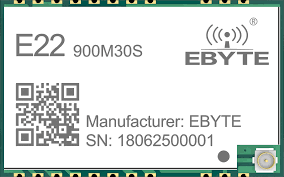
The E22-900M30S is a high-performance RF module manufactured by EBYTE. It is designed for wireless communication applications and operates in the 900 MHz frequency band. This module is ideal for low-power, long-range data transmission, making it a popular choice for IoT devices, remote sensor networks, and industrial automation systems.
Explore Projects Built with E22-900M30S
 Open Project in Cirkit Designer
 Open Project in Cirkit Designer
 Open Project in Cirkit Designer
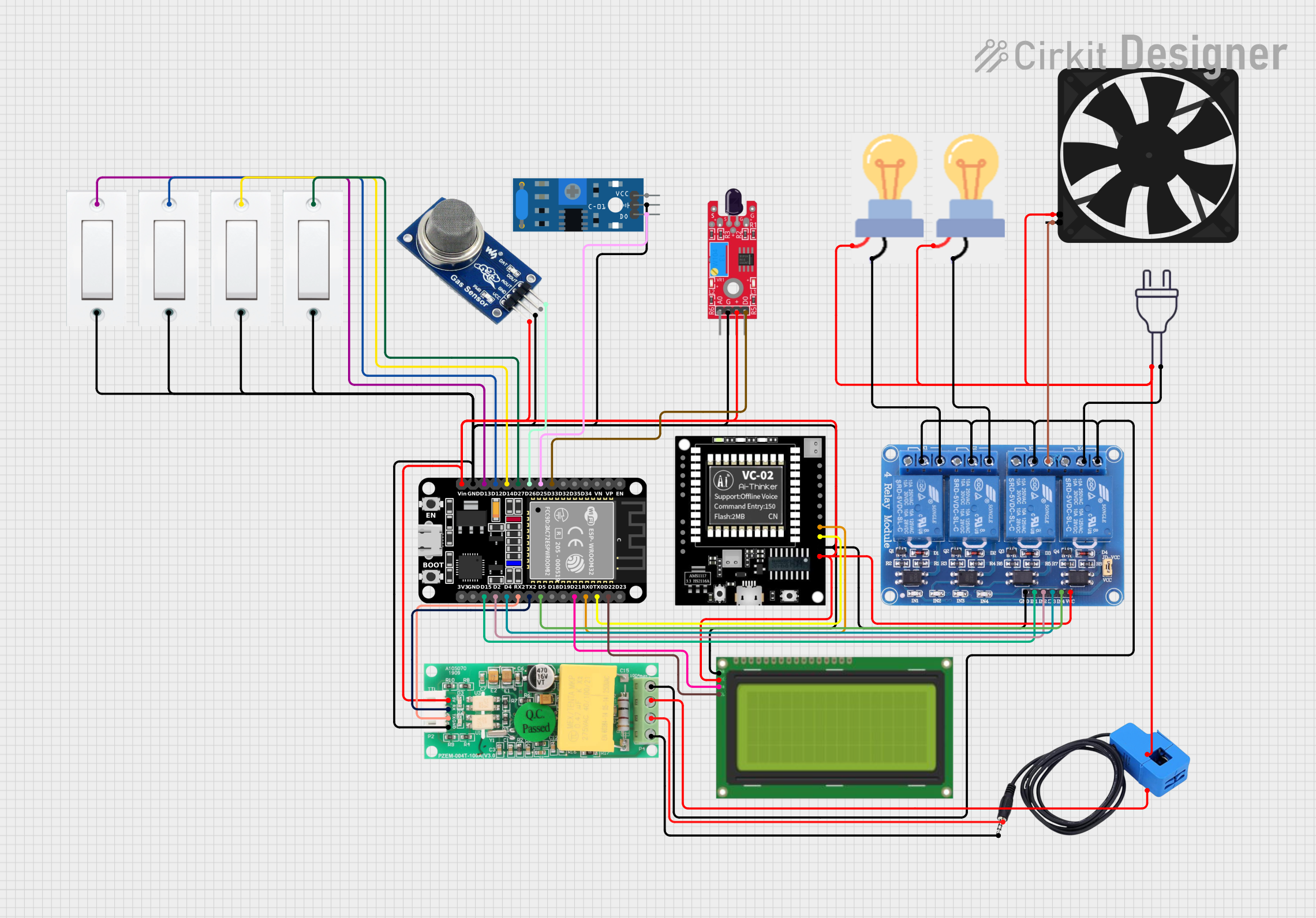 Open Project in Cirkit Designer
Explore Projects Built with E22-900M30S
Open Project in Cirkit DesignerOpen Project in Cirkit DesignerOpen Project in Cirkit DesignerOpen Project in Cirkit DesignerCommon Applications
- Internet of Things (IoT) devices
- Remote monitoring and control systems
- Wireless sensor networks
- Smart agriculture and environmental monitoring
- Industrial automation and telemetry
Technical Specifications
Key Technical Details
| Parameter | Value |
|---|---|
| Operating Frequency | 900 MHz |
| Modulation Type | LoRa (Long Range) |
| Transmission Power | Up to 30 dBm (1 Watt) |
| Communication Distance | Up to 10 km (line of sight) |
| Supply Voltage | 2.8V to 5.5V |
| Operating Current | 120 mA (transmit mode) |
| Sleep Current | < 5 µA |
| Data Rate | 0.3 kbps to 19.2 kbps |
| Operating Temperature | -40°C to +85°C |
| Dimensions | 24 mm x 43 mm x 3 mm |
Pin Configuration and Descriptions
The E22-900M30S module has 16 pins. Below is the pinout and description:
| Pin Number | Pin Name | Description |
|---|---|---|
| 1 | M0 | Mode selection pin 0 (used to configure operating modes) |
| 2 | M1 | Mode selection pin 1 (used to configure operating modes) |
| 3 | RXD | UART data input (connect to TXD of the microcontroller) |
| 4 | TXD | UART data output (connect to RXD of the microcontroller) |
| 5 | AUX | Auxiliary pin (indicates module status, e.g., busy or idle) |
| 6 | VCC | Power supply input (2.8V to 5.5V) |
| 7 | GND | Ground |
| 8 | SET | Configuration pin (used for parameter settings) |
| 9-16 | NC | Not connected (reserved for future use) |
Usage Instructions
How to Use the E22-900M30S in a Circuit
- Power Supply: Connect the VCC pin to a stable power source (2.8V to 5.5V) and the GND pin to ground.
- UART Communication: Connect the RXD and TXD pins to the corresponding TXD and RXD pins of your microcontroller.
- Mode Selection: Use the M0 and M1 pins to configure the module's operating mode:
- Mode 0 (Normal): M0 = 0, M1 = 0
- Mode 1 (Wake-up): M0 = 1, M1 = 0
- Mode 2 (Power-saving): M0 = 0, M1 = 1
- Mode 3 (Sleep): M0 = 1, M1 = 1
- AUX Pin: Monitor the AUX pin to check the module's status. For example, a high signal indicates the module is idle, while a low signal indicates it is busy.
- Configuration: Use the SET pin to configure parameters such as frequency, data rate, and transmission power. This can be done via AT commands or a dedicated configuration tool.
Example: Connecting to an Arduino UNO
Below is an example of how to connect the E22-900M30S to an Arduino UNO and send data.
Wiring Diagram
| E22-900M30S Pin | Arduino UNO Pin |
|---|---|
| VCC | 5V |
| GND | GND |
| RXD | D3 (via voltage divider if using 5V logic) |
| TXD | D2 |
| M0 | D4 |
| M1 | D5 |
| AUX | D6 |
Arduino Code Example
#include <SoftwareSerial.h>

// Define pins for SoftwareSerial
#define E22_TX 2  // Connect to TXD of E22-900M30S
#define E22_RX 3  // Connect to RXD of E22-900M30S
#define M0_PIN 4  // Connect to M0 of E22-900M30S
#define M1_PIN 5  // Connect to M1 of E22-900M30S
#define AUX_PIN 6 // Connect to AUX of E22-900M30S

SoftwareSerial E22Serial(E22_RX, E22_TX);

void setup() {
  // Initialize serial communication
  Serial.begin(9600);       // For debugging
  E22Serial.begin(9600);    // Communication with E22-900M30S

  // Configure mode pins
  pinMode(M0_PIN, OUTPUT);
  pinMode(M1_PIN, OUTPUT);
  pinMode(AUX_PIN, INPUT);

  // Set module to Normal mode (M0 = 0, M1 = 0)
  digitalWrite(M0_PIN, LOW);
  digitalWrite(M1_PIN, LOW);

  Serial.println("E22-900M30S Initialized");
}

void loop() {
  // Send data to the E22 module
  E22Serial.println("Hello, E22-900M30S!");

  // Wait for the module to process the data
  delay(1000);

  // Check for incoming data
  if (E22Serial.available()) {
    String receivedData = E22Serial.readString();
    Serial.print("Received: ");
    Serial.println(receivedData);
  }

  delay(2000); // Delay between transmissions
}
Important Considerations
- Voltage Levels: The E22-900M30S operates at 3.3V logic levels. If using a 5V microcontroller (e.g., Arduino UNO), use a voltage divider or level shifter for the RXD pin.
- Antenna: Ensure a proper 900 MHz antenna is connected to the module for optimal performance.
- Distance: The maximum communication range (10 km) is achievable only in line-of-sight conditions with minimal interference.
Troubleshooting and FAQs
Common Issues and Solutions
No Communication Between Devices
- Ensure the RXD and TXD pins are correctly connected.
- Verify that both modules are configured with the same frequency, data rate, and other parameters.
Short Communication Range
- Check the antenna connection and ensure it is suitable for the 900 MHz band.
- Avoid obstacles and interference sources between the transmitter and receiver.
Module Not Responding
- Verify the power supply voltage (2.8V to 5.5V).
- Check the AUX pin to ensure the module is not busy.
Data Corruption
- Ensure the baud rate of the microcontroller matches the module's UART baud rate.
- Use shielded cables to reduce electromagnetic interference.
FAQs
Q: Can I use the E22-900M30S with a 5V microcontroller?
A: Yes, but you must use a voltage divider or level shifter for the RXD pin to avoid damaging the module.
Q: How do I configure the module's parameters?
A: Parameters can be configured using AT commands via UART or a dedicated configuration tool provided by EBYTE.
Q: What is the maximum data rate of the module?
A: The maximum data rate is 19.2 kbps, which is suitable for low-power, long-range applications.