The 7408 IC is a fundamental digital component from Texas Instruments, consisting of four independent 2-input AND gates. Each gate performs the logical AND function, outputting a high level only when both its inputs are high. This IC is commonly used in digital circuits for logic operations and is a staple in both educational environments and industry applications.
Explore Projects Built with 7408
Use Cirkit Designer to design, explore, and prototype these projects online. Some projects support real-time simulation. Click "Open Project" to start designing instantly!
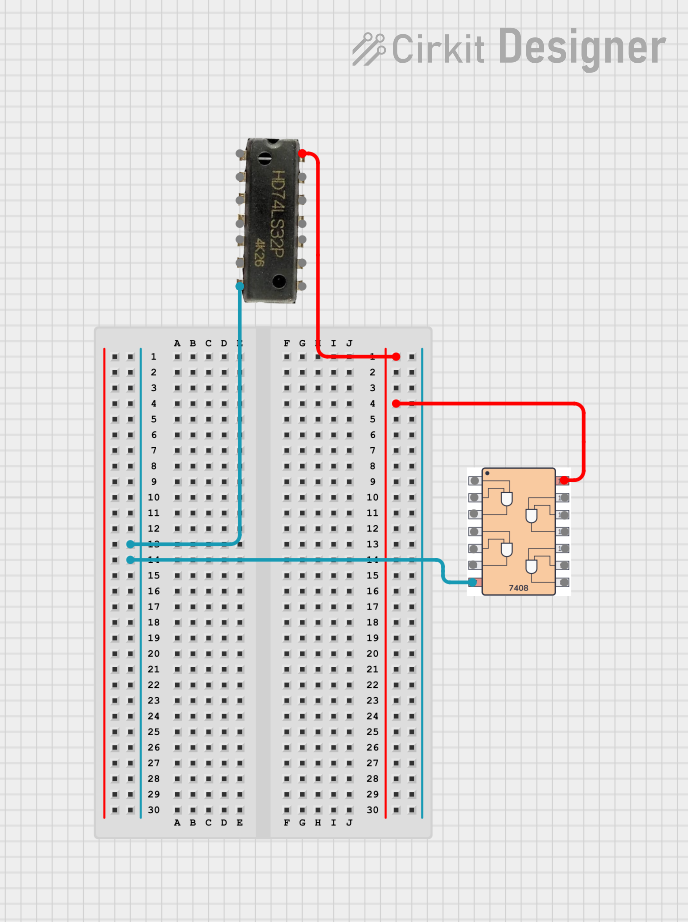
This circuit includes a 7408 AND gate IC and a 7432 OR gate IC, both powered by a common VCC and GND connection. The circuit is designed to perform basic logical operations, combining AND and OR gates for digital signal processing.
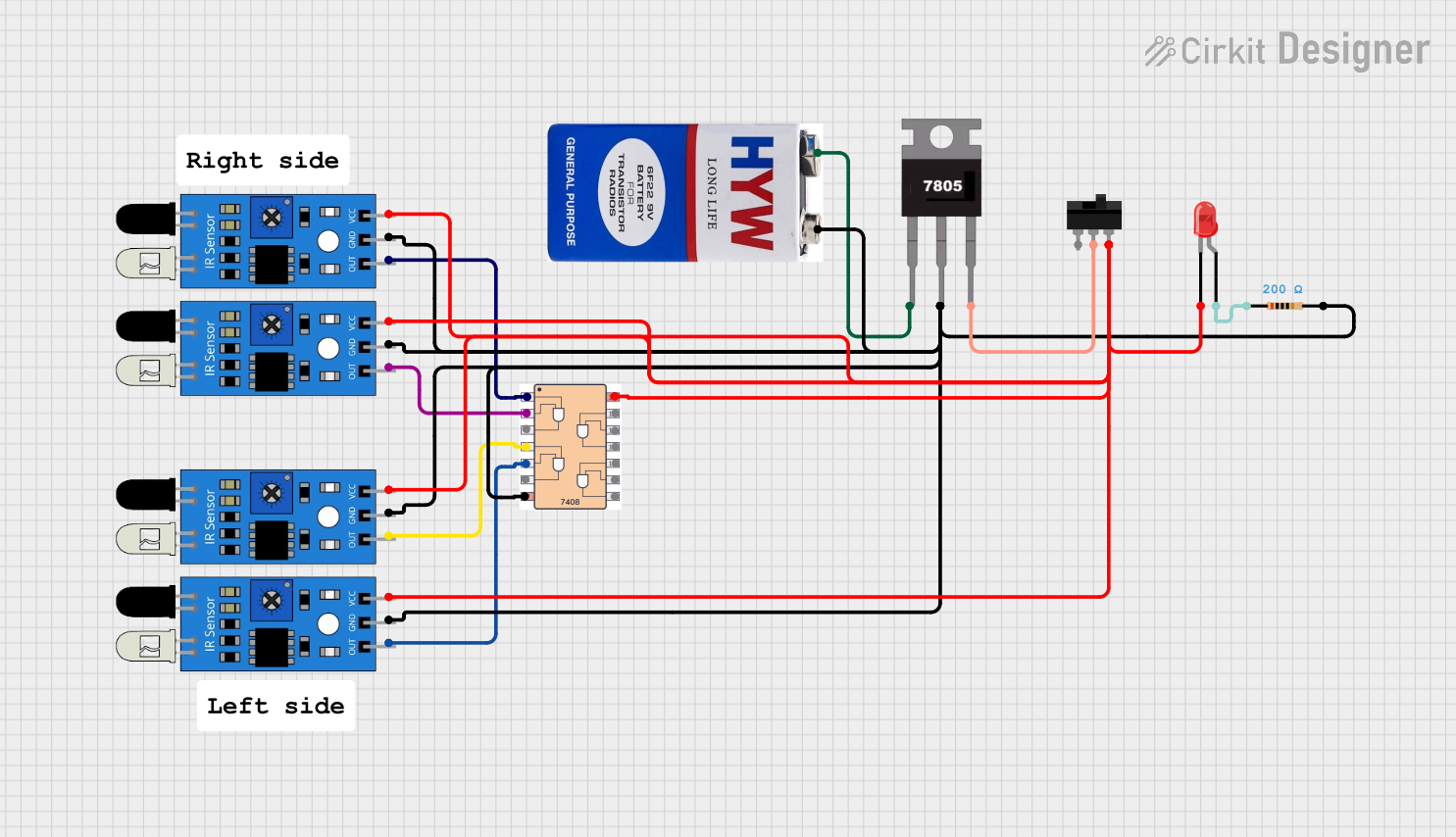
This circuit uses four IR sensors connected to a 7408 AND gate IC to detect the presence of objects. The output of the AND gate drives an LED indicator, with power regulated by a 7805 voltage regulator and controlled by a toggle switch.
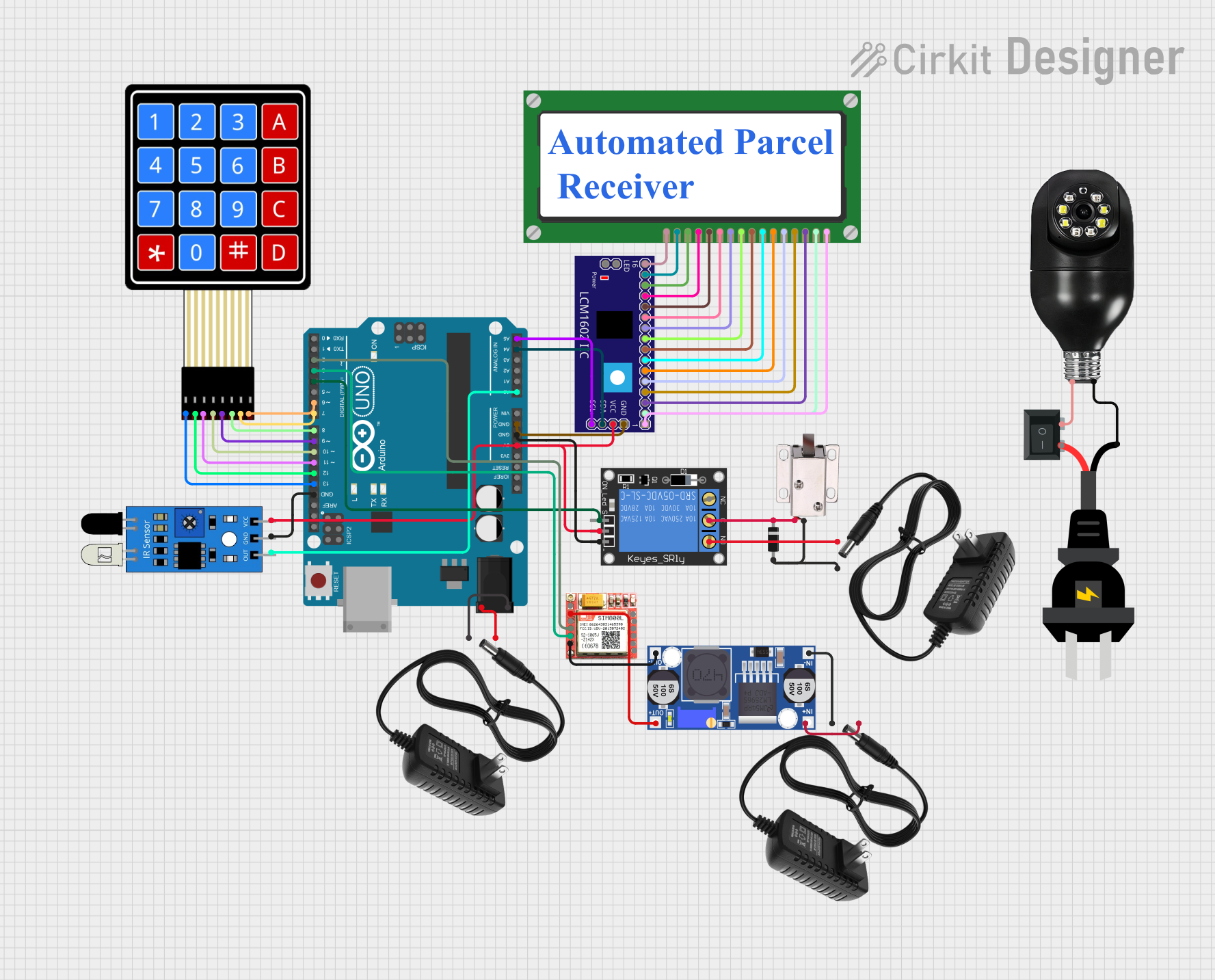
This is a security system featuring an Arduino UNO microcontroller that communicates via a SIM800L GSM module, detects motion with an IR sensor, and accepts user input through a 4x4 keypad. It controls a 12V solenoid lock via a relay and displays information on an LCD. The system includes a CCTV camera and uses buck converters for power regulation.
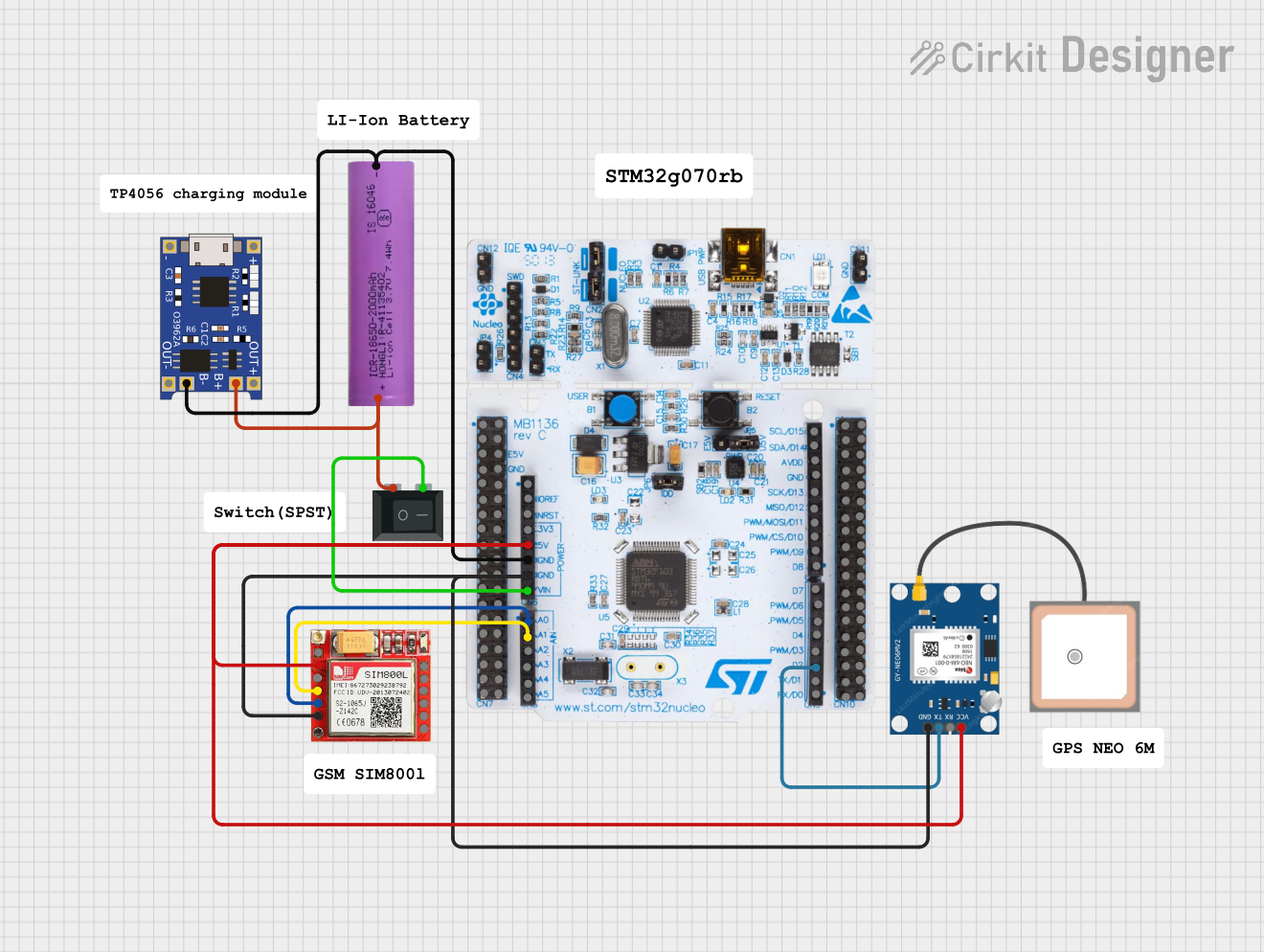
This circuit is an emergency alert system that uses a NUCLEO-F072RB microcontroller to send SMS alerts and make calls via a SIM800L GSM module, while obtaining location data from a GPS NEO 6M module. The system is powered by a Li-ion battery and includes a TP4056 module for battery charging and protection, with a rocker switch to control power to the microcontroller.
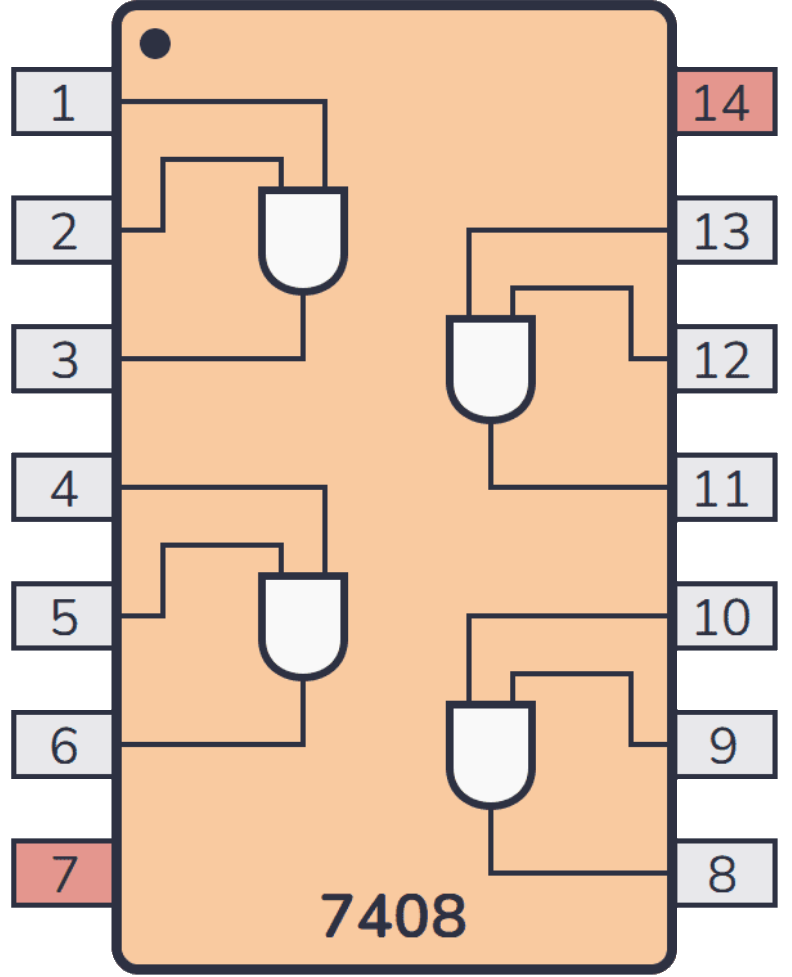
Power Supply Connection: Connect pin 14 (Vcc) to the positive supply voltage (5V) and pin 7 (GND) to the ground of the power supply.
Input Connection: Apply logic signals to the input pins (1A, 1B, 2A, 2B, 3A, 3B, 4A, 4B) as required for your logic circuit.
Output Connection: Connect the output pins (1Y, 2Y, 3Y, 4Y) to the next stage of your circuit or to an indicator like an LED with a current-limiting resistor.
Important Considerations and Best Practices
Ensure that the power supply voltage does not exceed the recommended operating voltage range to prevent damage to the IC.
Inputs should not be left floating; they should be connected to a high or low logic level to avoid unpredictable behavior.
Decoupling capacitors (typically 0.1 µF) should be placed close to the IC's power pins to filter out noise and provide a stable power supply.
Avoid exceeding the maximum current ratings for the outputs to prevent damage to the IC.
Example Circuit: Connecting 7408 to an Arduino UNO
// Define the input and output pins
const int inputPinA1 = 2; // Connect to 1A on the 7408
const int inputPinB1 = 3; // Connect to 1B on the 7408
const int outputPinY1 = 4; // Connect to 1Y on the 7408

void setup() {
  // Initialize the input and output pins
  pinMode(inputPinA1, OUTPUT);
  pinMode(inputPinB1, OUTPUT);
  pinMode(outputPinY1, INPUT);
}

void loop() {
  // Set both inputs to HIGH and check the output
  digitalWrite(inputPinA1, HIGH);
  digitalWrite(inputPinB1, HIGH);
  if (digitalRead(outputPinY1) == HIGH) {
    // The AND condition is true, perform actions here
  }

  // Add other logic combinations as needed
  // ...
}
Note: In this example, the Arduino UNO is used to simulate the inputs to the 7408. The output is read back into the Arduino for demonstration purposes. In a practical application, the output would be connected to the next stage of the digital circuit.
Troubleshooting and FAQs
Common Issues
Output not as expected: Verify that the inputs are at correct logic levels and that the power supply is stable and within the specified range.
IC getting hot: Check if the power supply voltage is too high or if there is a short circuit at the outputs.
Solutions and Tips
Double-check wiring, especially the power and ground connections.
Use a multimeter to measure the voltage levels at the inputs and outputs.
Ensure that the total output current does not exceed the maximum specified current rating.
FAQs
Q: Can the 7408 IC be used with a 3.3V logic level system?
A: The 7408 is designed for 5V systems. While it may work at 3.3V, it is not guaranteed, and the logic levels may not be compatible with other 3.3V components.
Q: What happens if I exceed the maximum output current?
A: Exceeding the maximum output current can damage the IC and affect its performance and reliability.
Q: Can I replace the 7408 with another AND gate IC?
A: Yes, you can replace it with another AND gate IC, but ensure that the replacement has compatible pin configurations and electrical characteristics.
This documentation provides a comprehensive guide to using the 7408 Quad 2-Input AND Gate IC. For further information, consult the manufacturer's datasheet and application notes.

 Open Project in Cirkit Designer