
How to Use LC1D12 Kontaktor: Examples, Pinouts, and Specs
 Design with LC1D12 Kontaktor in Cirkit Designer
Introduction
The LC1D12 is an electromechanical contactor manufactured by Schneider Electric. It is designed for switching electrical circuits and controlling high-power devices. This contactor is widely used in industrial applications due to its robust design and ability to handle significant electrical loads. The LC1D12 is particularly suitable for motor control, automation systems, and other high-power switching applications.
Explore Projects Built with LC1D12 Kontaktor
 Open Project in Cirkit Designer
 Open Project in Cirkit Designer
 Open Project in Cirkit Designer
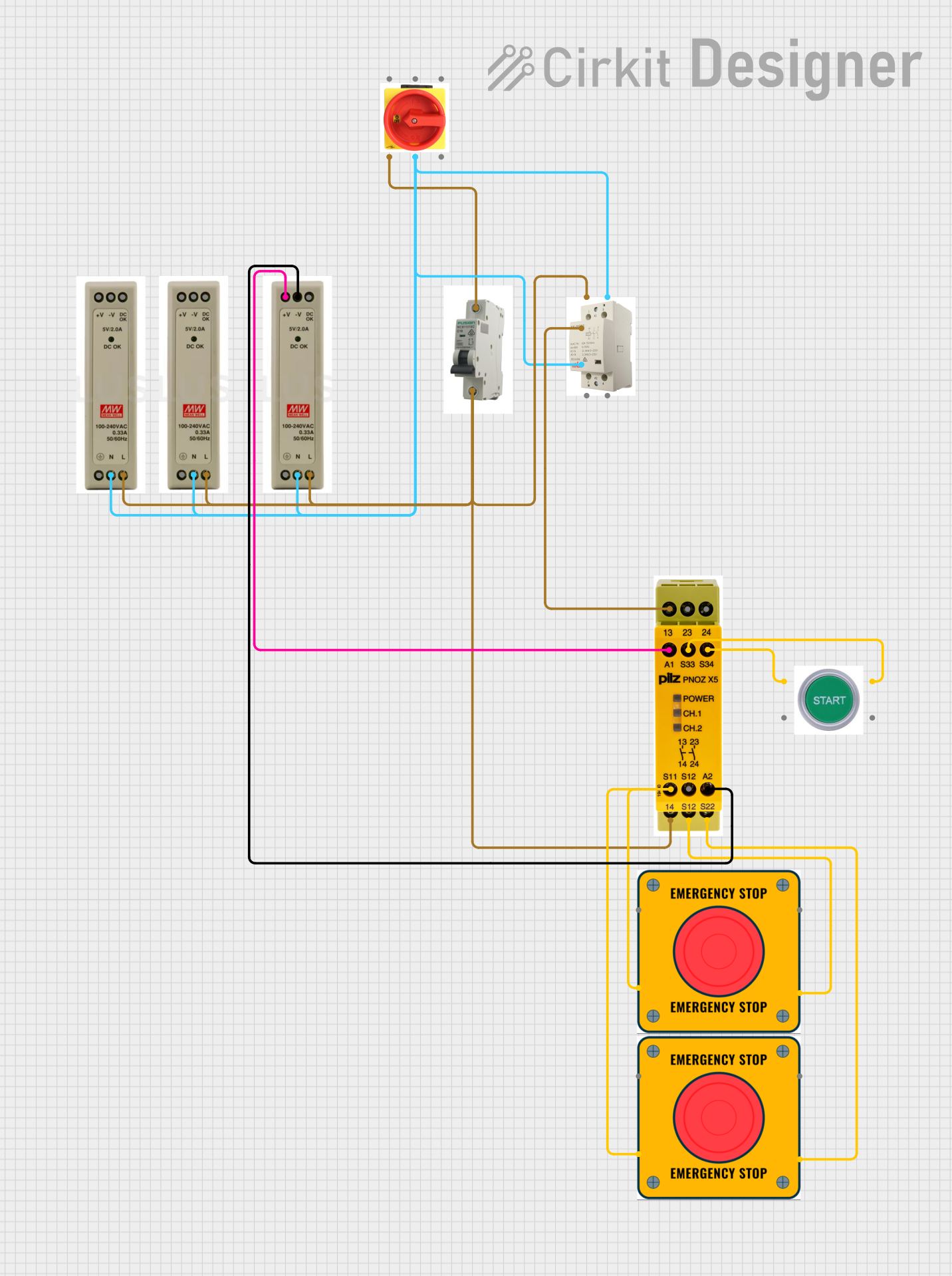 Open Project in Cirkit Designer
Explore Projects Built with LC1D12 Kontaktor
Open Project in Cirkit DesignerOpen Project in Cirkit DesignerOpen Project in Cirkit DesignerOpen Project in Cirkit DesignerCommon Applications
- Motor starters in industrial automation systems
- Switching and controlling resistive, inductive, or capacitive loads
- HVAC systems for controlling compressors and fans
- Lighting control in commercial and industrial environments
- Integration into programmable logic controllers (PLCs) for automated processes
Technical Specifications
Key Technical Details
| Parameter | Value |
|---|---|
| Manufacturer | Schneider Electric |
| Model | LC1D12 |
| Rated Operational Voltage | Up to 690V AC |
| Rated Current (AC-3) | 12A |
| Coil Voltage Options | 24V AC/DC, 48V AC/DC, 110V AC/DC, etc. |
| Number of Poles | 3 (Three-phase) |
| Auxiliary Contacts | 1 NO + 1 NC (expandable) |
| Mechanical Durability | 10 million operations |
| Electrical Durability | 1 million operations (AC-3) |
| Mounting Type | DIN rail or screw mounting |
| Operating Temperature Range | -5°C to +60°C |
| Standards Compliance | IEC 60947-4-1, UL, CSA |
Pin Configuration and Descriptions
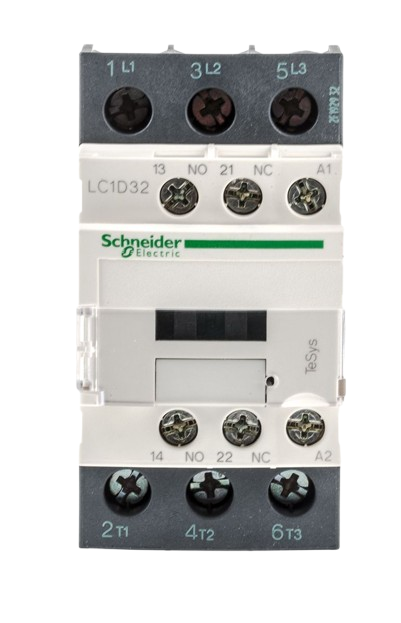
The LC1D12 contactor has two main sections: power terminals for the load and control terminals for the coil. Below is the pin configuration:
Power Terminals
| Terminal Label | Description |
|---|---|
| L1, L2, L3 | Input terminals for three-phase power supply |
| T1, T2, T3 | Output terminals to the load |
Control Terminals
| Terminal Label | Description |
|---|---|
| A1, A2 | Coil terminals for energizing the contactor |
| 13, 14 | Auxiliary contact (Normally Open - NO) |
| 21, 22 | Auxiliary contact (Normally Closed - NC) |
Usage Instructions
How to Use the LC1D12 in a Circuit
Power Connections:
- Connect the three-phase power supply to the input terminals L1, L2, L3.
- Connect the load (e.g., motor) to the output terminals T1, T2, T3.
Control Circuit:
- Connect the control voltage (as per the coil voltage rating) to terminals A1 and A2.
- Use a push-button or relay to control the coil circuit for switching the contactor.
Auxiliary Contacts:
- Use the auxiliary contacts (13-14 for NO, 21-22 for NC) for signaling or interlocking purposes in the control circuit.
Mounting:
- Mount the contactor on a DIN rail or secure it using screws, ensuring proper alignment and ventilation.
Important Considerations
- Coil Voltage: Ensure the control voltage matches the coil voltage rating of the contactor.
- Overload Protection: Use an appropriate overload relay in series with the contactor to protect the load.
- Wiring: Use wires with appropriate current ratings and ensure all connections are secure.
- Environment: Avoid exposure to excessive dust, moisture, or vibration to ensure reliable operation.
Example: Connecting the LC1D12 to an Arduino UNO
The LC1D12 can be controlled using an Arduino UNO by energizing its coil through a relay module. Below is an example code snippet:
// Example: Controlling LC1D12 Contactor with Arduino UNO
// This code energizes the contactor coil using a relay module connected to pin 7.

const int relayPin = 7; // Pin connected to the relay module

void setup() {
  pinMode(relayPin, OUTPUT); // Set relay pin as output
  digitalWrite(relayPin, LOW); // Ensure relay is off initially
}

void loop() {
  digitalWrite(relayPin, HIGH); // Turn on relay (energize contactor coil)
  delay(5000); // Keep contactor ON for 5 seconds
  digitalWrite(relayPin, LOW); // Turn off relay (de-energize contactor coil)
  delay(5000); // Wait for 5 seconds before repeating
}
Note: Use a relay module to interface the Arduino with the LC1D12 coil, as the Arduino cannot directly supply the required current for the contactor coil.
Troubleshooting and FAQs
Common Issues and Solutions
Contactor Does Not Energize:
- Cause: Incorrect coil voltage or loose connections.
- Solution: Verify the control voltage matches the coil rating and check all connections.
Excessive Heating:
- Cause: Overloaded contactor or poor ventilation.
- Solution: Ensure the load current does not exceed the rated current (12A for AC-3). Improve ventilation around the contactor.
Chattering Noise:
- Cause: Insufficient control voltage or unstable power supply.
- Solution: Check the control voltage and ensure it is stable and within the specified range.
Auxiliary Contacts Not Working:
- Cause: Miswiring or damaged contacts.
- Solution: Verify the wiring of auxiliary contacts and replace them if damaged.
FAQs
Q: Can the LC1D12 be used for single-phase loads?
A: Yes, connect the single-phase load across one pair of input and output terminals (e.g., L1-T1).Q: How do I expand the auxiliary contacts?
A: Use an auxiliary contact block compatible with the LC1D12 to add more NO/NC contacts.Q: What is the difference between AC-3 and AC-1 ratings?
A: AC-3 is for motor loads (inductive), while AC-1 is for resistive loads. The LC1D12 is rated for 12A under AC-3 conditions.Q: Can I use the LC1D12 outdoors?
A: The LC1D12 is not designed for outdoor use unless housed in a weatherproof enclosure.
By following this documentation, users can effectively integrate the LC1D12 contactor into their electrical systems for reliable and efficient operation.