
How to Use SIMHOLDER2: Examples, Pinouts, and Specs
 Design with SIMHOLDER2 in Cirkit Designer
Introduction
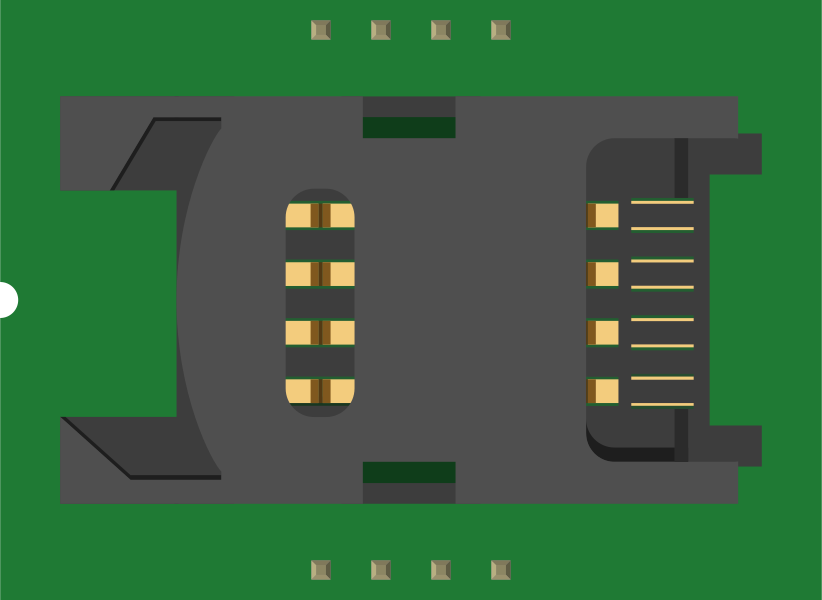
The SIMHOLDER2 is a SIM card holder designed to securely house a SIM card within electronic devices. It ensures proper connectivity between the SIM card and the device's circuitry while providing physical protection to the card. This component is commonly used in GSM modules, IoT devices, mobile phones, and other communication systems that require SIM card integration.
Explore Projects Built with SIMHOLDER2
 Open Project in Cirkit Designer
 Open Project in Cirkit Designer
 Open Project in Cirkit Designer
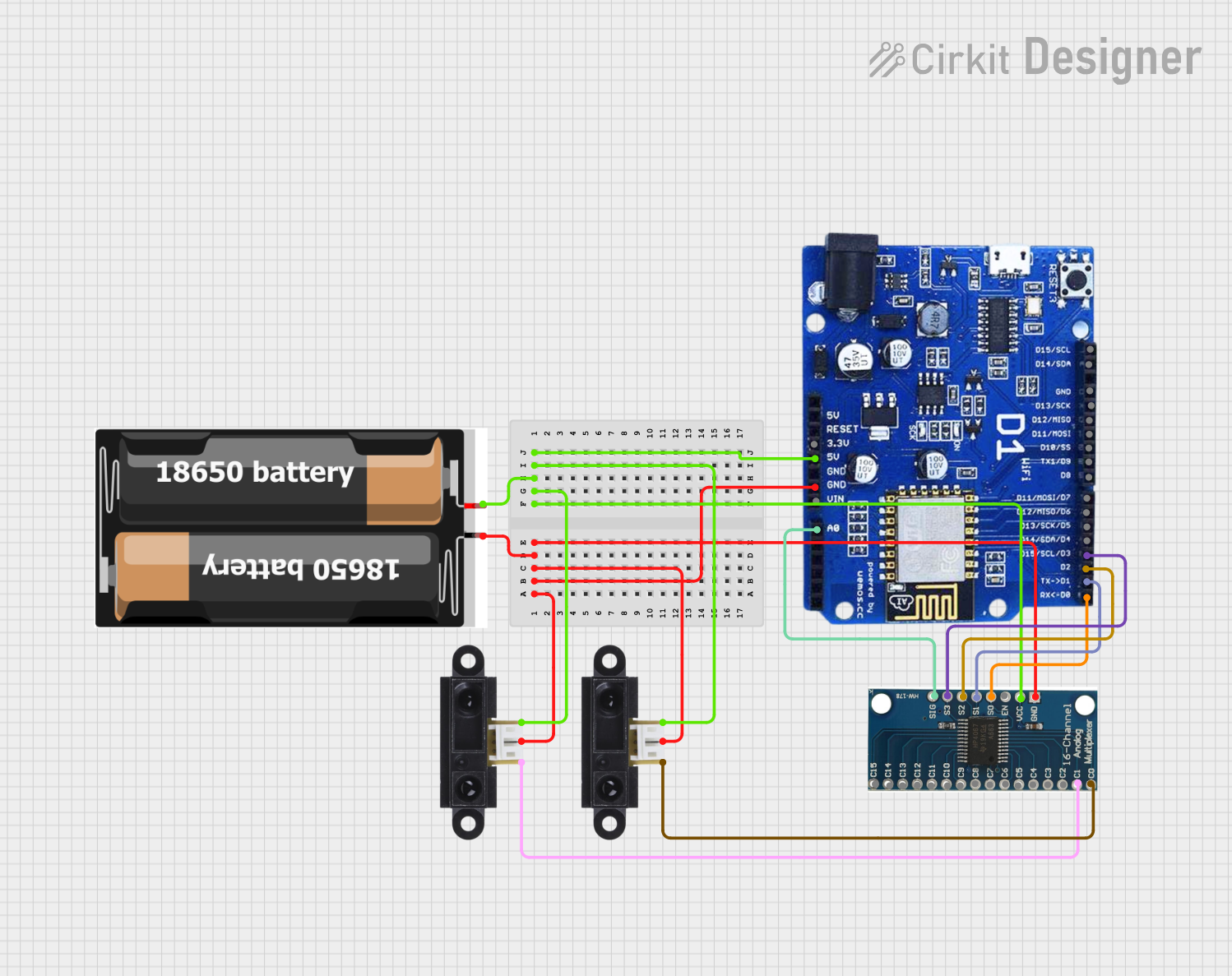 Open Project in Cirkit Designer
Explore Projects Built with SIMHOLDER2
Open Project in Cirkit DesignerOpen Project in Cirkit DesignerOpen Project in Cirkit DesignerOpen Project in Cirkit DesignerCommon Applications and Use Cases
- GSM-based communication modules
- IoT devices with cellular connectivity
- Mobile phones and tablets
- GPS trackers
- Embedded systems requiring SIM card functionality
Technical Specifications
The SIMHOLDER2 is a compact and durable component designed for easy integration into electronic circuits. Below are its key technical details:
Key Specifications
| Parameter | Value |
|---|---|
| SIM Card Compatibility | Standard SIM, Micro SIM |
| Operating Voltage | 0V to 5V |
| Contact Resistance | ≤ 100 mΩ |
| Insulation Resistance | ≥ 1000 MΩ |
| Operating Temperature | -25°C to +85°C |
| Durability | ≥ 5000 insertion/removal cycles |
| Mounting Type | Surface Mount (SMD) or Through-Hole |
Pin Configuration and Descriptions
The SIMHOLDER2 typically has six contact pins that interface with the SIM card. The pin configuration is as follows:
| Pin Number | Pin Name | Description |
|---|---|---|
| 1 | VCC | Power supply for the SIM card (1.8V or 3.3V) |
| 2 | RST | Reset signal for the SIM card |
| 3 | CLK | Clock signal for SIM card communication |
| 4 | GND | Ground connection |
| 5 | VPP | Programming voltage (optional, rarely used) |
| 6 | I/O | Data input/output for communication |
Usage Instructions
To use the SIMHOLDER2 in a circuit, follow these steps:
Mounting the SIMHOLDER2:
- For SMD versions, solder the holder onto the PCB using standard reflow soldering techniques.
- For through-hole versions, insert the pins into the PCB and solder them manually.
Connecting to a GSM Module:
- Connect the pins of the SIMHOLDER2 to the corresponding pins on the GSM module:
- VCC to the module's SIM power pin.
- GND to the module's ground.
- I/O, CLK, and RST to the respective communication pins on the module.
- Ensure proper alignment of the SIM card within the holder to avoid connectivity issues.
- Connect the pins of the SIMHOLDER2 to the corresponding pins on the GSM module:
Important Considerations:
- Verify the operating voltage of the SIM card (1.8V or 3.3V) and ensure compatibility with the GSM module.
- Avoid excessive force when inserting or removing the SIM card to maintain the holder's durability.
- Use ESD protection measures to prevent damage to the SIM card and holder.
Example: Connecting to an Arduino UNO with a GSM Module: Below is an example code snippet for using the SIMHOLDER2 with an Arduino UNO and a GSM module:
#include <SoftwareSerial.h> // Define RX and TX pins for GSM module communication SoftwareSerial gsmSerial(7, 8); // RX = pin 7, TX = pin 8 void setup() { Serial.begin(9600); // Initialize serial communication with PC gsmSerial.begin(9600); // Initialize GSM module communication Serial.println("Initializing GSM module..."); delay(1000); // Send AT command to check GSM module connectivity gsmSerial.println("AT"); delay(1000); // Read and display response from GSM module while (gsmSerial.available()) { Serial.write(gsmSerial.read()); } } void loop() { // Continuously check for incoming data from GSM module if (gsmSerial.available()) { Serial.write(gsmSerial.read()); } // Send data to GSM module from Serial Monitor if (Serial.available()) { gsmSerial.write(Serial.read()); } }Note: Ensure the GSM module is properly connected to the Arduino UNO, and the SIM card is securely placed in the SIMHOLDER2.
Troubleshooting and FAQs
Common Issues
SIM Card Not Detected:
- Cause: Improper alignment of the SIM card in the holder.
- Solution: Reinsert the SIM card, ensuring it is properly seated and aligned with the contacts.
Intermittent Connectivity:
- Cause: Loose solder joints or poor contact between the SIM card and holder.
- Solution: Inspect and re-solder the connections if necessary. Clean the SIM card contacts.
No Response from GSM Module:
- Cause: Incorrect wiring between the SIMHOLDER2 and GSM module.
- Solution: Double-check the pin connections and ensure proper voltage levels.
Physical Damage to the Holder:
- Cause: Excessive force during SIM card insertion/removal.
- Solution: Replace the SIMHOLDER2 and handle the SIM card with care.
FAQs
Q1: Can the SIMHOLDER2 support Nano SIM cards?
A1: No, the SIMHOLDER2 is designed for Standard and Micro SIM cards. Use an adapter for Nano SIM cards if necessary.
Q2: Is the VPP pin mandatory for operation?
A2: No, the VPP pin is optional and is rarely used in modern applications.
Q3: How do I protect the SIM card from ESD damage?
A3: Use ESD protection diodes and ensure proper grounding in your circuit design.
Q4: Can I use the SIMHOLDER2 in outdoor devices?
A4: Yes, but ensure the device is enclosed in a weatherproof casing to protect the SIM card and holder from environmental factors.
By following this documentation, you can effectively integrate the SIMHOLDER2 into your electronic projects and ensure reliable SIM card connectivity.