
How to Use RXB12 RF Receiver: Examples, Pinouts, and Specs
 Design with RXB12 RF Receiver in Cirkit Designer
Introduction
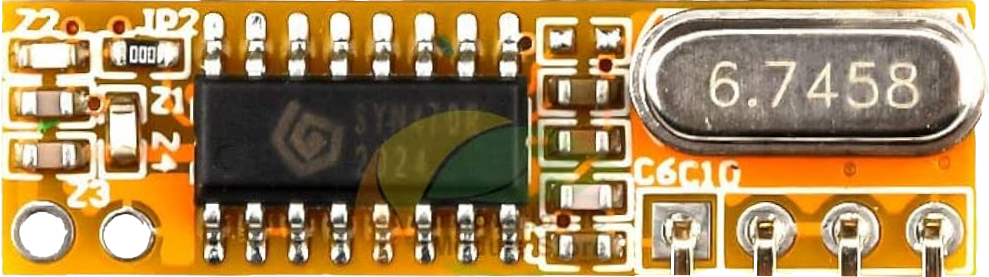
The RXB12 is a compact RF receiver module designed for receiving radio frequency signals in the 433 MHz band. It is widely used in remote control systems, wireless data transmission, and other communication applications. With its high sensitivity and low power consumption, the RXB12 is particularly suitable for battery-operated devices and systems requiring reliable wireless communication.
Explore Projects Built with RXB12 RF Receiver
 Open Project in Cirkit Designer
 Open Project in Cirkit Designer
 Open Project in Cirkit Designer
 Open Project in Cirkit Designer
Explore Projects Built with RXB12 RF Receiver
Open Project in Cirkit DesignerOpen Project in Cirkit DesignerOpen Project in Cirkit DesignerOpen Project in Cirkit DesignerCommon Applications
- Remote control systems (e.g., garage doors, home automation)
- Wireless data transmission
- Internet of Things (IoT) devices
- Alarm and security systems
- Wireless sensor networks
Technical Specifications
Key Technical Details
| Parameter | Value |
|---|---|
| Operating Frequency | 433 MHz |
| Operating Voltage | 3.3V to 5.5V |
| Current Consumption | ≤ 5.5 mA |
| Sensitivity | -110 dBm |
| Modulation Type | ASK/OOK |
| Data Rate | 2.4 kbps (max) |
| Operating Temperature | -20°C to +70°C |
| Dimensions | 30 mm x 14 mm x 7 mm |
Pin Configuration and Descriptions
| Pin Number | Pin Name | Description |
|---|---|---|
| 1 | VCC | Power supply input (3.3V to 5.5V) |
| 2 | DATA | Data output pin for received RF signals |
| 3 | GND | Ground connection |
| 4 | ANT | Antenna connection for receiving RF signals |
Usage Instructions
How to Use the RXB12 in a Circuit
- Power Supply: Connect the
VCCpin to a 3.3V or 5V power source and theGNDpin to the ground of your circuit. - Data Output: Connect the
DATApin to the input of a microcontroller or other processing unit to read the received RF signals. - Antenna: Attach an appropriate 433 MHz antenna to the
ANTpin to ensure optimal signal reception. - Decoding Signals: Use a microcontroller or decoder IC to process the data received on the
DATApin.
Important Considerations
- Antenna Design: Use a properly tuned 433 MHz antenna for maximum range and signal quality.
- Power Supply: Ensure a stable power supply to avoid noise and interference in the received signal.
- Interference: Minimize interference by keeping the module away from high-frequency noise sources.
- Data Decoding: The RXB12 outputs raw data, so you may need to implement a decoding algorithm or use a compatible encoder/decoder pair.
Example: Connecting RXB12 to Arduino UNO
Below is an example of how to connect the RXB12 to an Arduino UNO and read data from the module.
Circuit Connections
| RXB12 Pin | Arduino UNO Pin |
|---|---|
| VCC | 5V |
| DATA | Digital Pin 2 |
| GND | GND |
| ANT | 433 MHz Antenna |
Arduino Code
// RXB12 RF Receiver Example with Arduino UNO
// This code reads data from the RXB12 module and prints it to the Serial Monitor.

#define RXB12_PIN 2  // Define the pin connected to the DATA pin of RXB12

void setup() {
  pinMode(RXB12_PIN, INPUT);  // Set the RXB12 pin as input
  Serial.begin(9600);         // Initialize serial communication at 9600 baud
}

void loop() {
  int receivedData = digitalRead(RXB12_PIN);  // Read the data from RXB12
  Serial.println(receivedData);               // Print the received data to Serial Monitor
  delay(100);                                 // Add a small delay for stability
}
Notes
- The above code reads raw digital signals from the RXB12. For meaningful data, you may need to implement a decoding algorithm based on the transmitter's encoding scheme.
- Ensure the transmitter and receiver are operating on the same frequency (433 MHz).
Troubleshooting and FAQs
Common Issues and Solutions
No Signal Received
- Solution: Check the antenna connection and ensure it is tuned for 433 MHz.
- Solution: Verify that the transmitter is operating on the same frequency as the RXB12.
Intermittent Signal Loss
- Solution: Ensure a stable power supply to the RXB12 module.
- Solution: Reduce interference by keeping the module away from high-frequency noise sources.
Data Output is Unreadable
- Solution: Confirm that the transmitter and receiver use the same modulation type (ASK/OOK).
- Solution: Use a compatible decoder or implement a decoding algorithm in your microcontroller.
Short Range
- Solution: Use a properly tuned antenna for 433 MHz.
- Solution: Avoid obstructions and interference in the signal path.
FAQs
Q: Can the RXB12 operate at frequencies other than 433 MHz?
A: No, the RXB12 is specifically designed to operate at 433 MHz.
Q: What type of antenna should I use with the RXB12?
A: A 433 MHz whip antenna or a custom-designed PCB antenna tuned for 433 MHz is recommended.
Q: Can I use the RXB12 with a 3.3V microcontroller?
A: Yes, the RXB12 operates within a voltage range of 3.3V to 5.5V, making it compatible with 3.3V systems.
Q: Does the RXB12 support bidirectional communication?
A: No, the RXB12 is a receiver module and only supports one-way communication. For bidirectional communication, you will need a separate transmitter module.