
How to Use Fingerprint: Examples, Pinouts, and Specs
 Design with Fingerprint in Cirkit Designer
Introduction
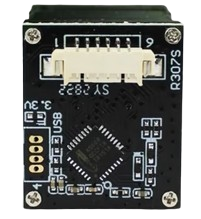
The R307S Fingerprint Sensor, manufactured by Shreyansh, is a biometric sensor designed to capture and verify fingerprints for authentication and security purposes. This compact and reliable module is widely used in access control systems, time attendance devices, and other applications requiring secure identification. The R307S combines a fingerprint scanner with an onboard processor to handle image processing, feature extraction, and fingerprint matching.
Explore Projects Built with Fingerprint
 Open Project in Cirkit Designer
 Open Project in Cirkit Designer
 Open Project in Cirkit Designer
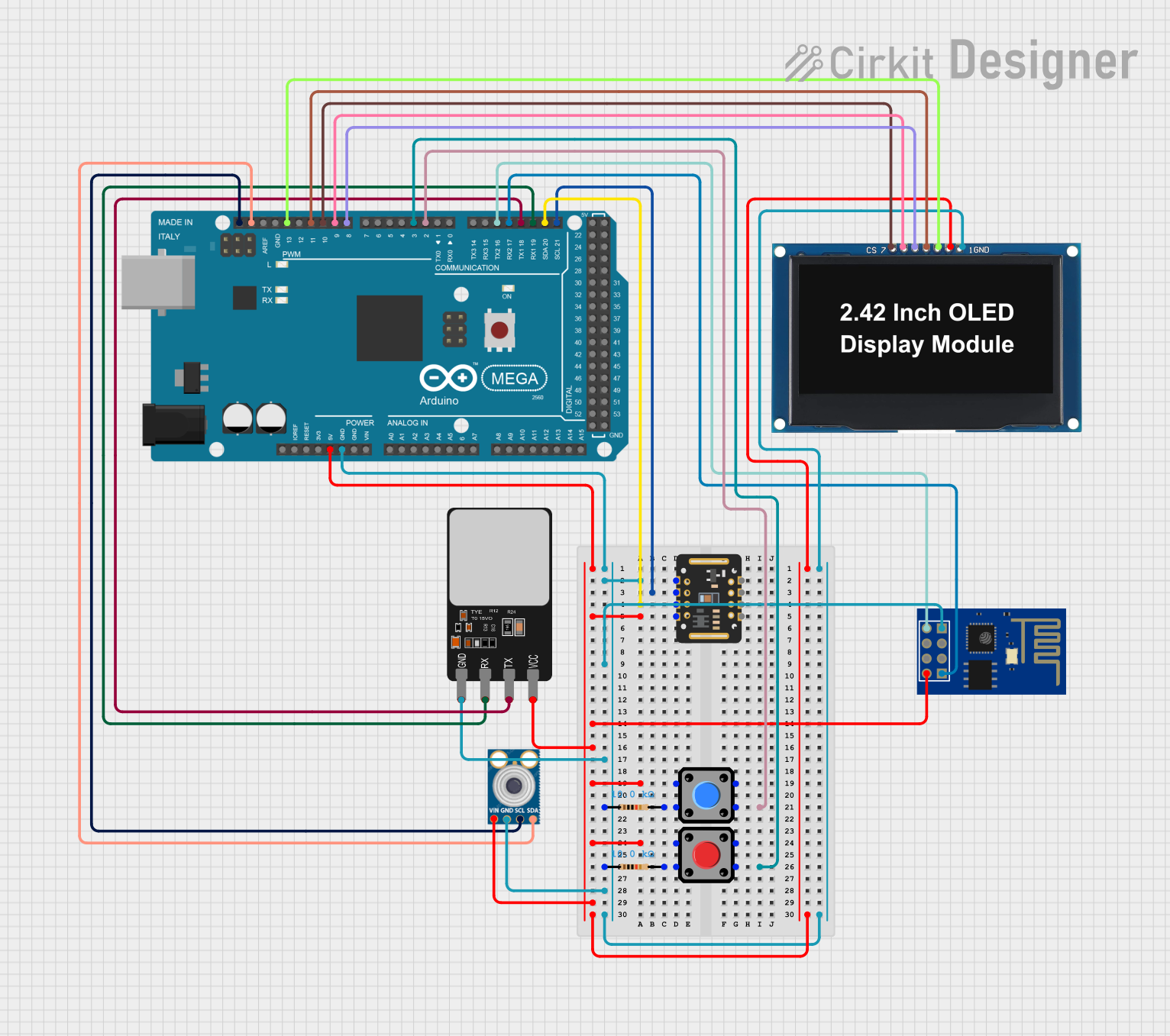 Open Project in Cirkit Designer
Explore Projects Built with Fingerprint
Open Project in Cirkit DesignerOpen Project in Cirkit DesignerOpen Project in Cirkit DesignerOpen Project in Cirkit DesignerCommon Applications
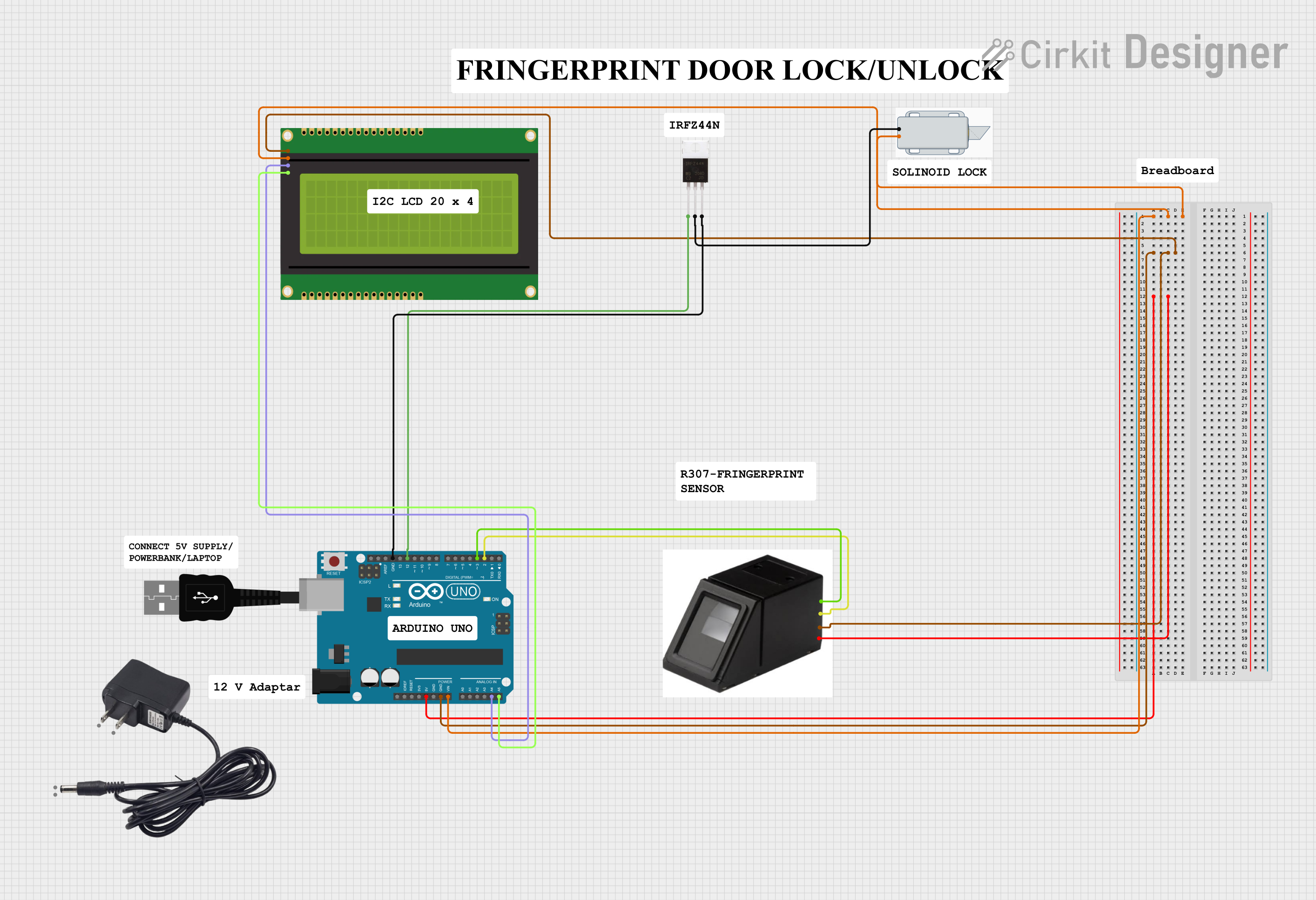
- Access control systems (e.g., door locks, safes)
- Time and attendance tracking systems
- Biometric authentication for embedded systems
- Secure login for devices and systems
- IoT-based security solutions
Technical Specifications
Below are the key technical details of the R307S Fingerprint Sensor:
| Parameter | Specification |
|---|---|
| Manufacturer | Shreyansh |
| Part ID | R307S |
| Operating Voltage | 3.6V - 6.0V DC |
| Operating Current | 50mA (typical), 80mA (maximum) |
| Interface | UART (TTL) |
| Baud Rate | Configurable (default: 57600 bps) |
| Fingerprint Capacity | 1000 templates |
| Image Resolution | 500 DPI |
| Scanning Area | 14mm x 18mm |
| Matching Speed | < 1 second |
| False Acceptance Rate | < 0.001% |
| False Rejection Rate | < 1.0% |
| Operating Temperature | -20°C to +50°C |
| Dimensions | 55mm x 21mm x 21.5mm |
Pin Configuration
The R307S module has a 6-pin interface for communication and power. The pinout is as follows:
| Pin | Name | Description |
|---|---|---|
| 1 | VCC | Power supply (3.6V - 6.0V DC) |
| 2 | GND | Ground |
| 3 | TX | UART Transmit (data output) |
| 4 | RX | UART Receive (data input) |
| 5 | TOUCH | Touch signal (active high) |
| 6 | NC | Not connected |
Usage Instructions
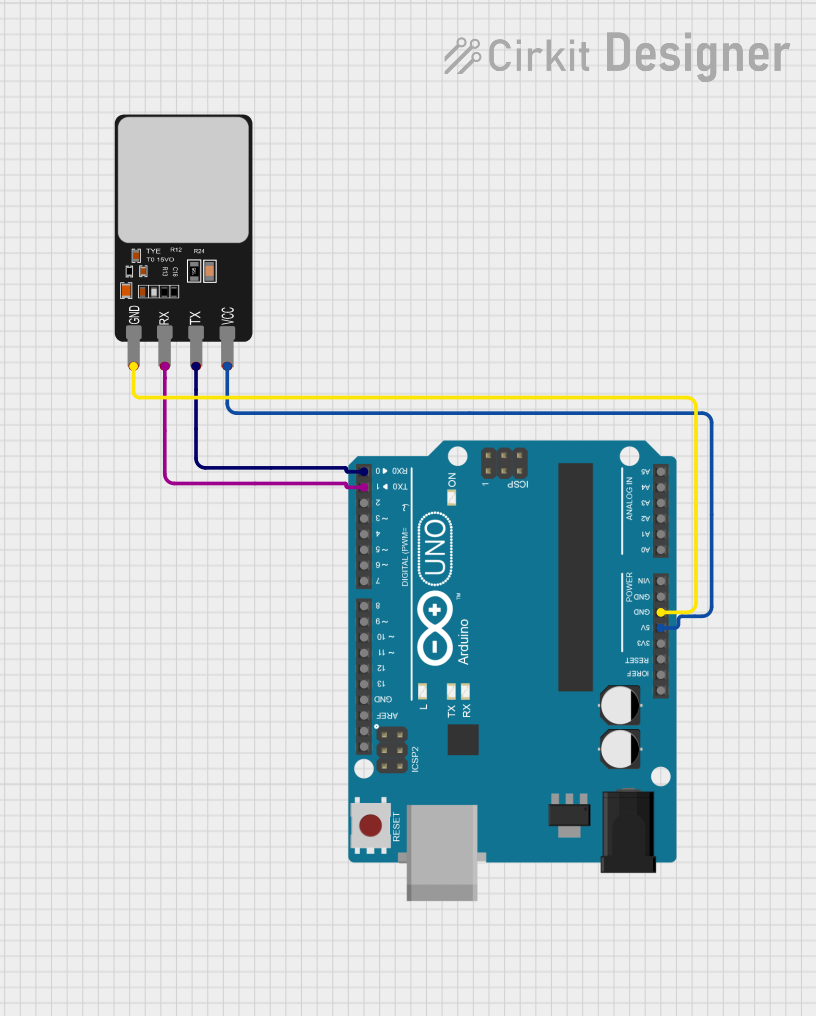
Connecting the R307S to an Arduino UNO
To use the R307S with an Arduino UNO, follow these steps:
- Connect the VCC pin of the R307S to the 5V pin on the Arduino.
- Connect the GND pin of the R307S to the GND pin on the Arduino.
- Connect the TX pin of the R307S to the Arduino's digital pin 2 (via a voltage divider if needed).
- Connect the RX pin of the R307S to the Arduino's digital pin 3.
Sample Arduino Code
Below is an example of how to interface the R307S with an Arduino UNO using the Adafruit Fingerprint Sensor Library:
#include <Adafruit_Fingerprint.h>
#include <SoftwareSerial.h>

// Define the RX and TX pins for the fingerprint sensor
SoftwareSerial mySerial(2, 3); // RX, TX

Adafruit_Fingerprint finger(&mySerial);

void setup() {
  Serial.begin(9600); // Initialize serial communication with the PC
  while (!Serial);    // Wait for the serial monitor to open
  Serial.println("Initializing fingerprint sensor...");

  // Initialize the fingerprint sensor
  finger.begin(57600);
  if (finger.verifyPassword()) {
    Serial.println("Fingerprint sensor detected!");
  } else {
    Serial.println("Fingerprint sensor not detected. Check connections.");
    while (1); // Halt the program if the sensor is not found
  }
}

void loop() {
  Serial.println("Place your finger on the sensor...");
  int result = finger.getImage(); // Capture the fingerprint image

  if (result == FINGERPRINT_OK) {
    Serial.println("Fingerprint image captured successfully.");
    result = finger.image2Tz(); // Convert the image to a template
    if (result == FINGERPRINT_OK) {
      Serial.println("Fingerprint template created.");
      result = finger.fingerFastSearch(); // Search for a match
      if (result == FINGERPRINT_OK) {
        Serial.print("Fingerprint matched! ID: ");
        Serial.println(finger.fingerID);
      } else {
        Serial.println("No match found.");
      }
    } else {
      Serial.println("Failed to create fingerprint template.");
    }
  } else {
    Serial.println("Failed to capture fingerprint image.");
  }

  delay(2000); // Wait before the next scan
}
Important Considerations
- Ensure the VCC voltage matches the sensor's operating range (3.6V - 6.0V).
- Use a level shifter or voltage divider if connecting the sensor to a 3.3V logic device.
- Avoid exposing the sensor to direct sunlight or dusty environments, as this may affect performance.
- Clean the sensor surface regularly to maintain accuracy.
Troubleshooting and FAQs
Common Issues
Fingerprint sensor not detected by the Arduino.
- Solution: Check the wiring connections, especially the TX and RX pins. Ensure the baud rate in the code matches the sensor's default baud rate (57600 bps).
Fingerprint image capture fails.
- Solution: Ensure the finger is placed properly on the sensor. Clean the sensor surface if it is dirty or smudged.
No match found for a registered fingerprint.
- Solution: Verify that the fingerprint was successfully enrolled in the sensor's memory. Re-enroll the fingerprint if necessary.
Sensor does not power on.
- Solution: Check the power supply voltage and ensure it is within the specified range (3.6V - 6.0V). Verify the GND connection.
FAQs
Q: How many fingerprints can the R307S store?
A: The R307S can store up to 1000 fingerprint templates.Q: Can the R307S be used with a Raspberry Pi?
A: Yes, the R307S can be interfaced with a Raspberry Pi using its UART interface.Q: What is the default baud rate of the R307S?
A: The default baud rate is 57600 bps, but it can be configured as needed.Q: How do I clean the sensor surface?
A: Use a soft, lint-free cloth slightly dampened with isopropyl alcohol to clean the sensor.
By following this documentation, you can effectively integrate the R307S Fingerprint Sensor into your projects for secure and reliable biometric authentication.