
How to Use LC76G Multi-GNSS Module, Supports GPS, BDS, GLONASS, Galileo, QZSS: Examples, Pinouts, and Specs
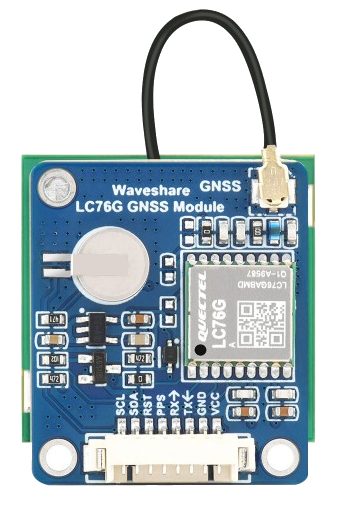
 Design with LC76G Multi-GNSS Module, Supports GPS, BDS, GLONASS, Galileo, QZSS in Cirkit Designer
Introduction
The LC76G Multi-GNSS Module by Waveshare is a compact and high-performance navigation module designed to support multiple global navigation satellite systems, including GPS, BDS, GLONASS, Galileo, and QZSS. This module provides accurate positioning and timing information, making it ideal for applications requiring precise location tracking and navigation.
Explore Projects Built with LC76G Multi-GNSS Module, Supports GPS, BDS, GLONASS, Galileo, QZSS
 Open Project in Cirkit Designer
 Open Project in Cirkit Designer
 Open Project in Cirkit Designer
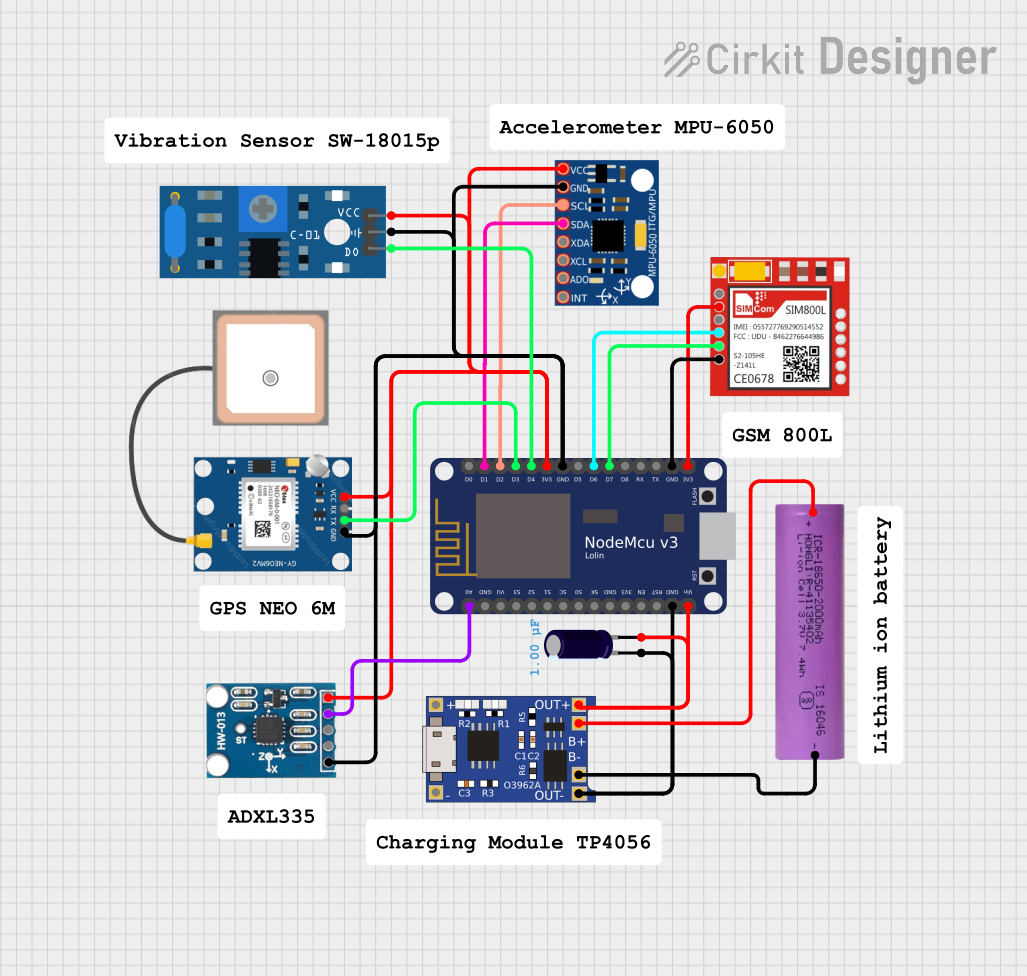 Open Project in Cirkit Designer
Explore Projects Built with LC76G Multi-GNSS Module, Supports GPS, BDS, GLONASS, Galileo, QZSS
Open Project in Cirkit DesignerOpen Project in Cirkit DesignerOpen Project in Cirkit DesignerOpen Project in Cirkit DesignerCommon Applications and Use Cases
- Vehicle navigation systems: For real-time tracking and route optimization.
- Drones and UAVs: To enable precise positioning and autonomous flight.
- IoT devices: For location-based services and geofencing.
- Surveying and mapping: For high-accuracy geospatial data collection.
- Timing synchronization: In telecommunications and industrial systems.
Technical Specifications
The LC76G module is designed to deliver reliable performance in a compact form factor. Below are its key technical details:
Key Technical Details
| Parameter | Specification |
|---|---|
| Manufacturer | Waveshare |
| Part Number | LC76G |
| GNSS Systems Supported | GPS, BDS, GLONASS, Galileo, QZSS |
| Positioning Accuracy | 1.5 meters (CEP50) |
| Cold Start Time | < 30 seconds |
| Hot Start Time | < 1 second |
| Update Rate | 1 Hz (default), configurable up to 10 Hz |
| Operating Voltage | 3.0V to 4.3V |
| Operating Current | ~30 mA (typical) |
| Communication Interface | UART (default baud rate: 9600 bps) |
| Operating Temperature | -40°C to +85°C |
| Dimensions | 10.1 mm × 9.7 mm × 2.2 mm |
Pin Configuration and Descriptions
The LC76G module has a simple pinout for easy integration into your designs. Below is the pin configuration:
| Pin Number | Pin Name | Description |
|---|---|---|
| 1 | VCC | Power supply input (3.0V to 4.3V) |
| 2 | GND | Ground connection |
| 3 | TXD | UART transmit pin (data output) |
| 4 | RXD | UART receive pin (data input) |
| 5 | PPS | Pulse-per-second output for timing synchronization |
| 6 | NC | Not connected (leave unconnected) |
Usage Instructions
The LC76G module is straightforward to use in a variety of applications. Below are the steps and best practices for integrating it into your circuit.
How to Use the LC76G in a Circuit
- Power Supply: Connect the VCC pin to a regulated 3.3V power source and the GND pin to ground.
- UART Communication:
- Connect the TXD pin to the RX pin of your microcontroller (e.g., Arduino UNO).
- Connect the RXD pin to the TX pin of your microcontroller.
- Antenna Connection: Attach an active GNSS antenna to the module for optimal signal reception.
- PPS Signal: Use the PPS pin if precise timing synchronization is required in your application.
- Software Configuration: Use a serial terminal or microcontroller code to communicate with the module via UART.
Important Considerations and Best Practices
- Antenna Placement: Ensure the GNSS antenna has a clear view of the sky for optimal satellite reception.
- Power Supply: Use a stable and noise-free power source to avoid interference with GNSS signals.
- UART Settings: The default UART baud rate is 9600 bps. Ensure your microcontroller matches this setting.
- Environmental Factors: Avoid using the module in areas with heavy signal obstruction, such as indoors or near tall buildings.
Example: Connecting LC76G to Arduino UNO
Below is an example of how to connect and use the LC76G module with an Arduino UNO:
Circuit Connections
| LC76G Pin | Arduino UNO Pin |
|---|---|
| VCC | 3.3V |
| GND | GND |
| TXD | D2 (SoftwareSerial RX) |
| RXD | D3 (SoftwareSerial TX) |
Arduino Code Example
#include <SoftwareSerial.h>

// Define SoftwareSerial pins for LC76G communication
SoftwareSerial GNSS(2, 3); // RX = D2, TX = D3

void setup() {
  Serial.begin(9600); // Initialize Serial Monitor
  GNSS.begin(9600);   // Initialize LC76G communication

  Serial.println("LC76G Multi-GNSS Module Test");
}

void loop() {
  // Check if data is available from the LC76G module
  if (GNSS.available()) {
    // Read and forward data to the Serial Monitor
    while (GNSS.available()) {
      char c = GNSS.read();
      Serial.print(c);
    }
  }
}
Notes on the Code
- The code uses the
SoftwareSeriallibrary to communicate with the LC76G module. - Ensure the Arduino UNO is connected to your computer via USB to view GNSS data in the Serial Monitor.
Troubleshooting and FAQs
Common Issues and Solutions
No Data Output from the Module
- Cause: Incorrect UART connections or mismatched baud rate.
- Solution: Verify the TXD and RXD connections and ensure the baud rate is set to 9600 bps.
Poor Satellite Reception
- Cause: Obstructed antenna placement or interference.
- Solution: Place the antenna in an open area with a clear view of the sky.
Module Not Powering On
- Cause: Insufficient or unstable power supply.
- Solution: Ensure the power supply provides 3.3V to 4.3V and is free of noise.
PPS Signal Not Working
- Cause: Incorrect configuration or usage.
- Solution: Verify the PPS pin connection and ensure your application supports timing synchronization.
FAQs
Q: Can the LC76G module operate indoors?
- A: While it can operate indoors, satellite reception may be poor. Use an external antenna for better results.
Q: How do I increase the update rate?
- A: The update rate can be configured via UART commands. Refer to the module's datasheet for details.
Q: Is the module compatible with 5V logic?
- A: No, the LC76G operates at 3.3V logic levels. Use a level shifter if interfacing with 5V systems.
By following this documentation, you can effectively integrate the LC76G Multi-GNSS Module into your projects for reliable and accurate navigation solutions.