
How to Use esp32: Examples, Pinouts, and Specs
 Design with esp32 in Cirkit Designer
Introduction
The ESP32, manufactured by ESP, is a low-cost, low-power system on a chip (SoC) with integrated Wi-Fi and Bluetooth capabilities. It is widely used in Internet of Things (IoT) applications, embedded systems, and smart devices. The ESP32 is highly versatile, offering dual-core processing, a rich set of peripherals, and support for various communication protocols, making it a popular choice for developers and hobbyists alike.
Explore Projects Built with esp32
 Open Project in Cirkit Designer
 Open Project in Cirkit Designer
 Open Project in Cirkit Designer
 Open Project in Cirkit Designer
Explore Projects Built with esp32
Open Project in Cirkit DesignerOpen Project in Cirkit DesignerOpen Project in Cirkit DesignerOpen Project in Cirkit DesignerCommon Applications and Use Cases
- IoT devices (e.g., smart home systems, environmental monitoring)
- Wireless communication (Wi-Fi and Bluetooth)
- Wearable devices
- Robotics and automation
- Data logging and remote sensing
- Prototyping and educational projects
Technical Specifications
The ESP32 is a feature-rich SoC with the following key specifications:
| Parameter | Value |
|---|---|
| Manufacturer | ESP |
| Part ID | 32 |
| Processor | Dual-core Xtensa® 32-bit LX6 microprocessor |
| Clock Speed | Up to 240 MHz |
| Flash Memory | 4 MB (varies by module) |
| SRAM | 520 KB |
| Wireless Connectivity | Wi-Fi 802.11 b/g/n, Bluetooth v4.2 + BLE |
| Operating Voltage | 3.0V to 3.6V |
| GPIO Pins | 34 (multiplexed with other functions) |
| ADC Channels | 18 (12-bit resolution) |
| DAC Channels | 2 |
| Communication Interfaces | UART, SPI, I2C, I2S, CAN, PWM |
| Power Consumption | Ultra-low power (supports deep sleep mode with <10 µA current draw) |
| Operating Temperature | -40°C to +125°C |
Pin Configuration and Descriptions
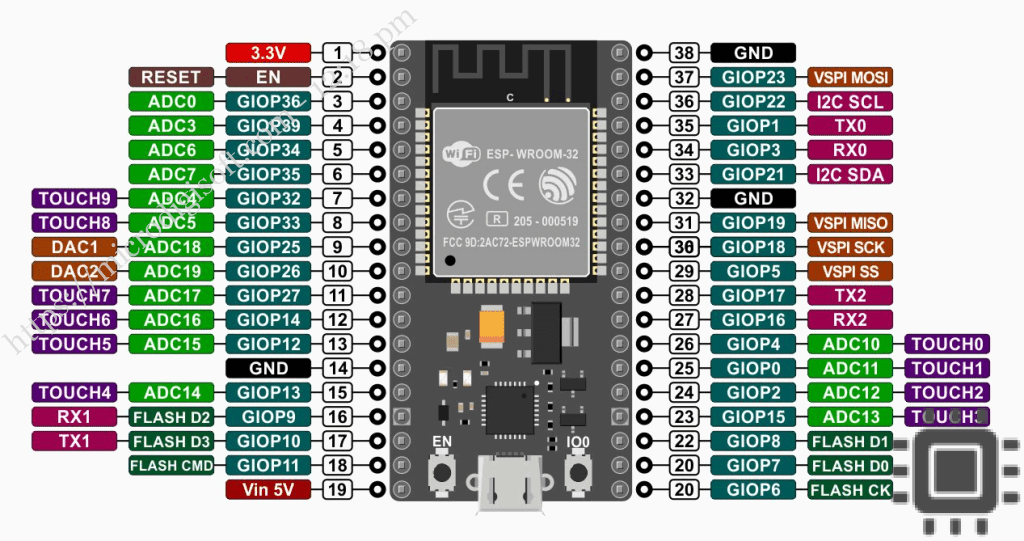
The ESP32 has a variety of pins, each with specific functions. Below is a table summarizing the key pin configurations:
| Pin Name | Function | Description |
|---|---|---|
| GPIO0 | Input/Output, Boot Mode Select | Used for boot mode selection during startup. |
| GPIO2 | Input/Output, ADC, PWM | General-purpose I/O, supports ADC and PWM. |
| GPIO12 | Input/Output, ADC, Touch Sensor | General-purpose I/O, supports ADC and capacitive touch sensing. |
| GPIO13 | Input/Output, ADC, Touch Sensor | General-purpose I/O, supports ADC and capacitive touch sensing. |
| GPIO15 | Input/Output, ADC, PWM | General-purpose I/O, supports ADC and PWM. |
| EN | Enable | Active-high pin to enable or reset the chip. |
| 3V3 | Power Supply | Provides 3.3V power to the ESP32. |
| GND | Ground | Ground connection. |
For a complete pinout, refer to the ESP32 datasheet provided by the manufacturer.
Usage Instructions
How to Use the ESP32 in a Circuit
- Power Supply: Connect the 3V3 pin to a 3.3V power source and GND to ground. Ensure the power supply can provide sufficient current (at least 500 mA).
- Programming: Use a USB-to-serial adapter or a development board (e.g., ESP32 DevKit) to program the ESP32. The chip supports programming via the Arduino IDE, PlatformIO, or ESP-IDF.
- Boot Mode: To enter bootloader mode for programming, connect GPIO0 to GND and reset the chip.
- Peripherals: Connect sensors, actuators, or other peripherals to the GPIO pins. Use appropriate pull-up or pull-down resistors as needed.
Important Considerations and Best Practices
- Voltage Levels: The ESP32 operates at 3.3V logic levels. Avoid connecting 5V signals directly to its GPIO pins.
- Power Consumption: Use deep sleep mode to minimize power consumption in battery-powered applications.
- Antenna Placement: Ensure the onboard antenna has sufficient clearance from metal objects to avoid signal interference.
- Heat Management: The ESP32 can get warm during operation. Ensure proper ventilation if used in enclosed spaces.
Example Code for Arduino UNO Integration
Below is an example of how to use the ESP32 with the Arduino IDE to connect to a Wi-Fi network:
#include <WiFi.h> // Include the Wi-Fi library for ESP32

// Replace with your network credentials
const char* ssid = "Your_SSID";       // Your Wi-Fi network name
const char* password = "Your_PASSWORD"; // Your Wi-Fi network password

void setup() {
  Serial.begin(115200); // Initialize serial communication at 115200 baud
  delay(1000);          // Wait for a second to stabilize the serial monitor

  Serial.println("Connecting to Wi-Fi...");
  WiFi.begin(ssid, password); // Start connecting to the Wi-Fi network

  while (WiFi.status() != WL_CONNECTED) {
    delay(500); // Wait for 500ms before checking the connection status again
    Serial.print(".");
  }

  Serial.println("\nWi-Fi connected!");
  Serial.print("IP Address: ");
  Serial.println(WiFi.localIP()); // Print the assigned IP address
}

void loop() {
  // Add your main code here
}
Troubleshooting and FAQs
Common Issues and Solutions
ESP32 Not Connecting to Wi-Fi
- Solution: Double-check the SSID and password. Ensure the Wi-Fi network is operational and within range.
- Tip: Use
WiFi.status()to debug connection issues.
GPIO Pins Not Responding
- Solution: Verify the pin configuration in your code. Ensure no conflicting peripherals are using the same pins.
- Tip: Use a multimeter to check for proper voltage levels on the pins.
ESP32 Not Entering Bootloader Mode
- Solution: Ensure GPIO0 is connected to GND during reset. Check the USB-to-serial adapter connection.
- Tip: Use a development board with an onboard USB interface for easier programming.
Overheating
- Solution: Reduce the clock speed or optimize the code to minimize processing load.
- Tip: Ensure proper ventilation and avoid placing the ESP32 in enclosed spaces.
FAQs
Q: Can the ESP32 operate on 5V?
- A: No, the ESP32 operates at 3.3V. Use a voltage regulator or level shifter for 5V systems.
Q: How do I update the ESP32 firmware?
- A: Use the ESP-IDF or Arduino IDE to upload new firmware via the USB interface.
Q: Can the ESP32 handle multiple tasks simultaneously?
- A: Yes, the ESP32 supports FreeRTOS, allowing multitasking with multiple threads.
This documentation provides a comprehensive guide to using the ESP32. For further details, refer to the official ESP32 datasheet and programming guides.