
How to Use Voltage Regulator LM317: Examples, Pinouts, and Specs
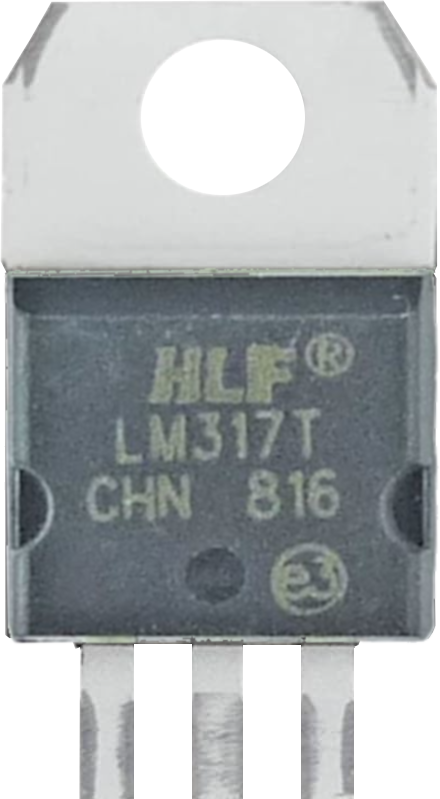
 Design with Voltage Regulator LM317 in Cirkit Designer
Introduction
The LM317 is an adjustable three-terminal voltage regulator capable of providing a stable output voltage ranging from 1.25V to 37V. It is designed to deliver a maximum output current of 1.5A, making it a versatile component for various power regulation applications. The LM317 is widely used in power supply circuits to maintain a constant output voltage, even in the presence of fluctuations in input voltage or load conditions. Its ease of use and reliability make it a popular choice for hobbyists and professionals alike.
Explore Projects Built with Voltage Regulator LM317
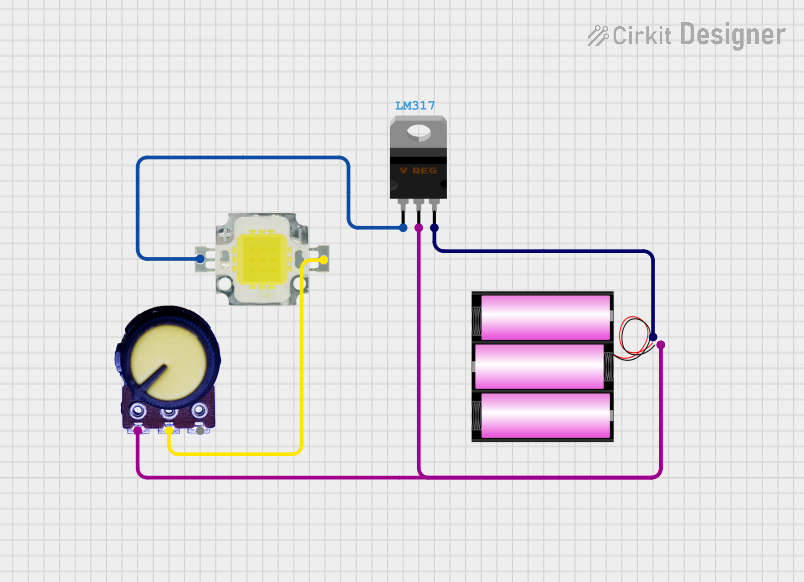 Open Project in Cirkit Designer
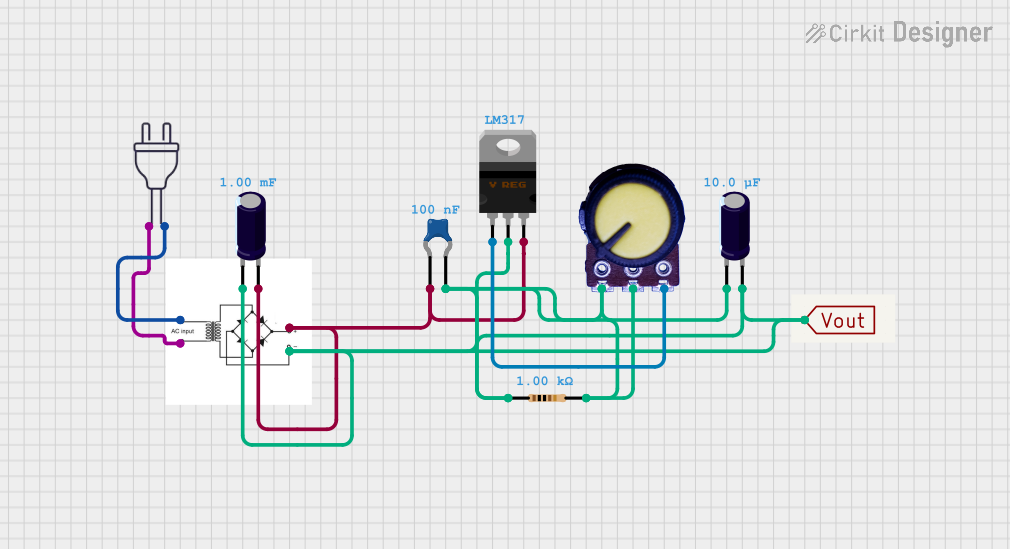 Open Project in Cirkit Designer
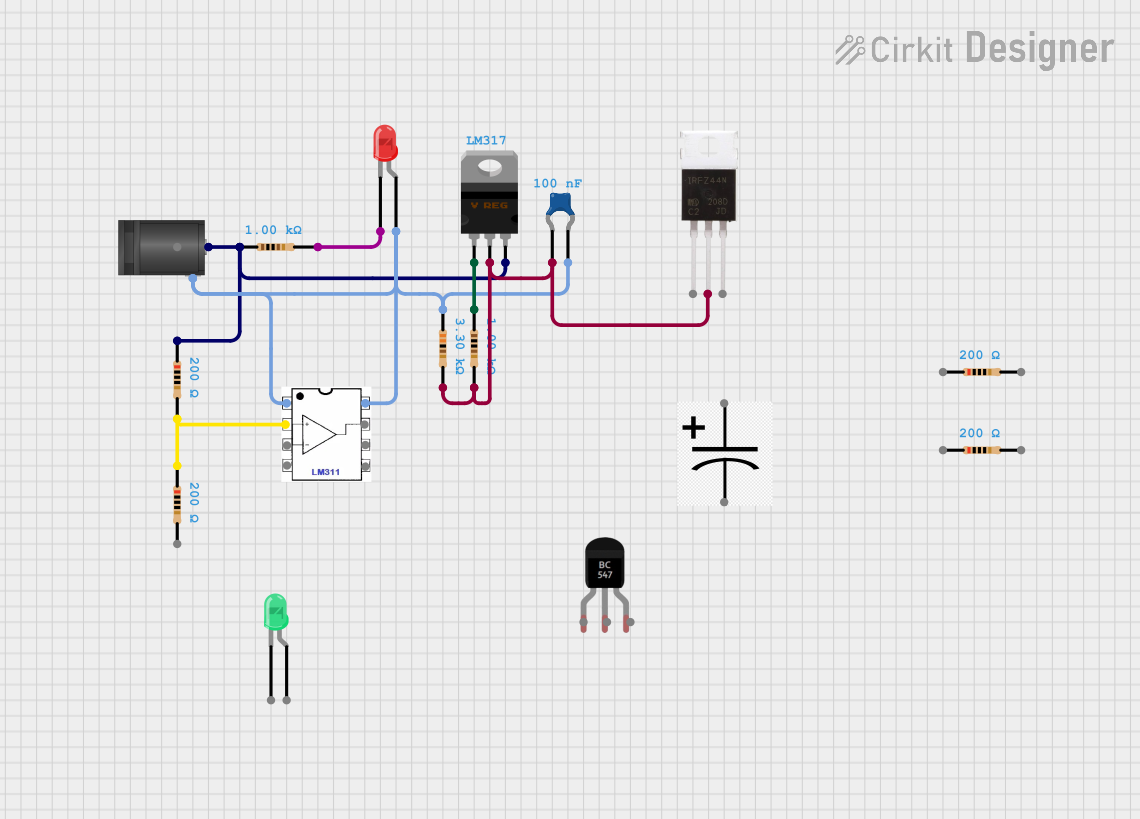 Open Project in Cirkit Designer
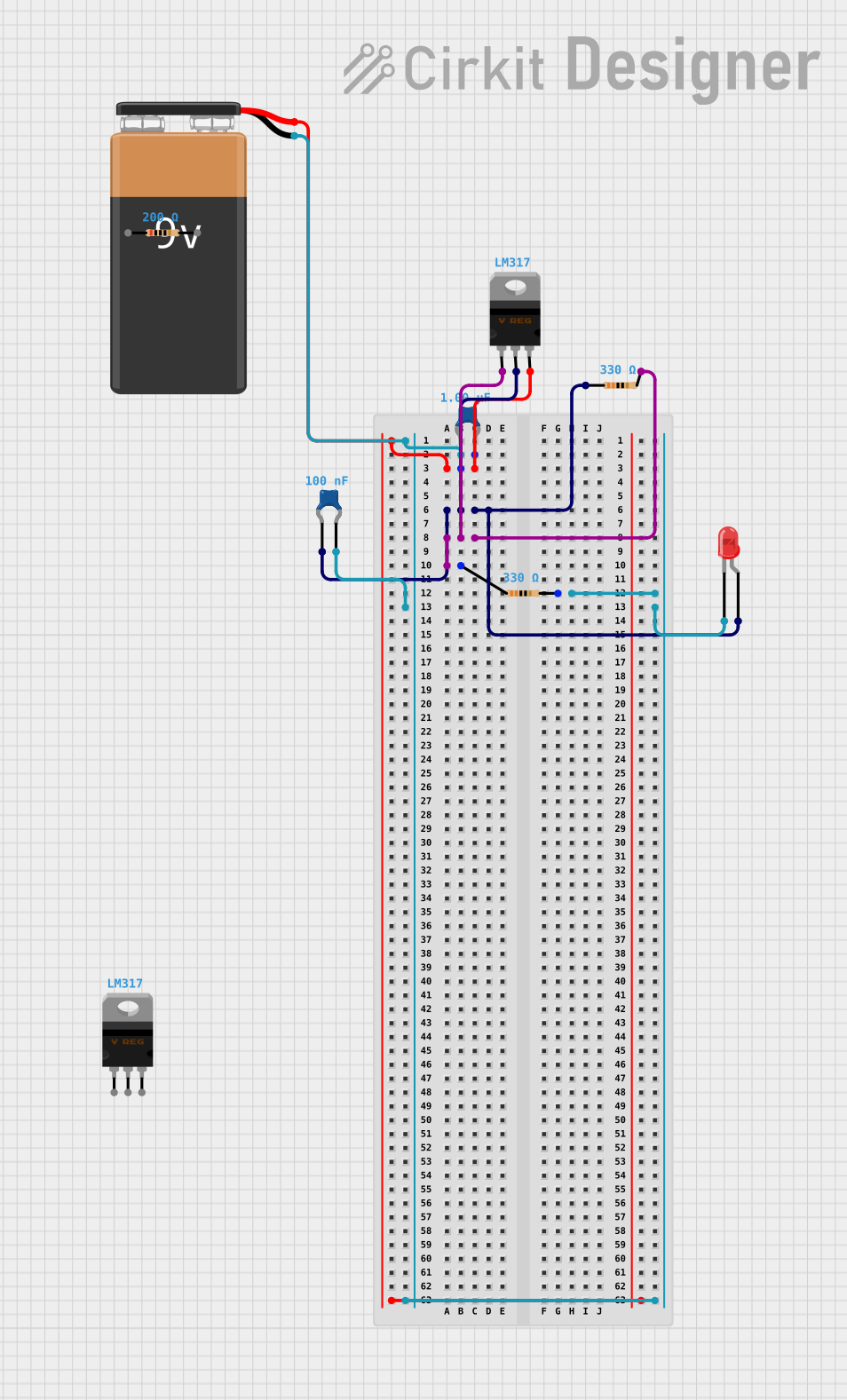 Open Project in Cirkit Designer
Explore Projects Built with Voltage Regulator LM317
Open Project in Cirkit DesignerOpen Project in Cirkit DesignerOpen Project in Cirkit DesignerOpen Project in Cirkit DesignerCommon Applications
- Adjustable power supplies
- Battery chargers
- Voltage regulation in embedded systems
- Current limiting circuits
- LED drivers
Technical Specifications
Below are the key technical details of the LM317 voltage regulator:
| Parameter | Value |
|---|---|
| Input Voltage Range | 3V to 40V |
| Output Voltage Range | 1.25V to 37V |
| Maximum Output Current | 1.5A |
| Dropout Voltage | 3V (typical) |
| Load Regulation | 0.1% (typical) |
| Line Regulation | 0.01%/V (typical) |
| Operating Temperature | -40°C to +125°C |
| Package Types | TO-220, TO-3, SOT-223 |
Pin Configuration
The LM317 has three pins, as described in the table below:
| Pin Number | Pin Name | Description |
|---|---|---|
| 1 | Adjust | Used to set the output voltage via an external resistor divider. |
| 2 | Output | Regulated output voltage. |
| 3 | Input | Unregulated input voltage. |
Usage Instructions
How to Use the LM317 in a Circuit
To use the LM317 as a voltage regulator, you need to configure it with external resistors to set the desired output voltage. The output voltage is determined by the following formula:
[ V_{OUT} = V_{REF} \times \left(1 + \frac{R_2}{R_1}\right) + I_{ADJ} \times R_2 ]
Where:
- ( V_{REF} ) = 1.25V (reference voltage)
- ( I_{ADJ} ) = Adjustment pin current (typically 50µA, negligible in most cases)
- ( R_1 ) and ( R_2 ) are external resistors.
A typical circuit configuration is shown below:
- Connect the input voltage to the Input pin.
- Use a resistor divider (R1 and R2) between the Output and Adjust pins to set the output voltage.
- Place a capacitor (e.g., 0.1µF) between the Input pin and ground for stability.
- Optionally, add a capacitor (e.g., 1µF) between the Output pin and ground to improve transient response.
Example Circuit
For an output voltage of 5V:
- ( R_1 = 240\Omega )
- ( R_2 = 720\Omega )
Arduino UNO Example
The LM317 can be used to power an Arduino UNO by regulating a higher input voltage (e.g., 12V) down to 5V. Below is an example of how to connect the LM317 to an Arduino UNO:
- Connect the Input pin of the LM317 to a 12V DC power source.
- Use a resistor divider to set the output voltage to 5V.
- Connect the Output pin of the LM317 to the 5V pin of the Arduino UNO.
- Ensure proper heat dissipation for the LM317 if the current exceeds 500mA.
Arduino Code Example
If you are using the LM317 to power sensors or peripherals connected to the Arduino, you can use the following code to read the regulated voltage:
// Arduino code to read the regulated voltage using an analog pin
const int voltagePin = A0; // Pin connected to the output of the LM317
float referenceVoltage = 5.0; // Reference voltage of the Arduino (5V)
int adcResolution = 1024; // 10-bit ADC resolution

void setup() {
  Serial.begin(9600); // Initialize serial communication
}

void loop() {
  int sensorValue = analogRead(voltagePin); // Read the analog value
  float voltage = (sensorValue * referenceVoltage) / adcResolution;

  // Print the measured voltage to the Serial Monitor
  Serial.print("Regulated Voltage: ");
  Serial.print(voltage);
  Serial.println(" V");

  delay(1000); // Wait for 1 second before the next reading
}
Important Considerations
- Heat Dissipation: The LM317 can generate significant heat when regulating high currents or large voltage drops. Use a heatsink to prevent overheating.
- Input Voltage: Ensure the input voltage is at least 3V higher than the desired output voltage to maintain proper regulation.
- Capacitors: Always use input and output capacitors for stability and noise reduction.
- Current Limiting: The LM317 includes built-in current limiting and thermal shutdown for protection.
Troubleshooting and FAQs
Common Issues
Output Voltage is Incorrect:
- Check the resistor values (R1 and R2) in the voltage divider.
- Verify that the input voltage is at least 3V higher than the desired output voltage.
LM317 Overheats:
- Ensure proper heatsinking.
- Reduce the current load or input voltage if possible.
No Output Voltage:
- Verify all connections and ensure the input voltage is within the specified range.
- Check for short circuits or damaged components.
Output Voltage is Unstable:
- Add or replace the input and output capacitors.
- Ensure the ground connections are secure.
FAQs
Q: Can the LM317 be used for current regulation?
A: Yes, the LM317 can be configured as a constant current source by placing a resistor between the output and adjust pins. The current is determined by ( I = \frac{1.25}{R} ), where ( R ) is the resistor value.
Q: What is the maximum power dissipation of the LM317?
A: The maximum power dissipation depends on the package type and the heatsink used. For the TO-220 package, it is typically around 20W with adequate heatsinking.
Q: Can the LM317 regulate negative voltages?
A: No, the LM317 is designed for positive voltage regulation. For negative voltages, use the LM337.
Q: Is the LM317 suitable for battery-powered applications?
A: The LM317 is not ideal for battery-powered applications due to its relatively high dropout voltage and quiescent current. Consider using a low-dropout regulator (LDO) instead.