
How to Use DF Player Mini: Examples, Pinouts, and Specs
 Design with DF Player Mini in Cirkit Designer
Introduction
The DF Player Mini is a compact MP3 player module designed for audio playback in embedded systems. It can play audio files directly from a micro SD card or USB drive and features a built-in amplifier for driving small speakers. The module supports various audio formats, including MP3, WAV, and WMA, making it a versatile choice for projects requiring sound output. Its small size and ease of integration make it ideal for applications such as DIY audio systems, talking devices, alarms, and interactive installations.
Explore Projects Built with DF Player Mini
 Open Project in Cirkit Designer
 Open Project in Cirkit Designer
 Open Project in Cirkit Designer
 Open Project in Cirkit Designer
Explore Projects Built with DF Player Mini
Open Project in Cirkit DesignerOpen Project in Cirkit DesignerOpen Project in Cirkit DesignerOpen Project in Cirkit DesignerTechnical Specifications
- Power Supply Voltage: 3.2V to 5.0V DC
- Current Consumption: 20mA (standby), up to 100mA (playback)
- Audio Formats Supported: MP3, WAV, WMA
- Storage Media: Micro SD card (up to 32GB) or USB drive
- Audio Output:
- DAC output for external amplifier
- Built-in 3W mono amplifier for direct speaker connection
- Communication Interfaces: UART (9600 bps default), AD key control
- Operating Temperature: -40°C to +70°C
Pin Configuration and Descriptions
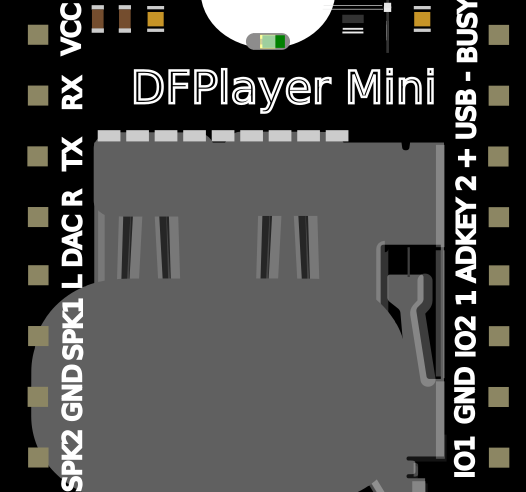
The DF Player Mini has 16 pins, as described in the table below:
| Pin | Name | Description |
|---|---|---|
| 1 | VCC | Power supply input (3.2V to 5.0V DC). |
| 2 | RX | UART receive pin for serial communication. |
| 3 | TX | UART transmit pin for serial communication. |
| 4 | DAC_R | Right channel DAC output for external amplifier. |
| 5 | DAC_L | Left channel DAC output for external amplifier. |
| 6 | SPK_1 | Positive terminal for speaker connection (built-in amplifier). |
| 7 | SPK_2 | Negative terminal for speaker connection (built-in amplifier). |
| 8 | GND | Ground connection. |
| 9 | IO_1 | General-purpose input/output pin 1. |
| 10 | IO_2 | General-purpose input/output pin 2. |
| 11 | ADKEY_1 | Analog key input 1 for button control. |
| 12 | ADKEY_2 | Analog key input 2 for button control. |
| 13 | BUSY | Output pin indicating playback status (HIGH = busy, LOW = idle). |
| 14 | USB+ | Positive terminal for USB drive connection. |
| 15 | USB- | Negative terminal for USB drive connection. |
| 16 | RESET | Reset pin to restart the module. Active LOW. |
Usage Instructions
Connecting the DF Player Mini
- Power Supply: Connect the VCC pin to a 3.2V–5.0V DC power source and the GND pin to ground.
- Speaker Connection:
- For direct speaker output, connect a small speaker (4Ω or 8Ω) to the SPK_1 and SPK_2 pins.
- For external amplification, use the DAC_L and DAC_R pins to connect to an external amplifier.
- Micro SD Card: Insert a FAT32-formatted micro SD card containing audio files into the module's SD card slot.
- Serial Communication: Connect the RX and TX pins to a microcontroller (e.g., Arduino) for UART communication. Use a voltage divider if the microcontroller operates at 5V logic levels.
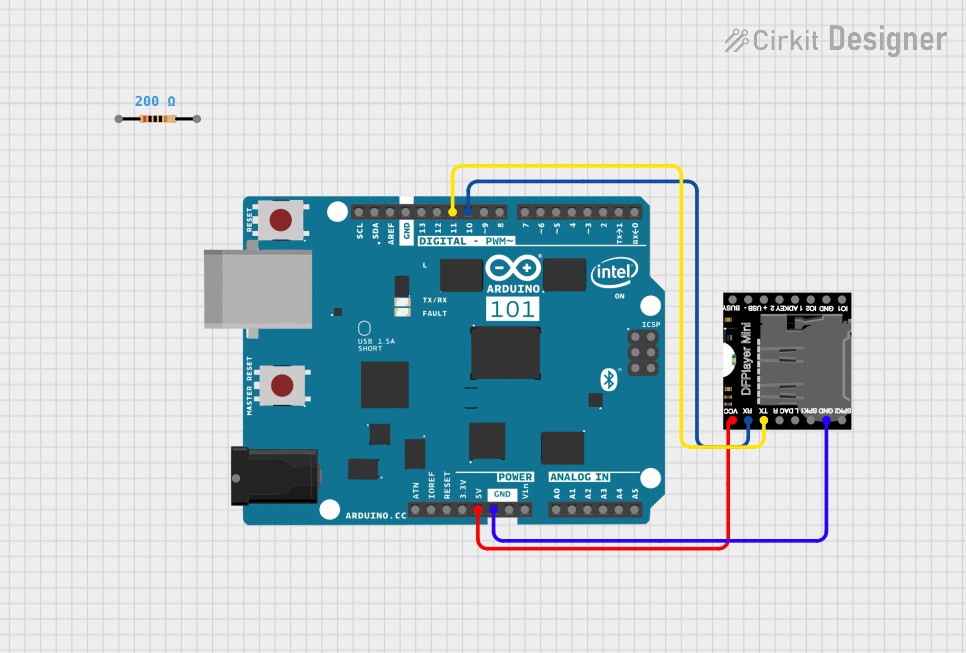
Example: Using DF Player Mini with Arduino UNO
Below is an example of how to control the DF Player Mini using an Arduino UNO:
Circuit Diagram
- Connect the DF Player Mini's RX pin to Arduino pin 10 (via a voltage divider).
- Connect the DF Player Mini's TX pin to Arduino pin 11.
- Connect VCC and GND to a 5V power source and ground, respectively.
- Connect a speaker to SPK_1 and SPK_2.
Arduino Code
#include "SoftwareSerial.h"

// Define RX and TX pins for SoftwareSerial
SoftwareSerial mySerial(10, 11); // RX = pin 10, TX = pin 11

void setup() {
  mySerial.begin(9600); // Initialize software serial communication
  Serial.begin(9600);   // Initialize hardware serial for debugging

  Serial.println("Initializing DF Player Mini...");
  delay(1000);

  // Send initialization command to DF Player Mini
  mySerial.write(0x7E); // Start byte
  mySerial.write(0xFF); // Version
  mySerial.write(0x06); // Length
  mySerial.write(0x09); // Command: Select device
  mySerial.write(0x00); // Feedback
  mySerial.write(0x02); // Parameter: SD card
  mySerial.write(0xEF); // End byte

  Serial.println("DF Player Mini initialized.");
}

void loop() {
  // Play the first track on the SD card
  mySerial.write(0x7E); // Start byte
  mySerial.write(0xFF); // Version
  mySerial.write(0x06); // Length
  mySerial.write(0x03); // Command: Play track
  mySerial.write(0x00); // Feedback
  mySerial.write(0x00); // High byte of track number
  mySerial.write(0x01); // Low byte of track number (track 1)
  mySerial.write(0xEF); // End byte

  Serial.println("Playing track 1...");
  delay(5000); // Wait for 5 seconds before repeating
}
Best Practices
- Use a decoupling capacitor (e.g., 100µF) across the VCC and GND pins to stabilize the power supply.
- Ensure the micro SD card is formatted as FAT32 and contains audio files in supported formats.
- Avoid connecting high-power speakers directly to the SPK_1 and SPK_2 pins to prevent damage to the module.
Troubleshooting and FAQs
Common Issues
No Sound Output:
- Ensure the speaker is properly connected to SPK_1 and SPK_2.
- Verify that the audio files are in a supported format and stored on a FAT32-formatted micro SD card.
- Check the power supply voltage (3.2V–5.0V DC).
Module Not Responding to Commands:
- Confirm the RX and TX connections between the module and microcontroller.
- Use a voltage divider on the RX pin if the microcontroller operates at 5V logic levels.
Playback Stops Unexpectedly:
- Check the BUSY pin to determine if the module is still playing.
- Ensure the micro SD card is not corrupted or damaged.
FAQs
Q: Can I use the DF Player Mini without a microcontroller?
A: Yes, the module can be controlled using AD key inputs or by connecting buttons to the ADKEY_1 and ADKEY_2 pins.
Q: What is the maximum speaker power supported by the built-in amplifier?
A: The built-in amplifier supports up to 3W output for a 4Ω speaker.
Q: Can I use a USB drive instead of a micro SD card?
A: Yes, the module supports USB drives, but you must connect the USB+ and USB- pins to the appropriate terminals.
Q: How do I reset the module?
A: Pull the RESET pin LOW momentarily to reset the module.
This concludes the DF Player Mini documentation.