The MKE-S04 IR Infrared Flame Sensor is a specialized electronic module designed to detect the presence of flames using infrared (IR) radiation. This sensor is particularly useful in fire alarm systems, safety automation in industrial environments, and robotics where fire detection is crucial. Its sensitivity to IR wavelengths allows it to identify flames from a distance, making it an essential component for early fire detection and prevention strategies.
Explore Projects Built with MKE-S04 IR Infrared Flame Sensor
Use Cirkit Designer to design, explore, and prototype these projects online. Some projects support real-time simulation. Click "Open Project" to start designing instantly!
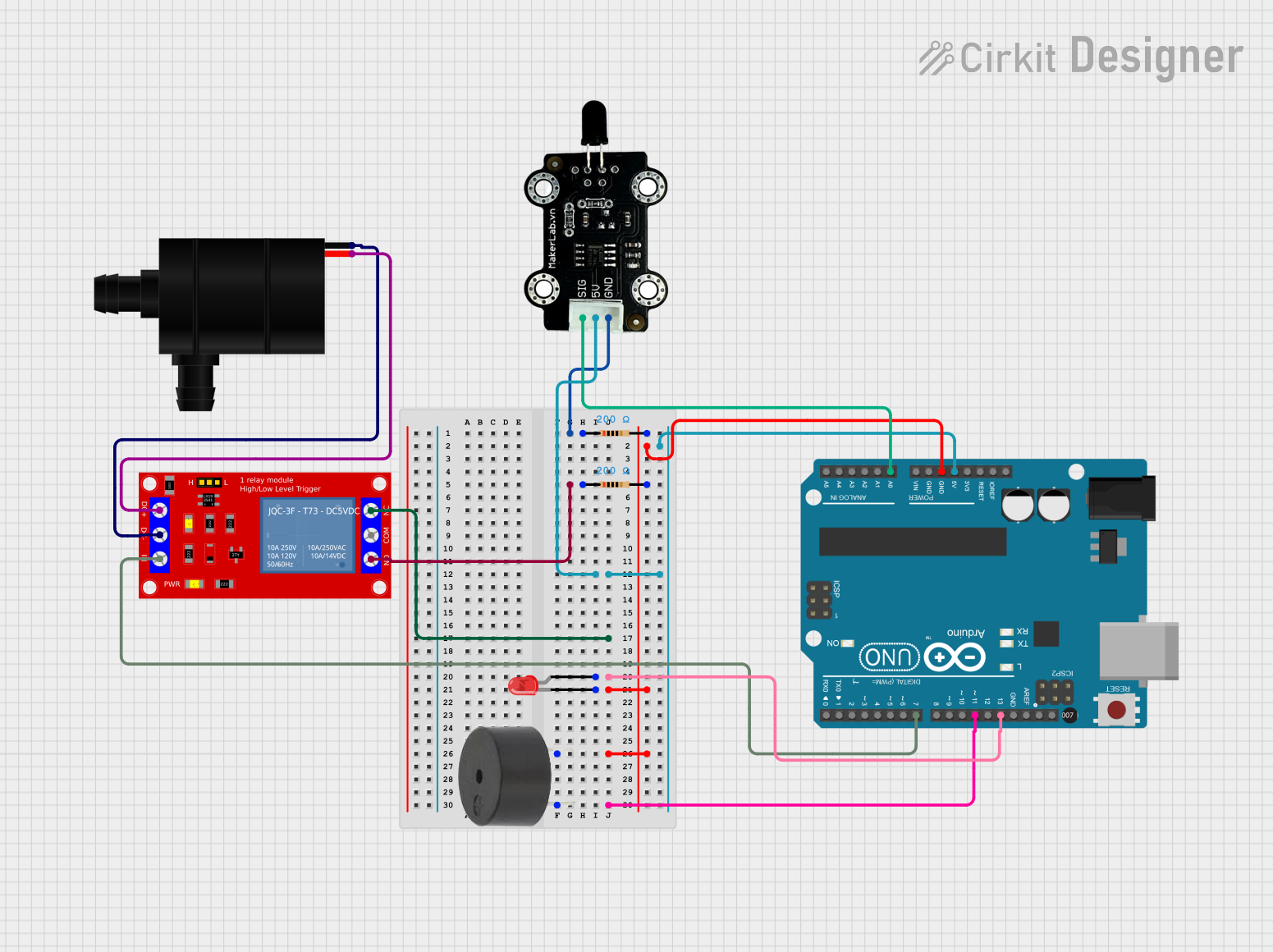
This circuit is a fire detection and response system using an Arduino UNO. It utilizes an IR flame sensor to detect fire, and upon detection, it activates a relay to turn on a water pump, sounds a buzzer, and lights up an LED to provide visual and auditory alerts.
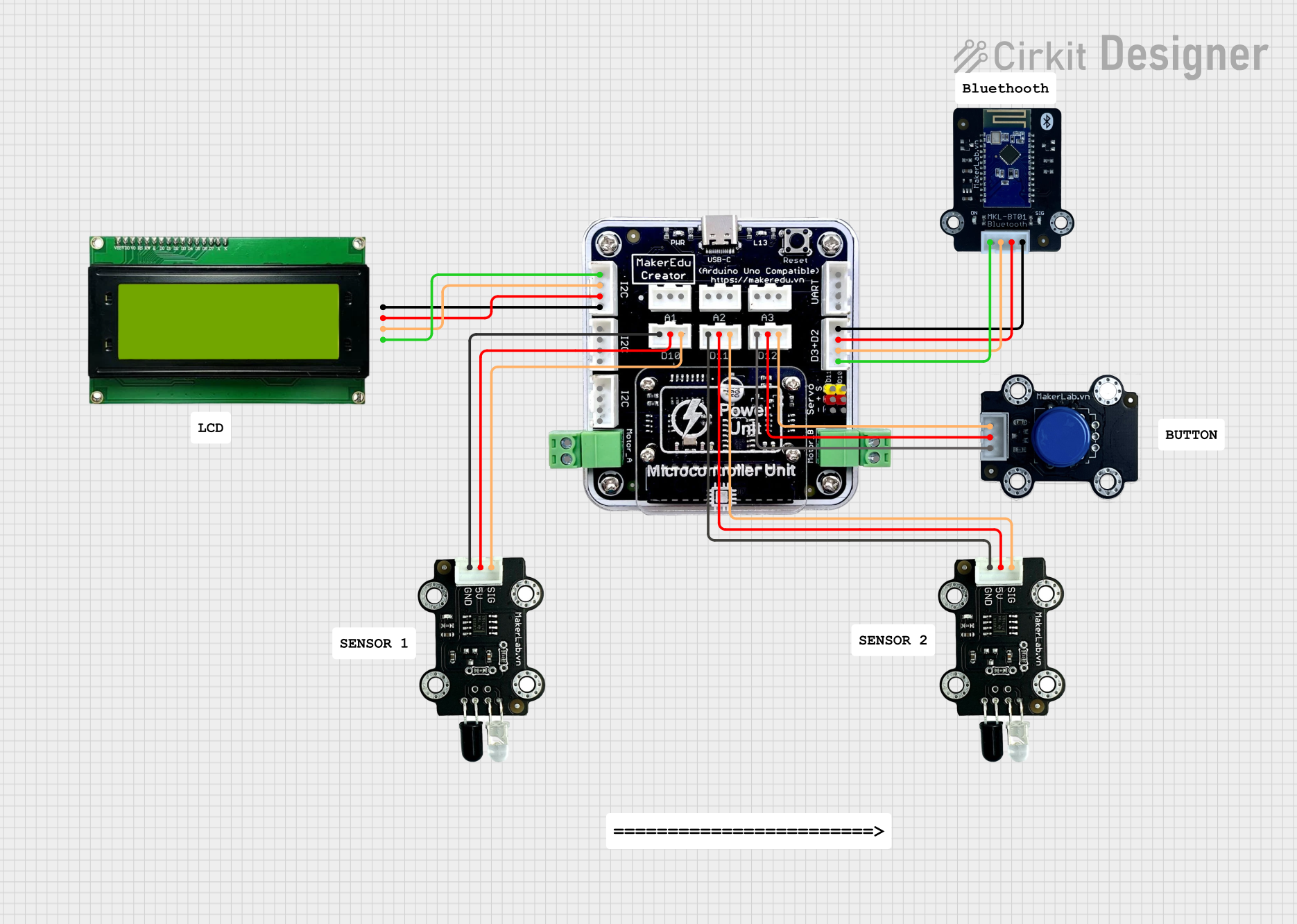
This circuit features a MakerEdu Creator microcontroller board interfaced with two MKE-S11 IR Infrared Obstacle Avoidance Sensors, a MKE-M02 Push Button Tact Switch, a MKE-M15 Bluetooth module, and a MKE-M08 LCD2004 I2C display module. The push button is connected to a digital input for user interaction, while the IR sensors are likely used for detecting obstacles. The Bluetooth module enables wireless communication, and the LCD display provides a user interface for displaying information or statuses.
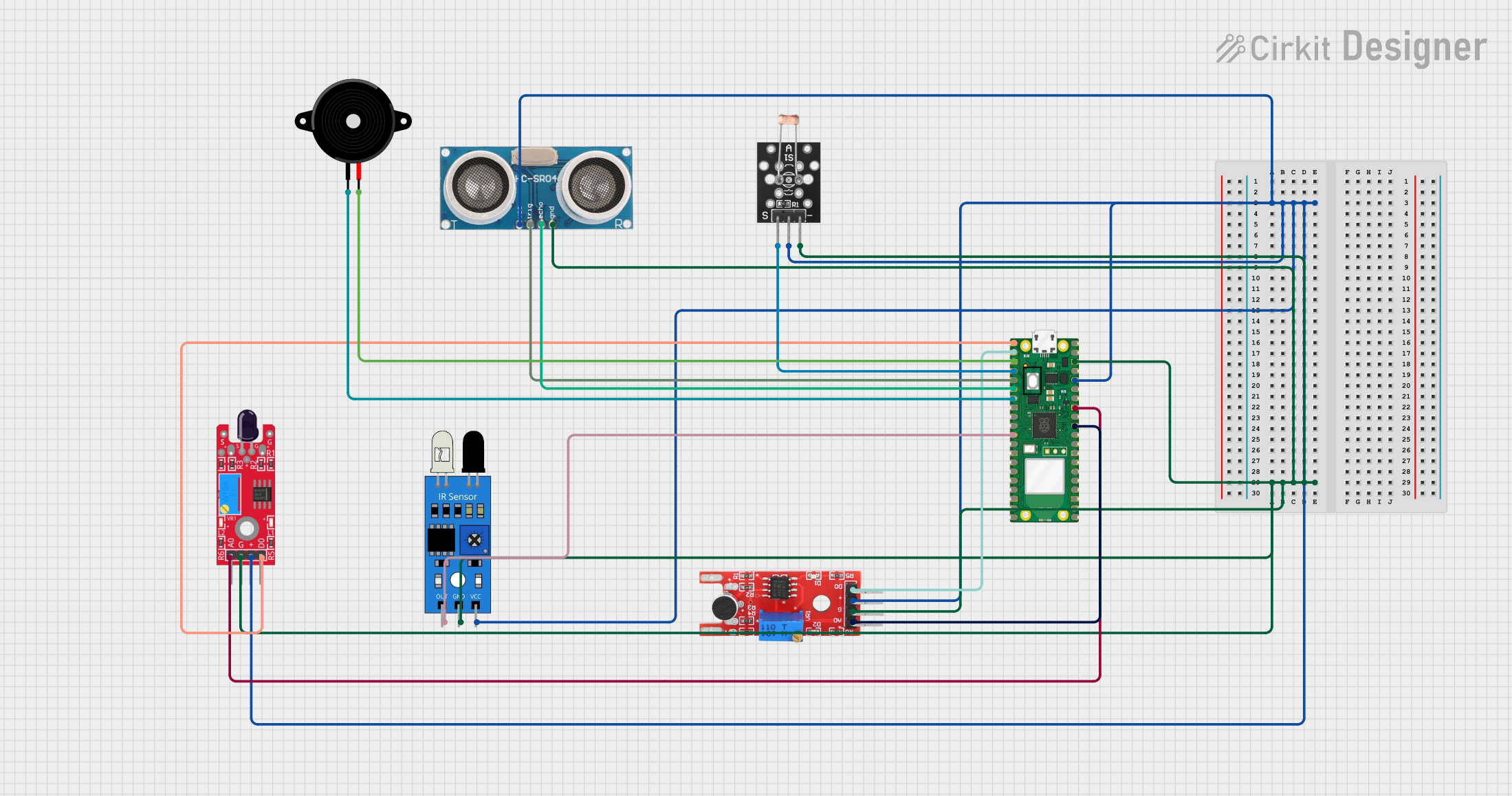
This circuit is designed for a security system that detects fire, sound, light changes, movement, and IR triggers using a Raspberry Pi Pico W as the central microcontroller. It includes a flame sensor, sound sensor (KY-038), LDR photoresistor, ultrasonic sensor, IR sensor, and a piezo speaker for alerts. The system monitors the environment for any disturbances and alerts personnel through the piezo speaker when an anomaly is detected.
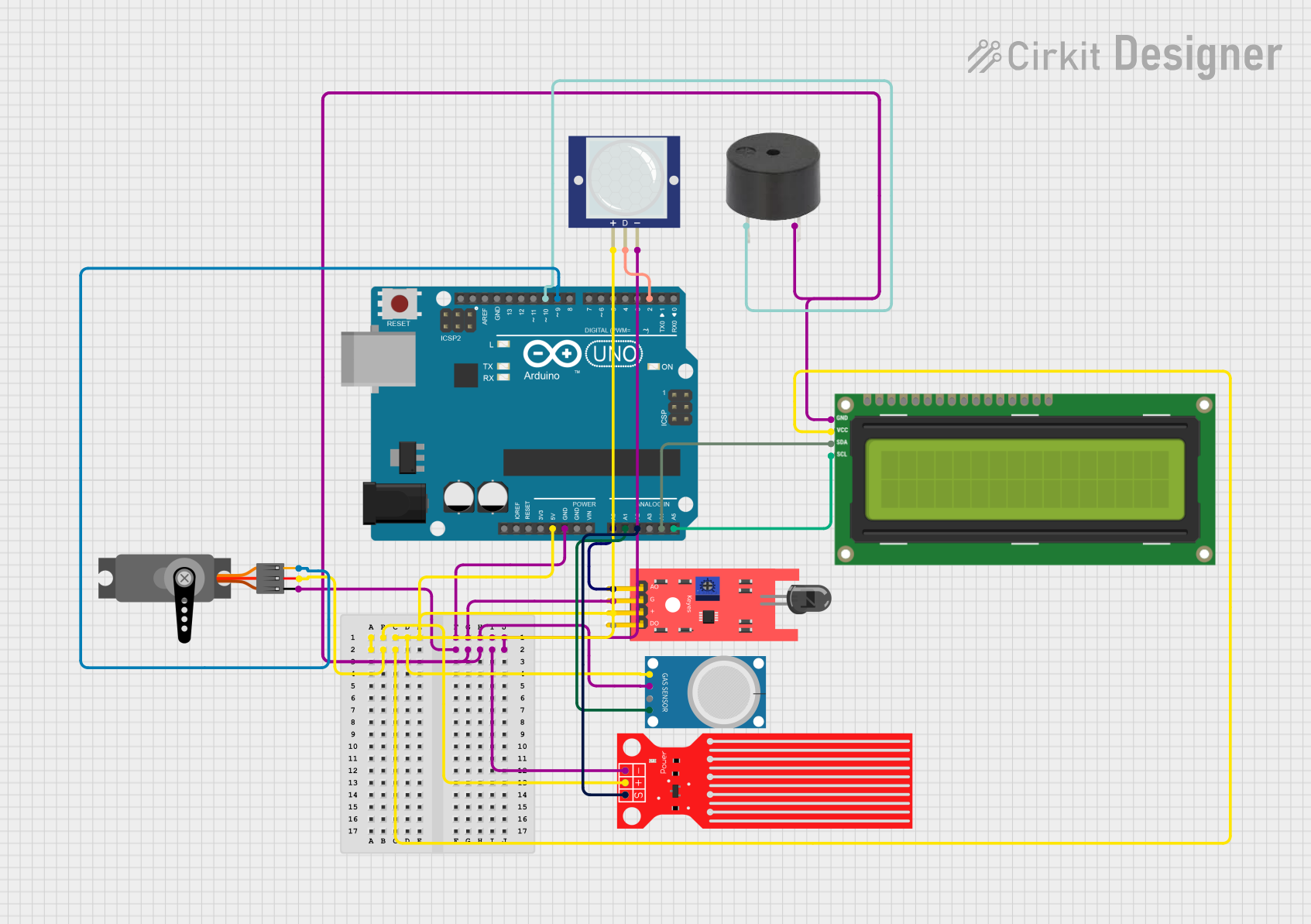
This circuit is a multi-sensor monitoring system controlled by an Arduino UNO microcontroller. It includes a flame sensor, gas sensor (MQ-4), water level sensor, PIR motion sensor, a servo motor, a buzzer, and an I2C LCD display for alerts. The system is designed to detect fire, gas leaks, intruders, and water levels, providing visual alerts on the LCD and audible alerts through the buzzer, with the servo motor potentially used for automated responses such as closing a valve or door.
Detection Wavelength: 760nm to 1100nm (infrared spectrum)
Detection Angle: Approximately 60 degrees
Output Type: Digital (0V or 5V)
Response Time: < 1 second
Operating Temperature: -25°C to +85°C
Pin Configuration and Descriptions
Pin Number
Pin Name
Description
1
VCC
Power supply (3.3V to 5V DC)
2
GND
Ground
3
DOUT
Digital output; HIGH when flame is detected
4
AOUT
Analog output (optional, not always used)
Usage Instructions
Integration with a Circuit
To use the MKE-S04 IR Infrared Flame Sensor in a circuit:
Connect the VCC pin to a 3.3V or 5V power supply.
Connect the GND pin to the ground of the power supply.
Connect the DOUT pin to a digital input pin on a microcontroller, such as an Arduino UNO, to read the digital signal.
(Optional) Connect the AOUT pin to an analog input pin on the microcontroller if you wish to measure the intensity of the detected IR radiation.
Best Practices
Avoid exposing the sensor to direct sunlight or other strong IR sources that may interfere with flame detection.
Ensure that the sensor is mounted away from heat sources that do not represent actual flames to prevent false alarms.
Use a pull-up resistor if the digital output is left floating to ensure a stable HIGH or LOW signal.
Regularly test the sensor in controlled conditions to verify its functionality and sensitivity.
Example Arduino UNO Code
// Define the digital input pin connected to the sensor's DOUT pin
const int flameSensorPin = 2;

void setup() {
  pinMode(flameSensorPin, INPUT); // Set the flame sensor pin as an input
  Serial.begin(9600);             // Start serial communication at 9600 baud
}

void loop() {
  int flameDetected = digitalRead(flameSensorPin); // Read the sensor's output

  if (flameDetected == HIGH) {
    // Flame has been detected
    Serial.println("Flame detected!");
    // Implement additional actions like activating an alarm or safety measures
  } else {
    // No flame detected
    Serial.println("No flame detected.");
  }

  delay(1000); // Wait for 1 second before reading the sensor again
}
Troubleshooting and FAQs
Common Issues
False Positives: The sensor may occasionally trigger a false alarm due to exposure to other IR sources.
No Response: If the sensor does not respond, ensure that it is correctly powered and the pins are properly connected.
Solutions and Tips
Reducing False Positives: Shield the sensor from other IR sources and adjust its placement to minimize interference.
Power Issues: Verify that the sensor is receiving the correct voltage and that connections are secure.
Sensor Testing: Periodically test the sensor with a controlled flame source to ensure it is functioning correctly.
FAQs
Q: Can the sensor detect flames through glass or other materials?
A: No, the sensor requires a direct line of sight to the flame as most materials will block or filter the IR radiation.
Q: How far can the sensor detect a flame?
A: The detection range depends on the size of the flame and environmental conditions but typically is within a few meters.
Q: Is the sensor waterproof?
A: No, the MKE-S04 IR Infrared Flame Sensor is not waterproof and should be protected from moisture and water exposure.
Q: Can the sensor differentiate between different types of flames?
A: The sensor detects IR radiation within a certain wavelength range and cannot differentiate between different flame sources.
For further assistance or technical support, please contact the manufacturer or your local distributor.


 Open Project in Cirkit Designer