
How to Use 2N2222: Examples, Pinouts, and Specs
 Design with 2N2222 in Cirkit Designer
Introduction
The 2N2222 is a widely used NPN bipolar junction transistor (BJT) known for its versatility in switching and amplification applications. It is designed to handle moderate current and voltage levels, making it suitable for a wide range of electronic circuits. Its robust design and reliability make it a popular choice for hobbyists and professionals alike.
Explore Projects Built with 2N2222
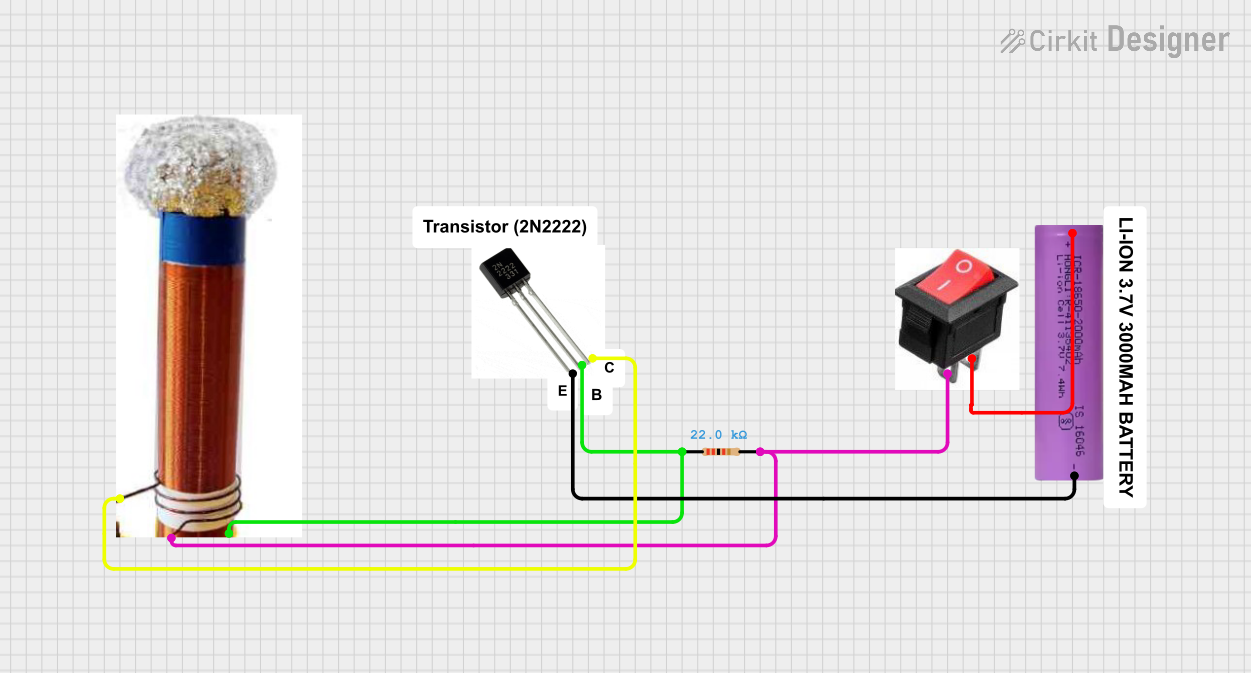 Open Project in Cirkit Designer
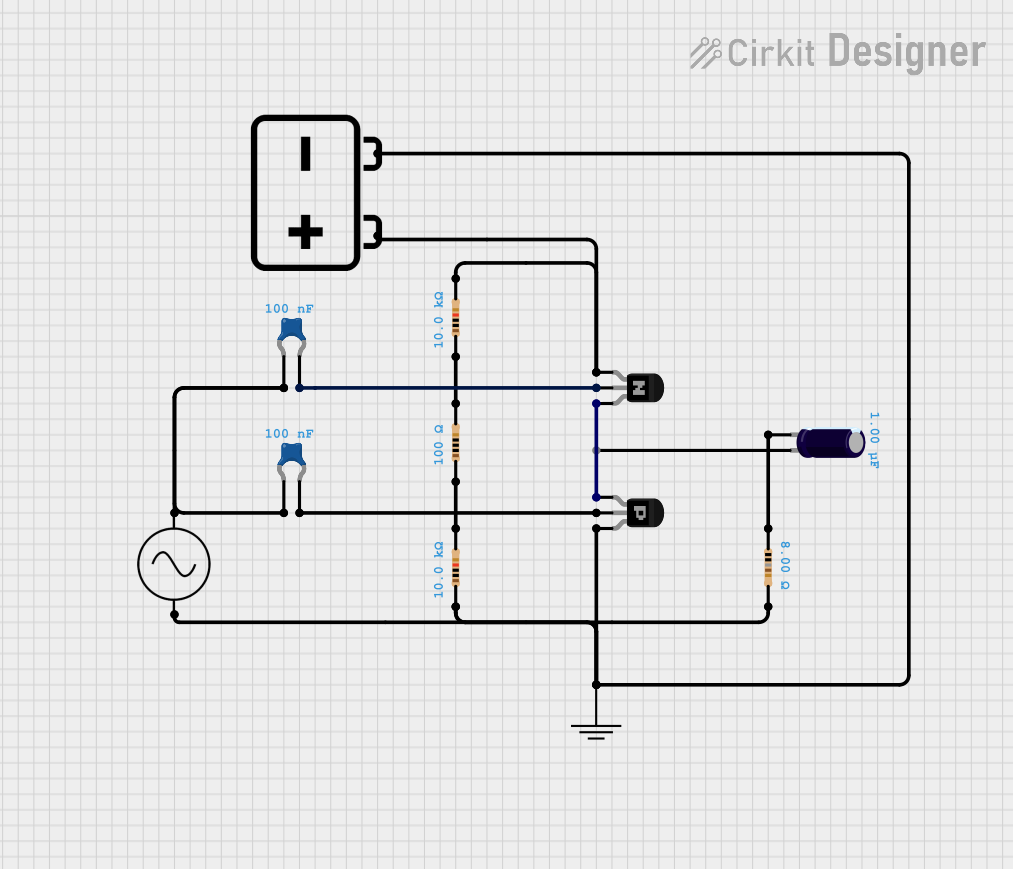 Open Project in Cirkit Designer
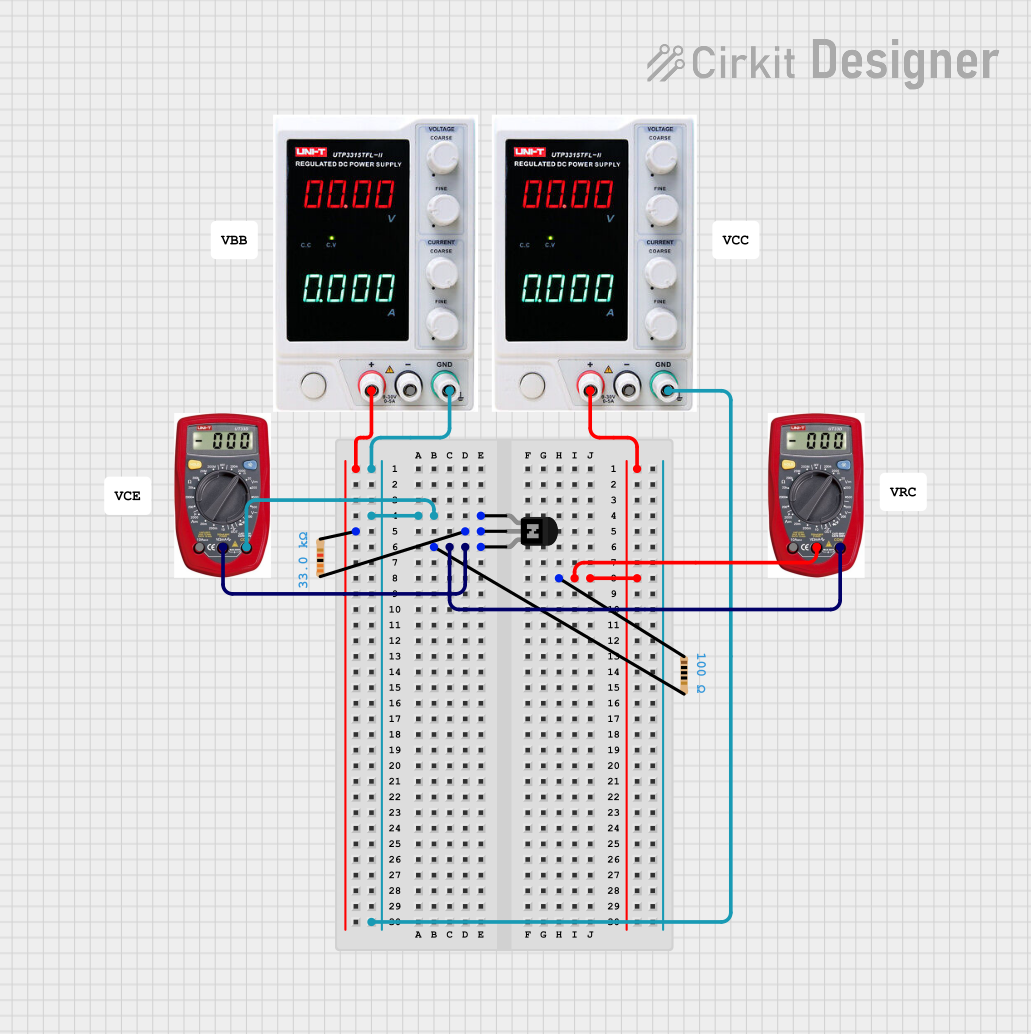 Open Project in Cirkit Designer
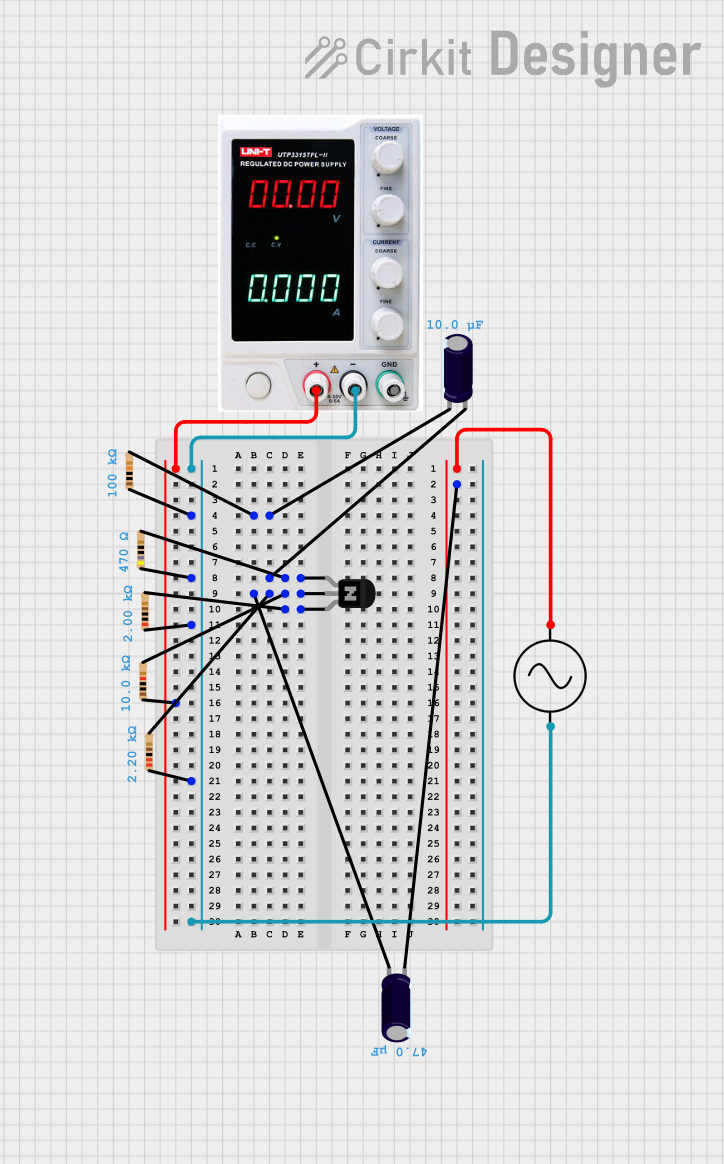 Open Project in Cirkit Designer
Explore Projects Built with 2N2222
Open Project in Cirkit DesignerOpen Project in Cirkit DesignerOpen Project in Cirkit DesignerOpen Project in Cirkit DesignerCommon Applications and Use Cases
- Signal amplification in audio and RF circuits
- Switching small loads such as LEDs, relays, and motors
- Oscillator circuits
- General-purpose low-power applications
- Digital logic circuits
Technical Specifications
The 2N2222 transistor is characterized by the following key specifications:
| Parameter | Value |
|---|---|
| Transistor Type | NPN |
| Maximum Collector-Emitter Voltage (VCEO) | 40V |
| Maximum Collector-Base Voltage (VCBO) | 75V |
| Maximum Emitter-Base Voltage (VEBO) | 6V |
| Maximum Collector Current (IC) | 800mA |
| Power Dissipation (PD) | 500mW |
| DC Current Gain (hFE) | 100 to 300 |
| Transition Frequency (fT) | 250 MHz |
| Package Type | TO-18 (metal can) or TO-92 (plastic) |
Pin Configuration
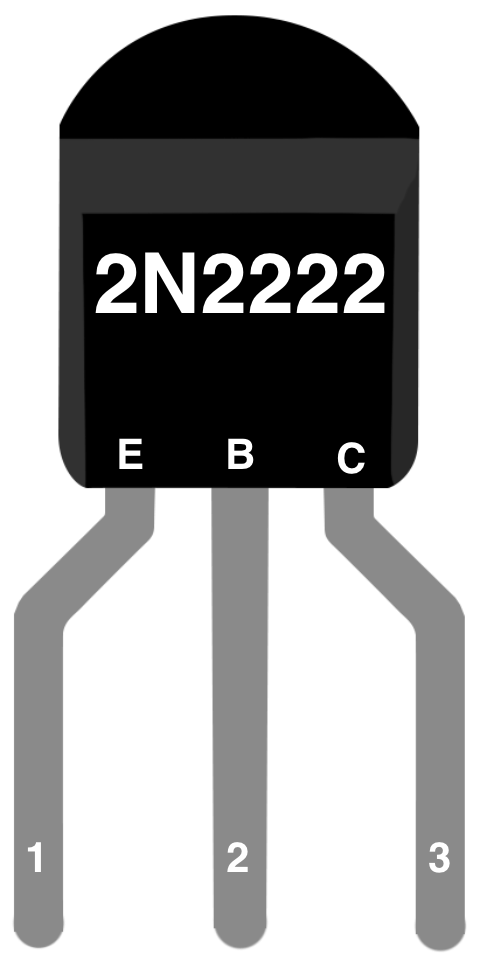
The 2N2222 is typically available in the TO-92 package. The pinout for this package is as follows:
| Pin Number | Pin Name | Description |
|---|---|---|
| 1 | Emitter | Connected to ground or negative terminal |
| 2 | Base | Controls the transistor's operation |
| 3 | Collector | Connected to the load or positive terminal |
Note: Ensure the flat side of the TO-92 package is facing you to correctly identify the pins.
Usage Instructions
How to Use the 2N2222 in a Circuit
Determine the Configuration: Decide whether the transistor will be used as a switch or an amplifier.
- Switching: Use the transistor to control a load by applying a small current to the base.
- Amplification: Use the transistor to amplify a small input signal applied to the base.
Base Resistor Selection: Always use a resistor in series with the base to limit the base current. The value of the resistor can be calculated using Ohm's Law: [ R_b = \frac{V_{in} - V_{BE}}{I_B} ] Where:
- ( V_{in} ) is the input voltage
- ( V_{BE} ) is typically 0.7V for the 2N2222
- ( I_B ) is the desired base current (usually ( I_B = I_C / h_{FE} ))
Connect the Load: Connect the load (e.g., LED, motor, or relay) to the collector pin. Ensure the load's current and voltage requirements are within the transistor's limits.
Power Supply: Provide a suitable power supply to the circuit, ensuring it does not exceed the maximum voltage and current ratings of the transistor.
Example: Controlling an LED with Arduino UNO
Below is an example of using the 2N2222 to control an LED with an Arduino UNO:
Circuit Diagram
- Emitter: Connect to ground.
- Base: Connect to an Arduino digital pin through a 1kΩ resistor.
- Collector: Connect to the negative terminal of the LED. The positive terminal of the LED is connected to a 220Ω resistor, which is then connected to the positive supply (5V).
Arduino Code
// Define the pin connected to the 2N2222 base
const int transistorBasePin = 9;

void setup() {
  // Set the transistor base pin as an output
  pinMode(transistorBasePin, OUTPUT);
}

void loop() {
  // Turn the LED on by sending a HIGH signal to the transistor base
  digitalWrite(transistorBasePin, HIGH);
  delay(1000); // Keep the LED on for 1 second

  // Turn the LED off by sending a LOW signal to the transistor base
  digitalWrite(transistorBasePin, LOW);
  delay(1000); // Keep the LED off for 1 second
}
Important Considerations and Best Practices
- Heat Dissipation: If the transistor is operating near its maximum power dissipation, consider using a heatsink.
- Current Limiting: Always use appropriate resistors to limit current through the base and collector.
- Voltage Ratings: Ensure the applied voltages do not exceed the maximum ratings to avoid damaging the transistor.
- Polarity: Double-check the pin connections to avoid reverse polarity, which can damage the component.
Troubleshooting and FAQs
Common Issues
Transistor Not Switching Properly
- Cause: Insufficient base current.
- Solution: Check the base resistor value and ensure the base current is sufficient to saturate the transistor.
Overheating
- Cause: Excessive power dissipation.
- Solution: Reduce the load current or use a heatsink.
No Output Signal
- Cause: Incorrect pin connections or damaged transistor.
- Solution: Verify the pin connections and replace the transistor if necessary.
LED Not Lighting Up
- Cause: Incorrect resistor value or insufficient supply voltage.
- Solution: Check the resistor value and ensure the supply voltage is adequate.
FAQs
Q: Can the 2N2222 handle high-power loads?
A: No, the 2N2222 is designed for low to moderate power applications. For high-power loads, consider using a power transistor like the TIP120.
Q: What is the maximum frequency the 2N2222 can operate at?
A: The 2N2222 has a transition frequency (( f_T )) of 250 MHz, making it suitable for high-frequency applications.
Q: Can I use the 2N2222 without a base resistor?
A: No, a base resistor is essential to limit the base current and prevent damage to the transistor.
Q: Is the 2N2222 suitable for audio amplification?
A: Yes, the 2N2222 can be used for low-power audio amplification, but it may not provide high fidelity compared to dedicated audio transistors.
By following this documentation, you can effectively use the 2N2222 transistor in your electronic projects!