
How to Use CCS811: Examples, Pinouts, and Specs
 Design with CCS811 in Cirkit Designer
Introduction
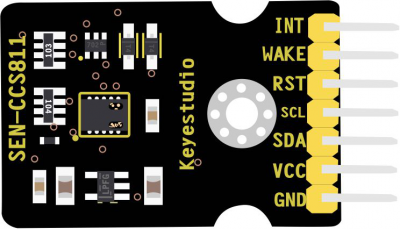
The CCS811 (Keyestudio Part ID: KS0457) is a digital gas sensor designed to measure indoor air quality. It detects levels of carbon dioxide (CO2) and total volatile organic compounds (TVOCs) in the environment. The sensor integrates a metal oxide (MOX) gas sensor and a microcontroller with an analog-to-digital converter (ADC) to provide accurate and reliable air quality data. Communication with the CCS811 is achieved via the I2C interface, making it easy to integrate into various microcontroller-based systems.
Explore Projects Built with CCS811
 Open Project in Cirkit Designer
 Open Project in Cirkit Designer
 Open Project in Cirkit Designer
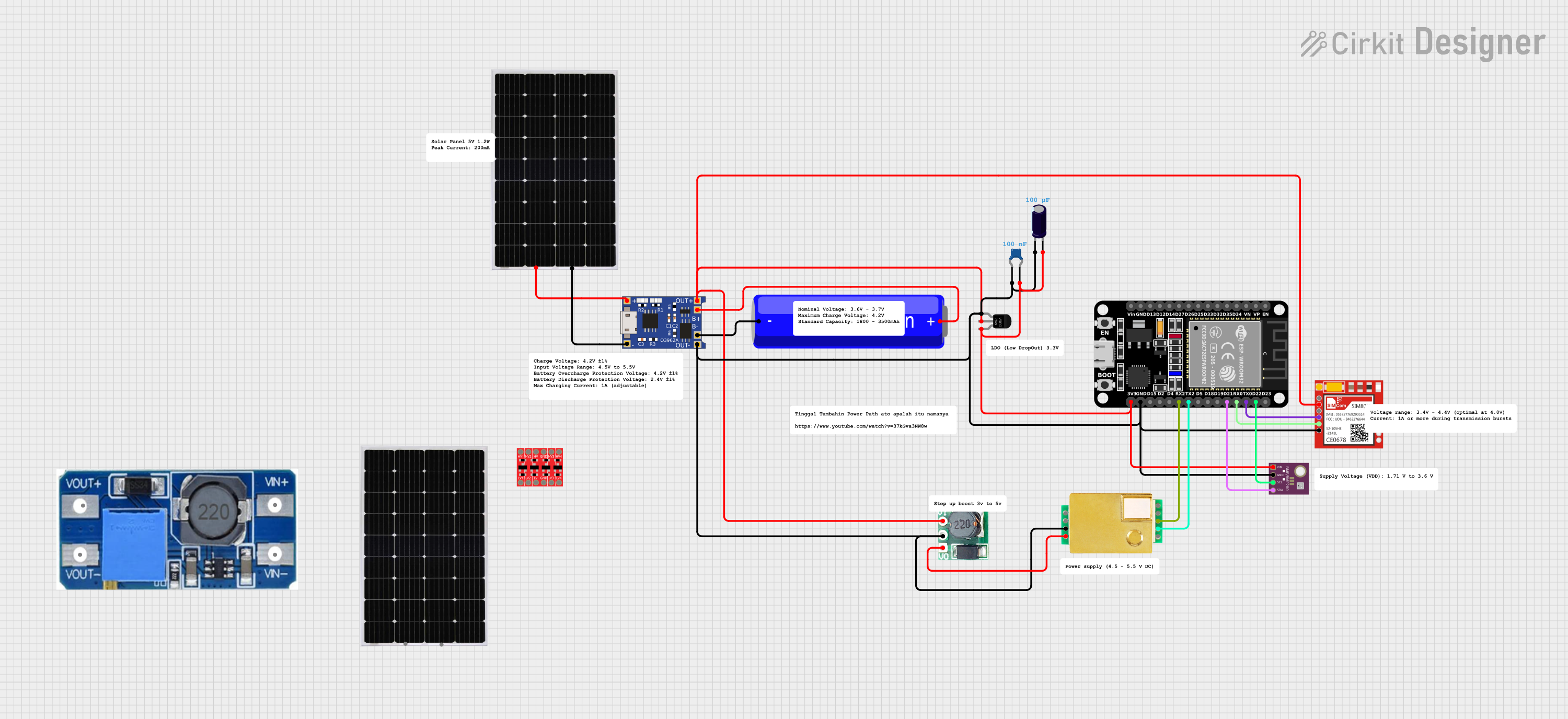 Open Project in Cirkit Designer
Explore Projects Built with CCS811
Open Project in Cirkit DesignerOpen Project in Cirkit DesignerOpen Project in Cirkit DesignerOpen Project in Cirkit DesignerCommon Applications and Use Cases
- Indoor air quality monitoring
- Smart home automation systems
- HVAC (Heating, Ventilation, and Air Conditioning) systems
- Environmental monitoring devices
- IoT (Internet of Things) applications for air quality tracking
Technical Specifications
The following table outlines the key technical details of the CCS811 sensor:
| Parameter | Value |
|---|---|
| Operating Voltage | 3.3V to 5V |
| Interface | I2C |
| CO2 Measurement Range | 400 ppm to 8192 ppm |
| TVOC Measurement Range | 0 ppb to 1187 ppb |
| Power Consumption | 1.2 mW (typical) |
| Operating Temperature Range | -40°C to 85°C |
| Humidity Range | 10% to 95% RH (non-condensing) |
| Dimensions | 20mm x 20mm x 3.2mm |
Pin Configuration and Descriptions
The CCS811 module has the following pinout:
| Pin | Name | Description |
|---|---|---|
| 1 | VIN | Power supply input (3.3V to 5V). |
| 2 | GND | Ground connection. |
| 3 | SDA | I2C data line. Used for communication with the microcontroller. |
| 4 | SCL | I2C clock line. Used for communication with the microcontroller. |
| 5 | INT | Interrupt pin. Can be used to signal when new data is available (optional). |
| 6 | RST | Reset pin. Pull low to reset the sensor (optional, typically not required). |
Usage Instructions
How to Use the CCS811 in a Circuit
- Power the Sensor: Connect the VIN pin to a 3.3V or 5V power source and the GND pin to ground.
- I2C Communication: Connect the SDA and SCL pins to the corresponding I2C pins on your microcontroller. For an Arduino UNO, connect:
- SDA to A4
- SCL to A5
- Optional Connections:
- The INT pin can be connected to a digital input pin on the microcontroller to handle interrupts.
- The RST pin can be left unconnected unless a hardware reset is required.
- Install Required Libraries: Use the Adafruit CCS811 library or a similar library to simplify communication with the sensor.
Important Considerations and Best Practices
- Burn-in Period: The sensor requires a burn-in period of 48 hours for optimal accuracy during the first use.
- Warm-up Time: Allow the sensor to warm up for 20 minutes before taking measurements after each power-up.
- Environmental Conditions: Avoid exposing the sensor to extreme humidity or temperature conditions outside its operating range.
- I2C Address: The default I2C address of the CCS811 is
0x5A. Ensure no other devices on the I2C bus share this address.
Example Code for Arduino UNO
Below is an example code snippet to read CO2 and TVOC values from the CCS811 using the Adafruit CCS811 library:
#include <Wire.h>
#include "Adafruit_CCS811.h"

// Create an instance of the CCS811 sensor
Adafruit_CCS811 ccs;

void setup() {
  Serial.begin(9600); // Initialize serial communication
  Serial.println("CCS811 Air Quality Sensor Test");

  if (!ccs.begin()) {
    Serial.println("Failed to start CCS811 sensor! Check connections.");
    while (1);
  }

  // Wait for the sensor to be ready
  while (!ccs.available());
}

void loop() {
  if (ccs.available()) {
    if (!ccs.readData()) {
      // Read CO2 and TVOC values
      Serial.print("CO2: ");
      Serial.print(ccs.geteCO2());
      Serial.print(" ppm, TVOC: ");
      Serial.print(ccs.getTVOC());
      Serial.println(" ppb");
    } else {
      Serial.println("Error reading data from CCS811 sensor.");
    }
  }
  delay(1000); // Wait 1 second before the next reading
}
Troubleshooting and FAQs
Common Issues and Solutions
Sensor Not Detected on I2C Bus:
- Ensure the SDA and SCL pins are correctly connected to the microcontroller.
- Verify the I2C address (
0x5A) matches the address used in your code. - Check for loose or faulty wiring.
Incorrect or Unstable Readings:
- Allow the sensor to complete its burn-in period (48 hours) for accurate measurements.
- Ensure the sensor is operating within the specified temperature and humidity range.
- Avoid placing the sensor near sources of contamination, such as solvents or aerosols.
Error Reading Data:
- Ensure the sensor is properly powered (3.3V or 5V).
- Verify that the library used in your code is compatible with the CCS811.
FAQs
Q: Can the CCS811 measure outdoor air quality?
A: The CCS811 is optimized for indoor air quality monitoring. It may not provide accurate readings in outdoor environments due to varying conditions.
Q: How often should I calibrate the sensor?
A: The CCS811 is factory-calibrated and does not require user calibration. However, ensure proper burn-in and warm-up periods for accurate results.
Q: Can I use the CCS811 with a 3.3V microcontroller?
A: Yes, the CCS811 is compatible with both 3.3V and 5V systems. Ensure the VIN pin is supplied with the appropriate voltage.
Q: What is the lifespan of the CCS811 sensor?
A: The sensor has a typical lifespan of 5 years under normal operating conditions.