
How to Use PLANTOWER PMS7003 Gas Sensor: Examples, Pinouts, and Specs
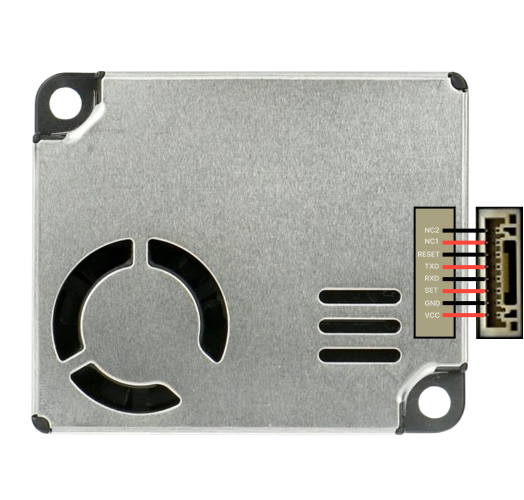
 Design with PLANTOWER PMS7003 Gas Sensor in Cirkit Designer
Introduction
The PLANTOWER PMS7003 is a high-precision laser-based air quality sensor designed to measure particulate matter (PM) concentrations in the air. It can detect PM1.0, PM2.5, and PM10 particles, providing real-time data on air pollution levels. The sensor uses laser scattering technology to achieve accurate and reliable measurements, making it ideal for applications such as indoor air quality monitoring, outdoor environmental monitoring, air purifiers, HVAC systems, and IoT-based air quality solutions.
Explore Projects Built with PLANTOWER PMS7003 Gas Sensor
 Open Project in Cirkit Designer
 Open Project in Cirkit Designer
 Open Project in Cirkit Designer
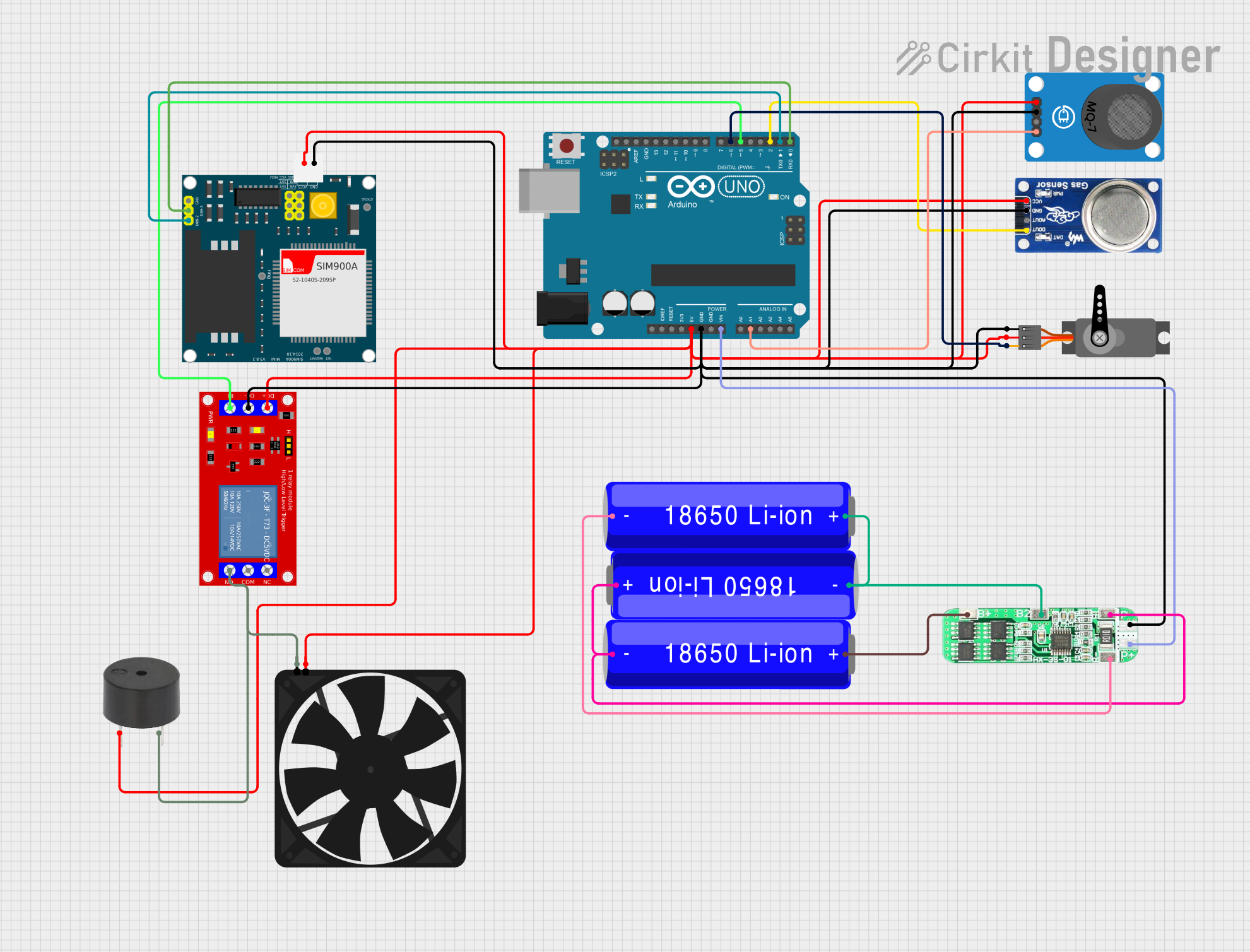 Open Project in Cirkit Designer
Explore Projects Built with PLANTOWER PMS7003 Gas Sensor
Open Project in Cirkit DesignerOpen Project in Cirkit DesignerOpen Project in Cirkit DesignerOpen Project in Cirkit DesignerTechnical Specifications
The following table outlines the key technical specifications of the PMS7003 sensor:
| Parameter | Value |
|---|---|
| Manufacturer | Plantower |
| Part Number | PMS7003 |
| Measurement Range | 0.3 µm to 10 µm (particle size) |
| PM Concentration Range | 0 to 1,000 µg/m³ |
| Accuracy | ±10% (standard particles) |
| Response Time | ≤ 1 second |
| Operating Voltage | 4.5V to 5.5V |
| Operating Current | ≤ 100mA |
| Interface | UART (3.3V TTL) |
| Operating Temperature | -10°C to 60°C |
| Operating Humidity | 0% to 99% RH (non-condensing) |
| Dimensions | 50mm x 38mm x 21mm |
| Weight | ~50g |
Pin Configuration and Descriptions
The PMS7003 sensor has an 8-pin connector. The pin configuration and descriptions are as follows:
| Pin Number | Pin Name | Description |
|---|---|---|
| 1 | VCC | Power supply input (4.5V to 5.5V) |
| 2 | GND | Ground |
| 3 | SET | Sleep mode control (Low: Sleep, High: Active) |
| 4 | RX | UART Receive (3.3V TTL) |
| 5 | TX | UART Transmit (3.3V TTL) |
| 6 | RESET | Reset signal (Low: Reset, High: Normal operation) |
| 7 | NC | Not connected |
| 8 | NC | Not connected |
Usage Instructions
How to Use the PMS7003 in a Circuit
- Power Supply: Connect the VCC pin to a 5V power source and the GND pin to ground.
- UART Communication: Connect the RX and TX pins to a microcontroller or UART interface. Ensure the UART logic level is 3.3V to avoid damaging the sensor.
- Sleep Mode: Use the SET pin to control the sensor's sleep mode. Pull the pin low to put the sensor in sleep mode and high to activate it.
- Reset: Use the RESET pin to reset the sensor if needed. Pull the pin low momentarily to reset the sensor.
Important Considerations and Best Practices
- Placement: Install the sensor in a location with good airflow for accurate measurements. Avoid placing it near sources of high humidity or condensation.
- Power Stability: Use a stable power supply to prevent measurement errors.
- UART Configuration: Set the UART baud rate to 9600 bps for communication with the sensor.
- Data Parsing: The sensor outputs data in a fixed 32-byte frame format. Ensure your microcontroller or software can parse this format correctly.
Example Code for Arduino UNO
Below is an example of how to interface the PMS7003 with an Arduino UNO:
#include <SoftwareSerial.h>

// Define RX and TX pins for SoftwareSerial
SoftwareSerial pms7003Serial(10, 11); // RX = Pin 10, TX = Pin 11

// Buffer to store incoming data
uint8_t dataBuffer[32];

void setup() {
  Serial.begin(9600); // Initialize Serial Monitor
  pms7003Serial.begin(9600); // Initialize PMS7003 UART communication

  Serial.println("PMS7003 Sensor Initialization...");
}

void loop() {
  if (pms7003Serial.available() >= 32) {
    // Read 32 bytes of data from the sensor
    for (int i = 0; i < 32; i++) {
      dataBuffer[i] = pms7003Serial.read();
    }

    // Validate the data frame (check start and checksum)
    if (dataBuffer[0] == 0x42 && dataBuffer[1] == 0x4D) {
      uint16_t pm1_0 = (dataBuffer[10] << 8) | dataBuffer[11];
      uint16_t pm2_5 = (dataBuffer[12] << 8) | dataBuffer[13];
      uint16_t pm10 = (dataBuffer[14] << 8) | dataBuffer[15];

      // Print PM values to Serial Monitor
      Serial.print("PM1.0: ");
      Serial.print(pm1_0);
      Serial.print(" µg/m³, PM2.5: ");
      Serial.print(pm2_5);
      Serial.print(" µg/m³, PM10: ");
      Serial.print(pm10);
      Serial.println(" µg/m³");
    }
  }
}
Notes:
- Use a level shifter if your microcontroller operates at 5V logic levels.
- Ensure the sensor is powered on and in active mode before reading data.
Troubleshooting and FAQs
Common Issues and Solutions
No Data Output:
- Ensure the sensor is powered correctly (4.5V to 5.5V).
- Verify the UART connections (RX and TX) and baud rate (9600 bps).
- Check if the SET pin is set to high (active mode).
Incorrect or Fluctuating Readings:
- Ensure the sensor is placed in a stable environment with good airflow.
- Avoid placing the sensor near high humidity or condensation sources.
- Use a stable power supply to prevent voltage fluctuations.
Sensor Not Responding:
- Check the RESET pin. Ensure it is not held low.
- Verify the wiring and connections for any loose or incorrect connections.
FAQs
Q1: Can the PMS7003 detect gases like CO2 or VOCs?
A1: No, the PMS7003 is designed to measure particulate matter (PM1.0, PM2.5, PM10) and does not detect gases like CO2 or VOCs.
Q2: How often should the sensor be calibrated?
A2: The PMS7003 is factory-calibrated and does not require user calibration. However, periodic cleaning of the air inlet and outlet may help maintain accuracy.
Q3: Can the sensor operate outdoors?
A3: Yes, but it should be protected from direct exposure to rain, high humidity, and extreme temperatures.
Q4: What is the lifespan of the PMS7003 sensor?
A4: The sensor has an estimated lifespan of 3 years under normal operating conditions.