
How to Use Raspberry Pi 5: Examples, Pinouts, and Specs
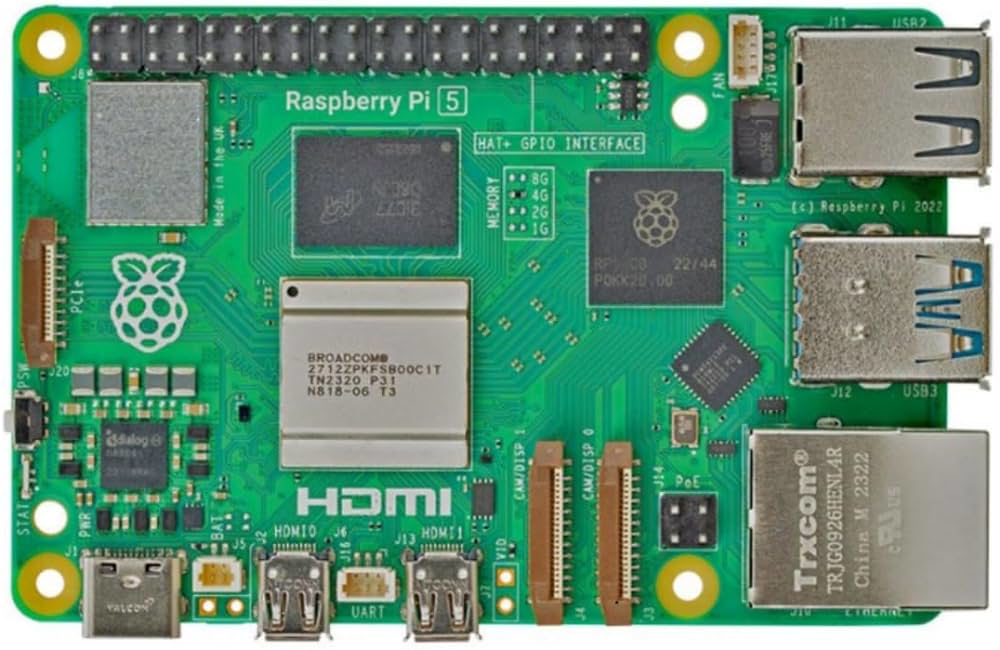
 Design with Raspberry Pi 5 in Cirkit Designer
Introduction
The Raspberry Pi 5, manufactured by Raspberry, is a compact and affordable single-board computer designed for a wide range of applications. It features a powerful quad-core processor, multiple USB ports, HDMI output, and GPIO pins, making it a versatile tool for programming, robotics, IoT, and other electronic projects. Its small form factor and robust capabilities make it an excellent choice for both beginners and experienced developers.
Explore Projects Built with Raspberry Pi 5
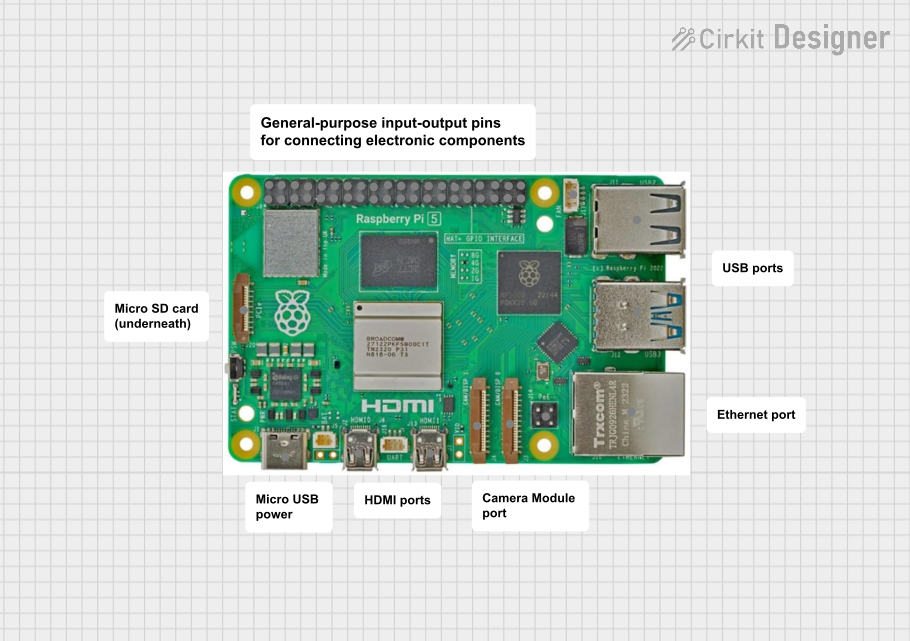 Open Project in Cirkit Designer
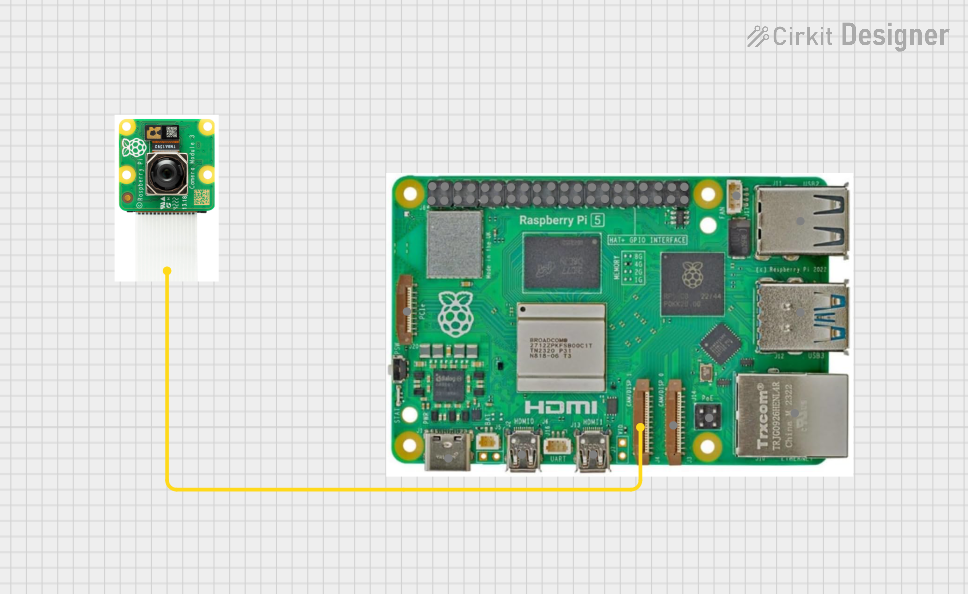 Open Project in Cirkit Designer
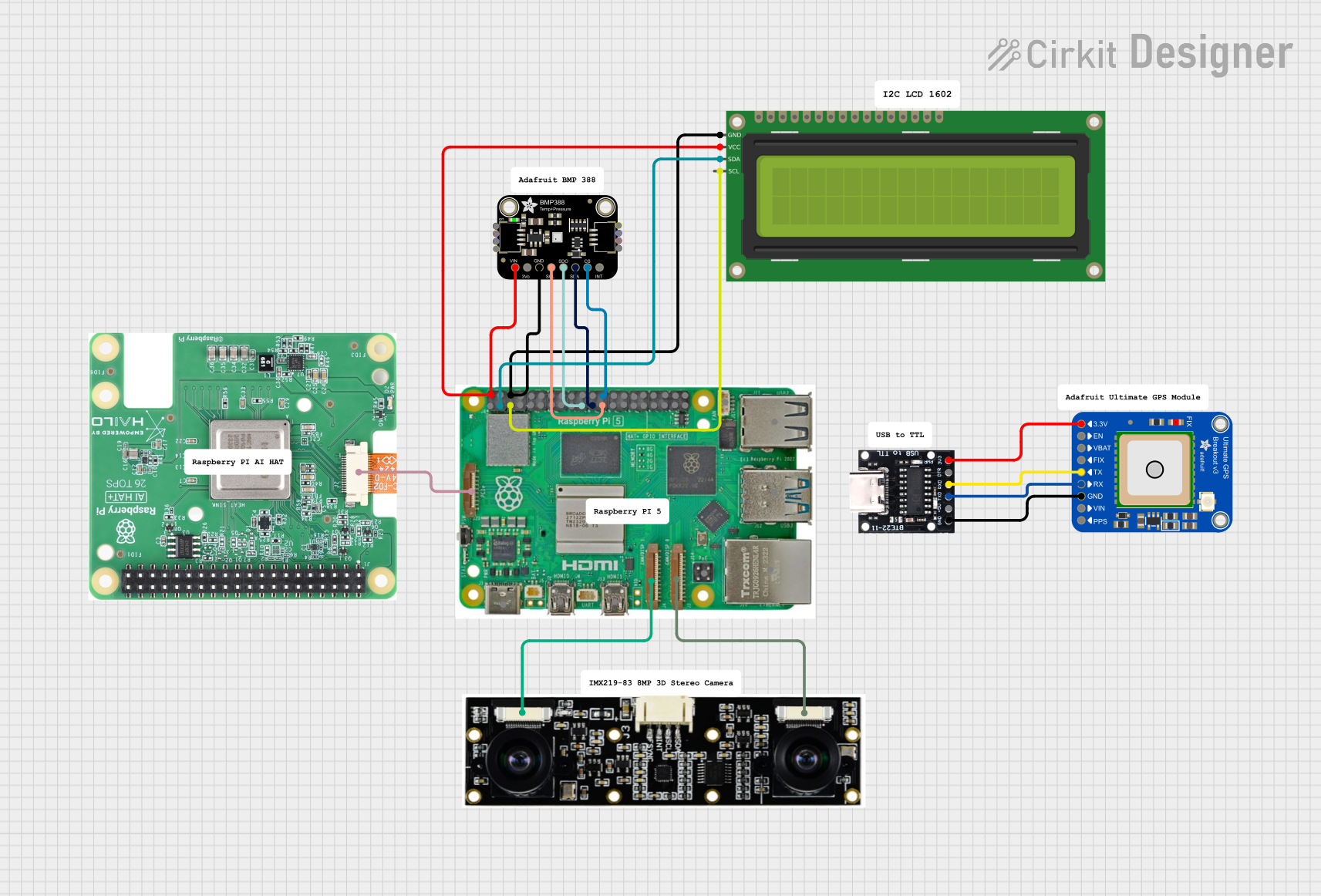 Open Project in Cirkit Designer
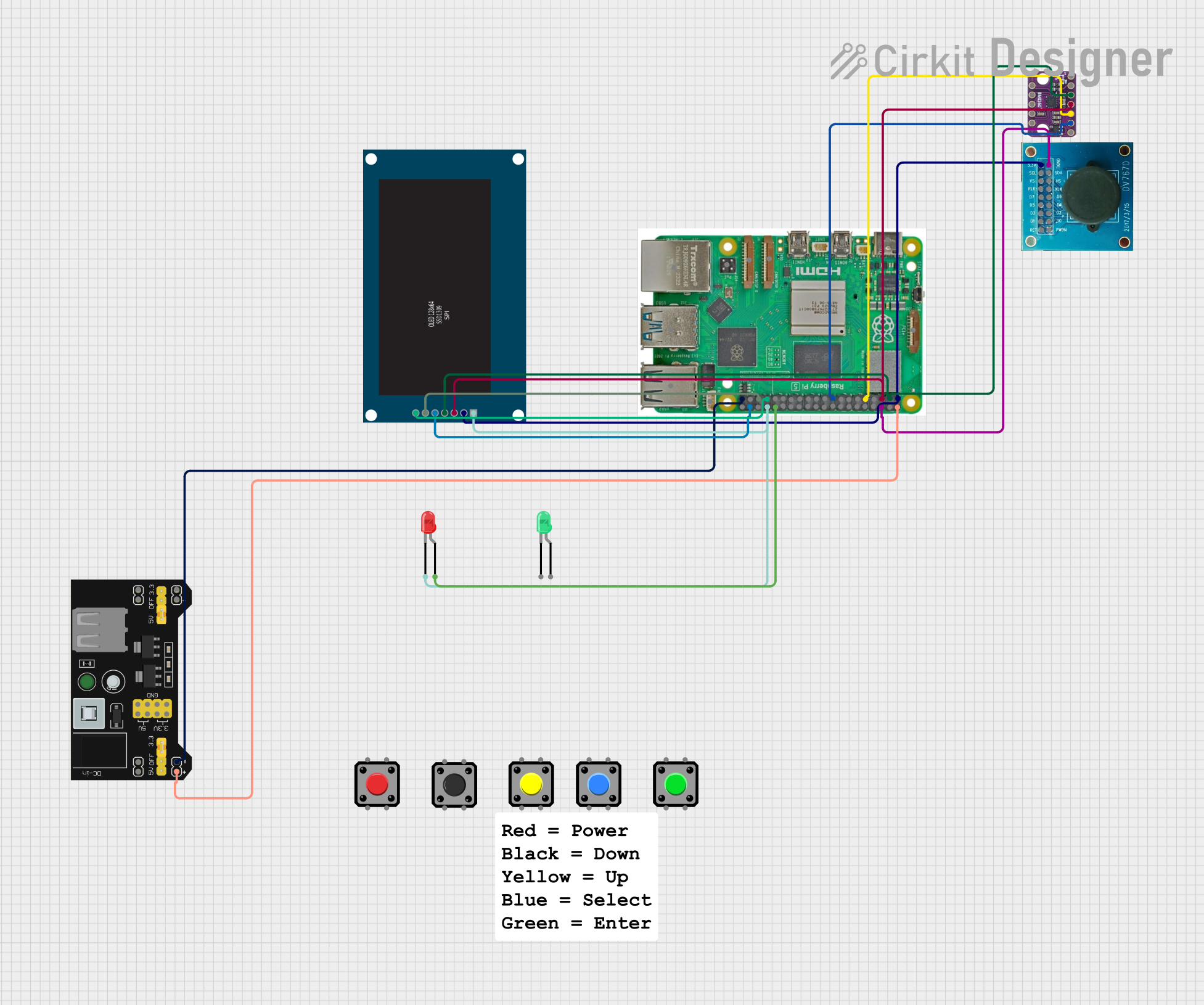 Open Project in Cirkit Designer
Explore Projects Built with Raspberry Pi 5
Open Project in Cirkit DesignerOpen Project in Cirkit DesignerOpen Project in Cirkit DesignerOpen Project in Cirkit DesignerCommon Applications and Use Cases
- Programming and Education: Ideal for learning programming languages like Python, C++, and Java.
- IoT Projects: Acts as a hub for smart home devices and IoT systems.
- Robotics: Controls motors, sensors, and other robotic components.
- Media Center: Streams videos and music using software like Kodi.
- Prototyping: Interfaces with sensors, actuators, and other hardware for rapid prototyping.
- Edge Computing: Performs lightweight data processing at the edge of networks.
Technical Specifications
The Raspberry Pi 5 is packed with features that make it a powerful and flexible platform for various applications. Below are its key technical specifications:
General Specifications
| Feature | Specification |
|---|---|
| Processor | Quad-core ARM Cortex-A76, 2.4 GHz |
| RAM | 4GB or 8GB LPDDR4 |
| Storage | MicroSD card slot, support for external SSDs |
| Connectivity | Gigabit Ethernet, Wi-Fi 6, Bluetooth 5.2 |
| USB Ports | 2x USB 3.0, 2x USB 2.0 |
| Video Output | 2x Micro HDMI (4K@60Hz) |
| GPIO Pins | 40-pin header |
| Power Supply | USB-C, 5V/3A |
| Dimensions | 85.6mm x 56.5mm x 17mm |
GPIO Pin Configuration
The Raspberry Pi 5 features a 40-pin GPIO header for interfacing with external components. Below is the pinout:
| Pin Number | Pin Name | Description |
|---|---|---|
| 1 | 3.3V Power | 3.3V power supply |
| 2 | 5V Power | 5V power supply |
| 3 | GPIO2 (SDA1) | I2C Data |
| 4 | 5V Power | 5V power supply |
| 5 | GPIO3 (SCL1) | I2C Clock |
| 6 | Ground | Ground |
| 7 | GPIO4 | General-purpose I/O |
| 8 | GPIO14 (TXD) | UART Transmit |
| 9 | Ground | Ground |
| 10 | GPIO15 (RXD) | UART Receive |
| ... | ... | ... (Refer to official documentation for full pinout) |
Usage Instructions
How to Use the Raspberry Pi 5 in a Circuit
Powering the Raspberry Pi 5:
- Use a USB-C power adapter that provides 5V/3A for stable operation.
- Ensure the power supply is reliable to avoid voltage drops.
Connecting Peripherals:
- Attach a monitor via the Micro HDMI ports.
- Connect a keyboard and mouse to the USB ports.
- Insert a microSD card with the Raspberry Pi OS or other compatible operating systems.
Using GPIO Pins:
- Use the GPIO pins to interface with sensors, LEDs, motors, and other components.
- Be cautious about voltage levels; GPIO pins operate at 3.3V.
Networking:
- Connect to the internet via Ethernet or Wi-Fi for software updates and remote access.
Important Considerations and Best Practices
- Static Protection: Handle the board with care to avoid static discharge damage.
- Cooling: Use a heatsink or fan for cooling during intensive tasks.
- Software Updates: Regularly update the operating system and firmware for optimal performance.
- Voltage Levels: Avoid applying more than 3.3V to GPIO pins to prevent damage.
Example: Blinking an LED with GPIO and Arduino UNO
The Raspberry Pi 5 can control an LED using its GPIO pins. Below is an example Python script:
Import the GPIO library
import RPi.GPIO as GPIO import time
Set the GPIO mode to BCM (Broadcom pin numbering)
GPIO.setmode(GPIO.BCM)
Define the GPIO pin connected to the LED
LED_PIN = 18
Set up the LED pin as an output
GPIO.setup(LED_PIN, GPIO.OUT)
Blink the LED in a loop
try: while True: GPIO.output(LED_PIN, GPIO.HIGH) # Turn the LED on time.sleep(1) # Wait for 1 second GPIO.output(LED_PIN, GPIO.LOW) # Turn the LED off time.sleep(1) # Wait for 1 second except KeyboardInterrupt: # Clean up GPIO settings on exit GPIO.cleanup()
Troubleshooting and FAQs
Common Issues and Solutions
The Raspberry Pi 5 does not boot:
- Ensure the microSD card is properly inserted and contains a valid OS image.
- Check the power supply for sufficient voltage and current.
No display on the monitor:
- Verify the HDMI cable connection and ensure the monitor is powered on.
- Check the Raspberry Pi's configuration file (
config.txt) for display settings.
GPIO pins not working:
- Confirm the correct pin numbering (BCM vs. physical pin numbers).
- Check for software errors in the GPIO library or script.
Overheating:
- Install a heatsink or fan to improve cooling.
- Avoid running intensive tasks for extended periods without proper ventilation.
FAQs
Can I use the Raspberry Pi 5 with an external SSD? Yes, the Raspberry Pi 5 supports external SSDs via USB 3.0 for faster storage.
What operating systems are compatible with the Raspberry Pi 5? The Raspberry Pi 5 supports Raspberry Pi OS, Ubuntu, and other Linux-based distributions.
How do I reset the Raspberry Pi 5? Power cycle the board by disconnecting and reconnecting the power supply.
Can I power the Raspberry Pi 5 via GPIO pins? Yes, you can power it via the 5V and GND pins, but ensure a stable 5V supply.
This documentation provides a comprehensive guide to using the Raspberry Pi 5 effectively. For further details, refer to the official Raspberry documentation.