The Adafruit AMG8833 IR Camera FeatherWing is a sophisticated thermal imaging add-on for hobbyists and professionals alike. It utilizes an 8x8 grid of IR thermal sensors to detect heat and represent it as a visual image. This module is particularly useful in applications such as human presence detection, temperature measurement in electronics, or even creating your own thermal camera.
Explore Projects Built with Adafruit AMG8833 IR Camera FeatherWing
Use Cirkit Designer to design, explore, and prototype these projects online. Some projects support real-time simulation. Click "Open Project" to start designing instantly!
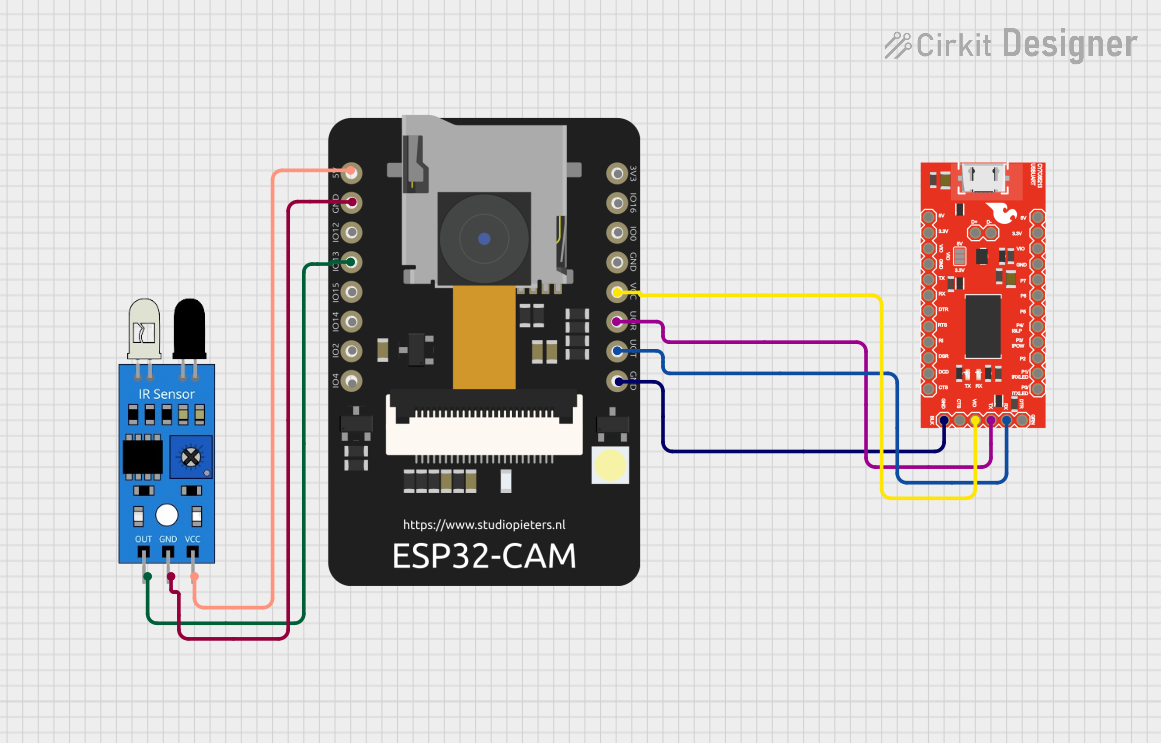
This circuit features an ESP32 CAM module interfaced with an IR sensor and a SparkFun USB UART Breakout board. The ESP32 CAM provides power to the IR sensor and receives its output signal, likely for processing or triggering camera actions based on IR detection. The USB UART Breakout board is connected to the ESP32 CAM for serial communication, enabling programming, debugging, or data exchange with a computer.
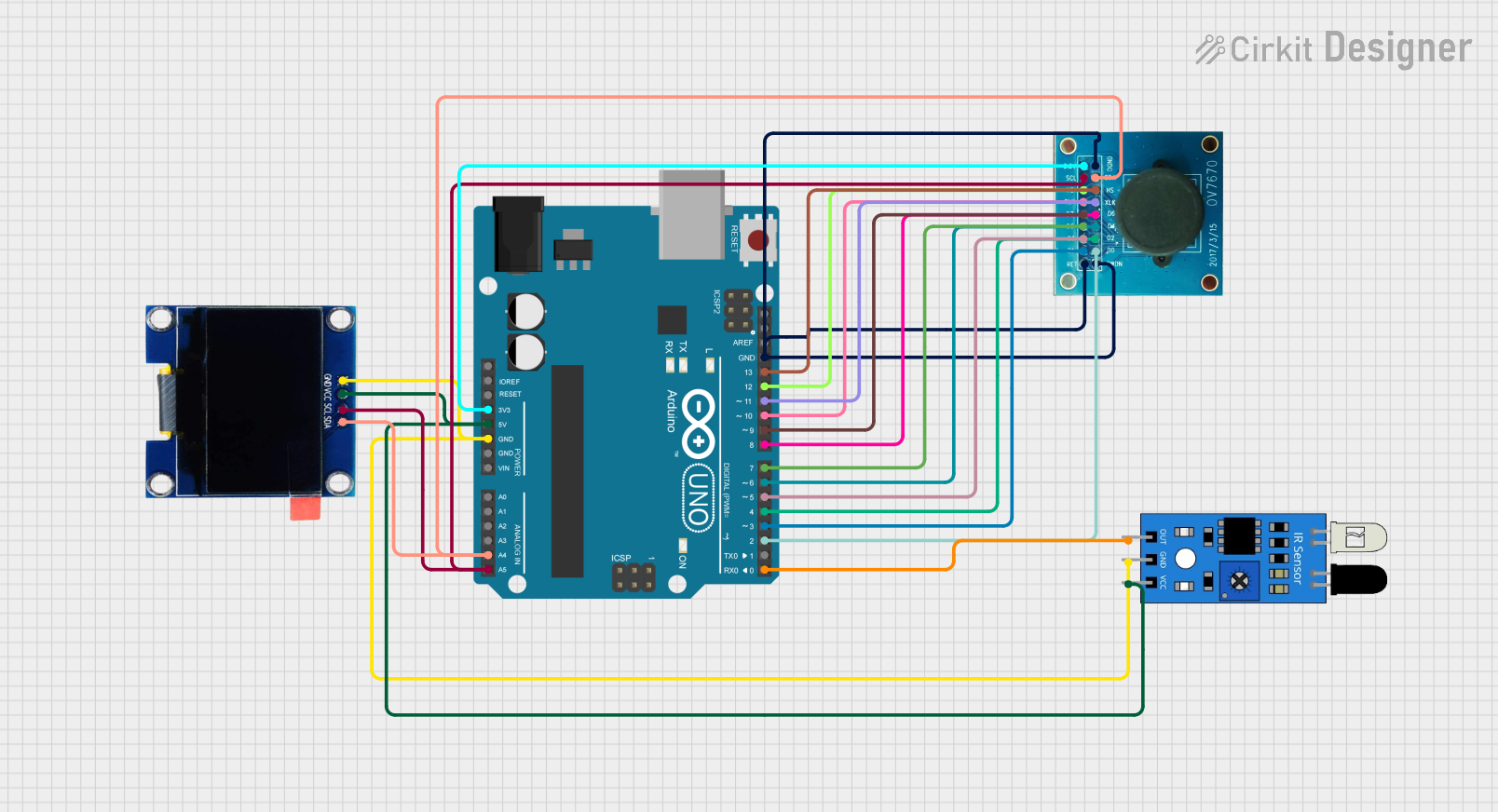
This circuit features an Arduino UNO microcontroller interfaced with an OLED display, an OV7670 camera module, and an IR sensor. The Arduino manages image capture from the OV7670 when the IR sensor detects an object, and then displays the image on the OLED screen. The Arduino's digital and analog pins are used to control the camera and communicate with the OLED via I2C, while the IR sensor output is connected to one of the Arduino's digital pins.
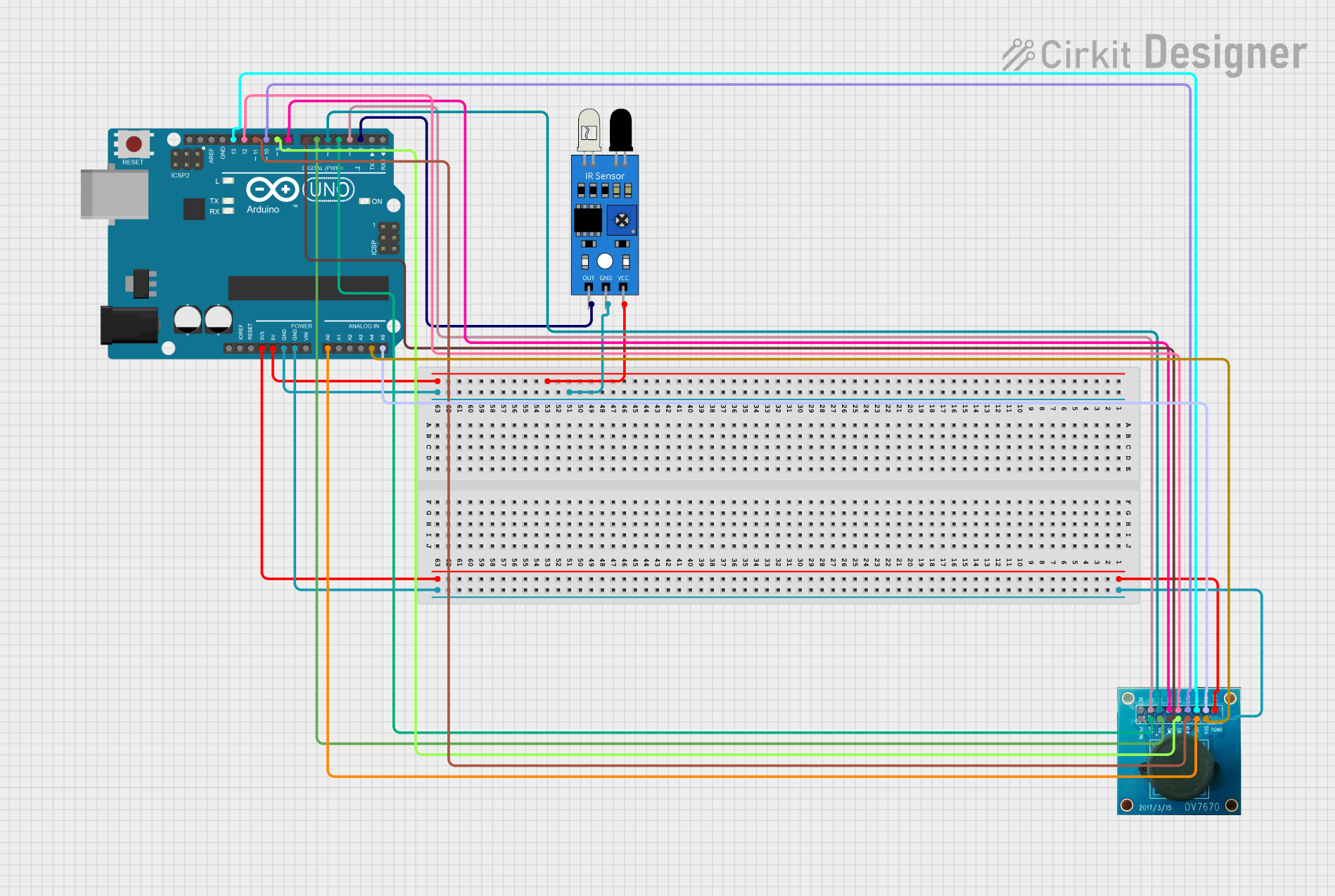
This circuit integrates an Arduino UNO with an OV7670 camera module and an IR sensor. The Arduino is configured to communicate with the OV7670 via digital pins for data transfer and control signals, and with the IR sensor via one of its digital pins to receive detection signals. The camera module and IR sensor are powered by the Arduino's 3.3V and 5V outputs, respectively, and share a common ground.
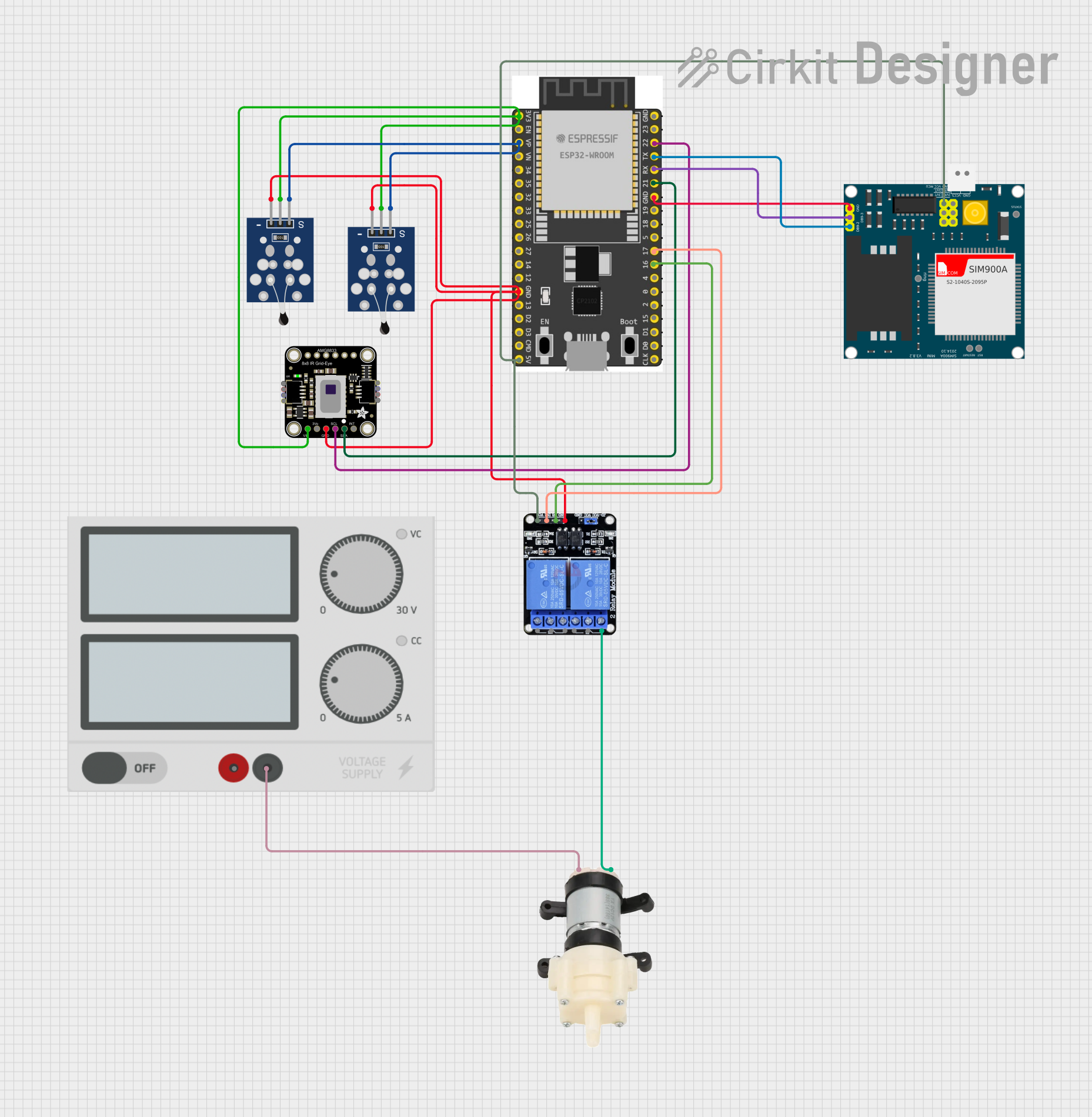
This circuit features an ESP32 microcontroller that interfaces with an Adafruit AMG8833 infrared thermal camera and two NTC analog temperature sensors for temperature monitoring. The ESP32 also communicates with a SIM900A module for cellular connectivity and controls a two-channel relay, which in turn operates a mini diaphragm water pump. The purpose of the circuit is likely for remote temperature monitoring and control of a water pump, possibly for applications like smart irrigation or climate control.
Temperature monitoring for system cooling or environmental data
Thermal imaging for night vision or heat leakage detection
Interactive art installations
Robotics for object detection or navigation
Technical Specifications
Key Technical Details
Sensor Array: 8x8 (64) IR sensor grid
Temperature Range: -20°C to 100°C
Frame Rate: 1 to 10 Hz
Interface: I2C
Operating Voltage: 3V to 5V
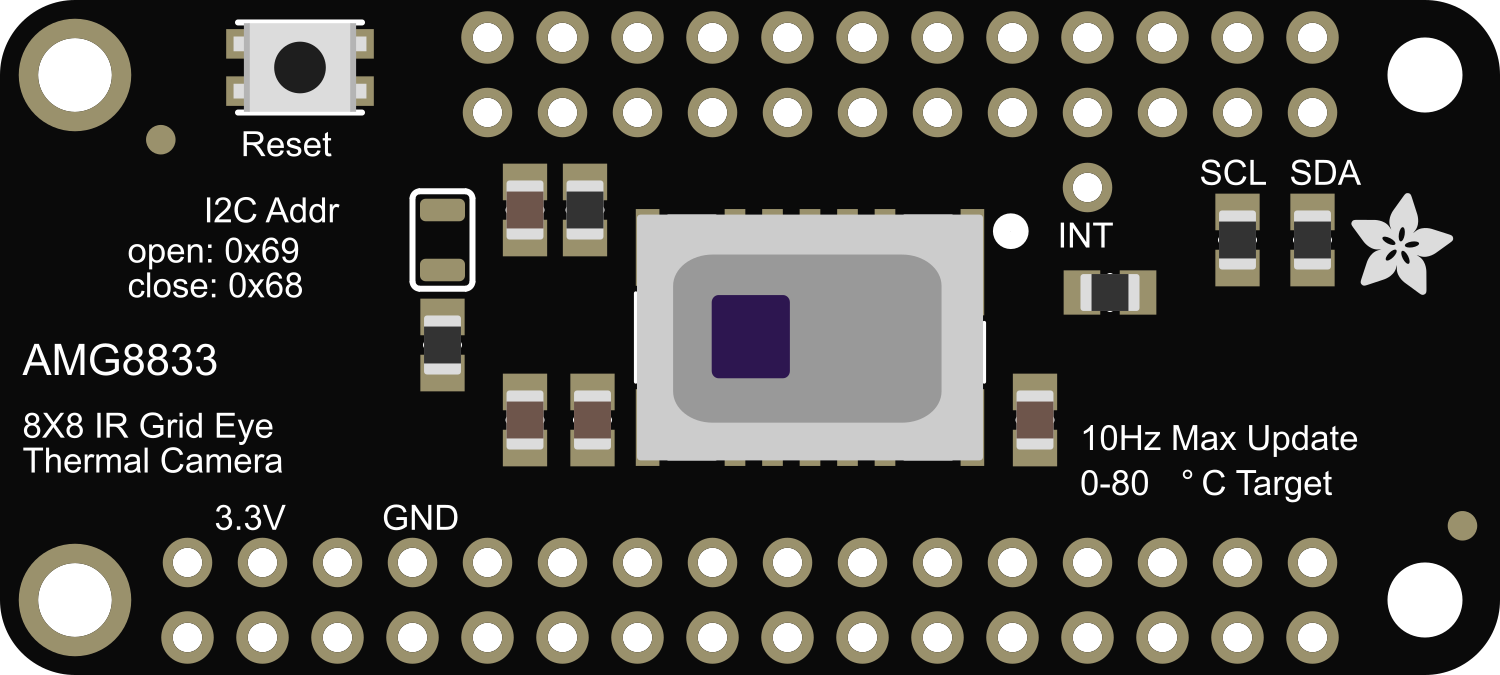
Pin Configuration and Descriptions
Pin
Description
VCC
Power supply (3V to 5V)
GND
Ground connection
SDA
I2C data line
SCL
I2C clock line
INT
Interrupt pin (optional use)
Usage Instructions
Integration with a Circuit
To use the AMG8833 FeatherWing with a microcontroller like the Arduino UNO, follow these steps:
Connect VCC to the 3.3V output on the Arduino.
Connect GND to a ground pin on the Arduino.
Connect SDA and SCL to the corresponding I2C pins on the Arduino (A4 and A5 on the UNO).
(Optional) Connect the INT pin to a digital pin if you plan to use the interrupt feature.
Important Considerations and Best Practices
Ensure that the power supply is within the specified range (3V to 5V).
Use pull-up resistors on the I2C lines if they are not included in your microcontroller board.
Avoid exposing the sensor to direct sunlight or strong infrared sources to prevent damage.
For accurate temperature readings, allow the sensor to acclimate to its environment before use.
Example Code for Arduino UNO
#include <Wire.h>
#include <Adafruit_AMG88xx.h>

Adafruit_AMG88xx amg;

void setup() {
  Serial.begin(9600);
  Serial.println(F("AMG8833 IR Camera FeatherWing"));

  bool status = amg.begin();
  if (!status) {
    Serial.println("Could not find a valid AMG8833 sensor, check wiring!");
    while (1);
  }

  // Wait for the sensor to stabilize
  delay(100);
}

void loop() {
  // Read the pixels from the sensor
  float pixels[AMG88xx_PIXEL_ARRAY_SIZE];
  amg.readPixels(pixels);

  Serial.println("Pixel Temperatures (C):");
  for(int i = 1; i <= AMG88xx_PIXEL_ARRAY_SIZE; i++){
    Serial.print(pixels[i-1]);
    Serial.print(", ");
    if( i % 8 == 0 ) Serial.println();
  }
  Serial.println();

  // Delay between readings
  delay(1000);
}
Troubleshooting and FAQs
Common Issues
Sensor not detected: Check the wiring, ensure that the SDA and SCL lines are connected properly, and that the correct voltage is applied.
Inaccurate temperature readings: Make sure the sensor has had time to acclimate to the ambient temperature. Avoid placing the sensor near heat sources or in direct sunlight.
Solutions and Tips for Troubleshooting
If the sensor is not responding, try resetting the power to the module.
Ensure that the I2C address of the sensor does not conflict with other devices on the I2C bus.
Use the interrupt pin to detect rapid temperature changes without polling the sensor continuously.
FAQs
Q: Can I connect multiple AMG8833 sensors to one microcontroller?
A: Yes, you can connect multiple sensors using different I2C addresses or separate I2C buses if your microcontroller supports this.
Q: How can I visualize the thermal data?
A: You can send the pixel data to a computer and use processing software to create a heatmap, or use an OLED/LCD display connected to your microcontroller to show the data in real-time.
Q: Is calibration required for the sensor?
A: The sensor comes factory-calibrated, but for precise applications, you may need to perform additional calibration against known temperature references.

 Open Project in Cirkit Designer