
How to Use Servo: Examples, Pinouts, and Specs
 Design with Servo in Cirkit Designer
Introduction
A servo is a rotary actuator that allows for precise control of angular position, velocity, and acceleration. It consists of a motor coupled to a sensor for position feedback, along with a control circuit. Servos are widely used in robotics, automation, remote-controlled vehicles, and industrial machinery due to their ability to provide accurate and repeatable motion.
Explore Projects Built with Servo
 Open Project in Cirkit Designer
 Open Project in Cirkit Designer
 Open Project in Cirkit Designer
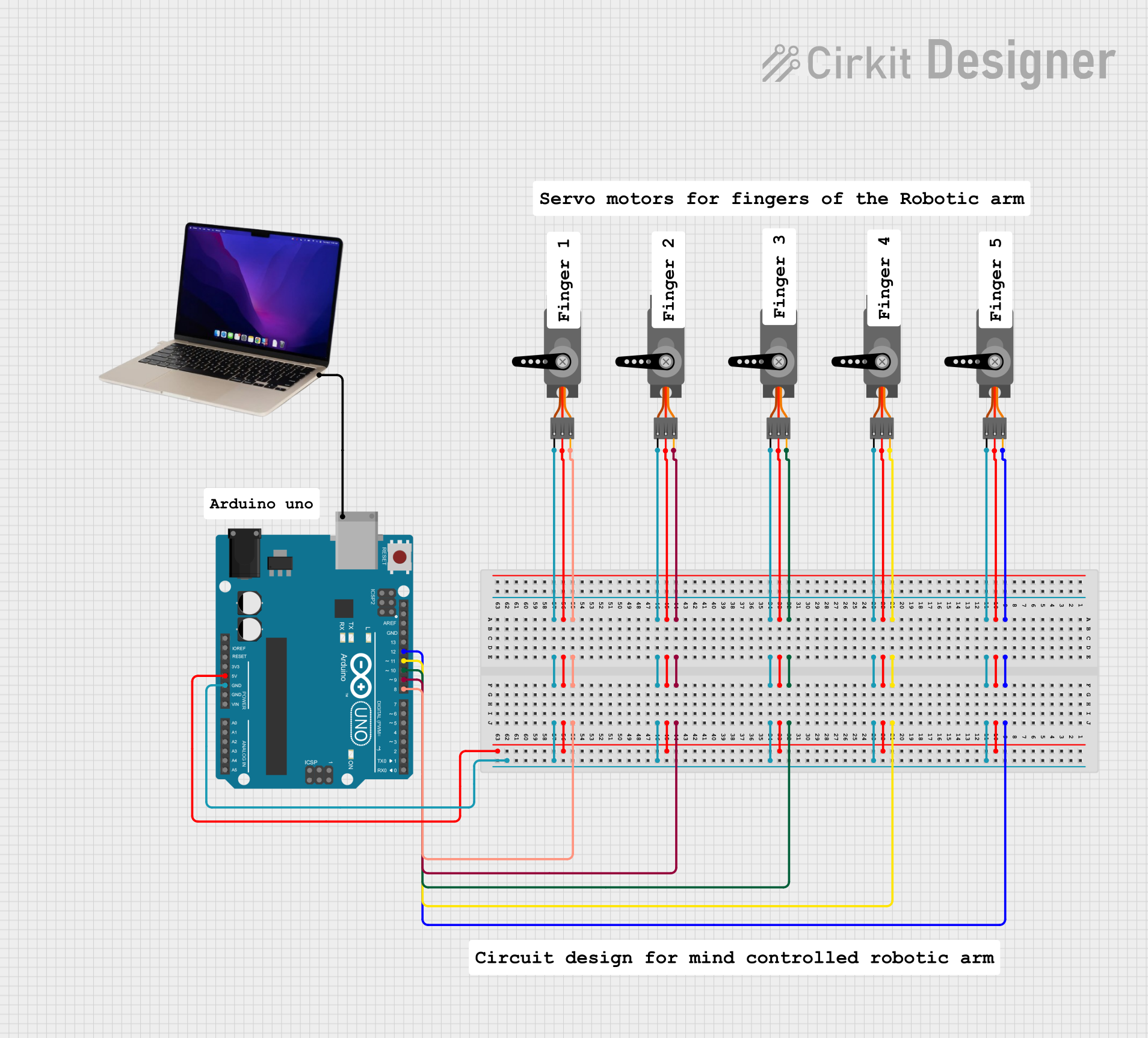 Open Project in Cirkit Designer
Explore Projects Built with Servo
Open Project in Cirkit DesignerOpen Project in Cirkit DesignerOpen Project in Cirkit DesignerOpen Project in Cirkit DesignerCommon Applications and Use Cases
- Robotics: Controlling robotic arms, grippers, and joints.
- RC Vehicles: Steering and throttle control in remote-controlled cars, boats, and planes.
- Automation: Positioning systems in conveyor belts and manufacturing equipment.
- DIY Projects: Automated doors, camera gimbals, and hobbyist creations.
- Aerospace: Flight control surfaces in model aircraft.
Technical Specifications
Below are the general technical specifications for a standard hobby servo. Note that specific models may vary slightly.
Key Technical Details
- Operating Voltage: 4.8V to 6.0V (typical range)
- Torque: 1.5 kg-cm to 20 kg-cm (varies by model)
- Speed: 0.1 to 0.2 seconds per 60° (at 6.0V)
- Control Signal: Pulse Width Modulation (PWM)
- Angle Range: 0° to 180° (standard), some models support 360° rotation
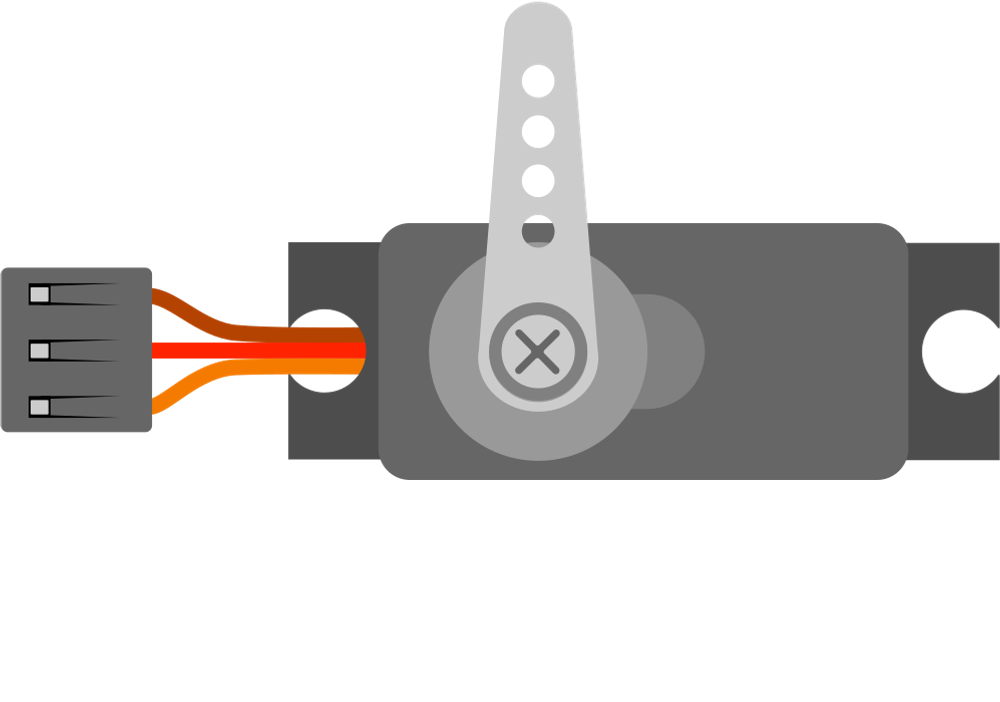
- Connector: 3-pin (Signal, VCC, GND)
Pin Configuration and Descriptions
The servo typically has a 3-pin connector with the following pinout:
| Pin Number | Name | Description |
|---|---|---|
| 1 | Signal | Receives PWM signal for position control |
| 2 | VCC | Power supply (4.8V to 6.0V) |
| 3 | GND | Ground connection |
Usage Instructions
How to Use the Servo in a Circuit
Connect the Servo:
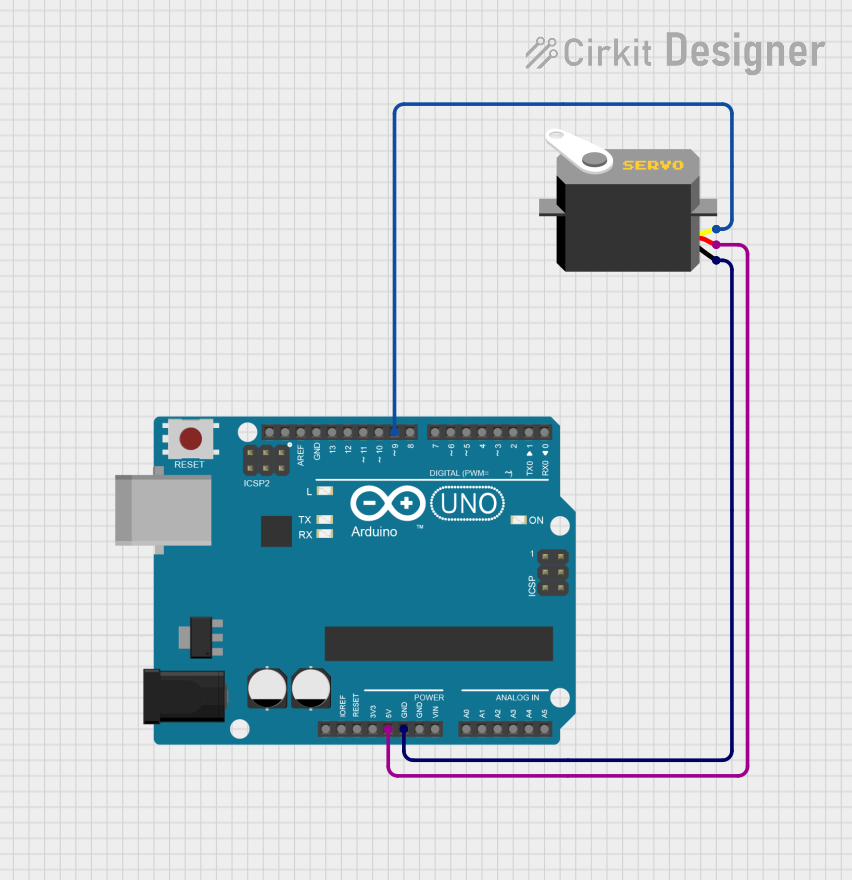
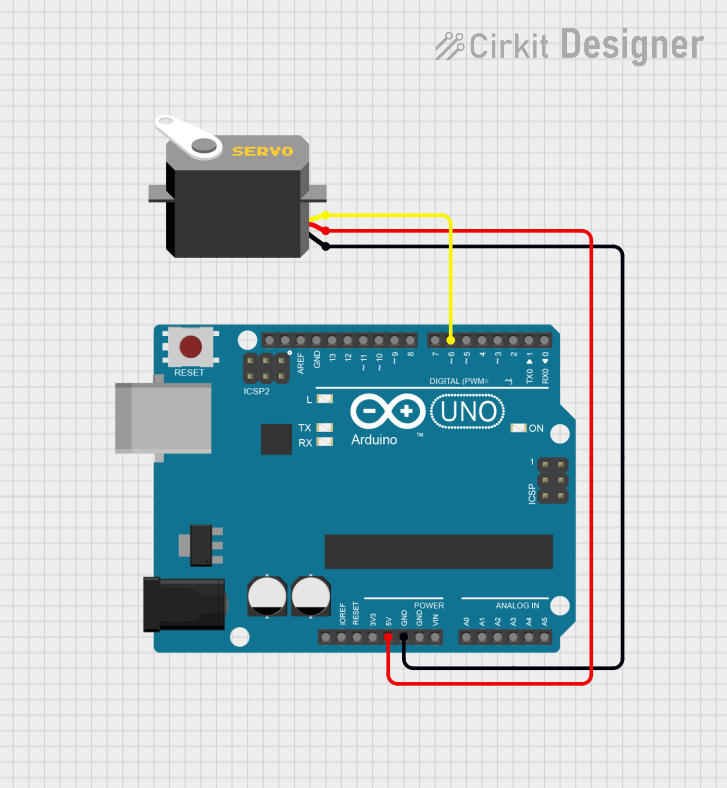
- Connect the Signal pin to a PWM-capable pin on your microcontroller (e.g., Arduino).
- Connect the VCC pin to a 5V power source.
- Connect the GND pin to the ground of your circuit.
Generate PWM Signal:
- Use a microcontroller to generate a PWM signal. The pulse width determines the servo's position:
- 1 ms pulse: 0° position
- 1.5 ms pulse: 90° position (center)
- 2 ms pulse: 180° position
- Use a microcontroller to generate a PWM signal. The pulse width determines the servo's position:
Power Considerations:
- Ensure the power supply can handle the servo's current draw, especially under load.
- For high-torque servos, use an external power source instead of relying on the microcontroller's 5V pin.
Example Code for Arduino UNO
Below is an example of how to control a servo using an Arduino UNO and the Servo library:
#include <Servo.h> // Include the Servo library

Servo myServo; // Create a Servo object to control the servo

void setup() {
  myServo.attach(9); // Attach the servo to pin 9 on the Arduino
}

void loop() {
  myServo.write(0); // Move the servo to 0 degrees
  delay(1000);      // Wait for 1 second

  myServo.write(90); // Move the servo to 90 degrees (center position)
  delay(1000);       // Wait for 1 second

  myServo.write(180); // Move the servo to 180 degrees
  delay(1000);        // Wait for 1 second
}
Important Considerations and Best Practices
- Avoid Overloading: Do not exceed the servo's torque rating to prevent damage.
- Stable Power Supply: Use a capacitor or external power source to avoid voltage drops.
- PWM Accuracy: Ensure the microcontroller generates accurate PWM signals for smooth operation.
- Mechanical Limits: Avoid forcing the servo beyond its physical range to prevent damage.
Troubleshooting and FAQs
Common Issues and Solutions
Servo Not Moving:
- Cause: Incorrect wiring or insufficient power.
- Solution: Double-check connections and ensure the power supply meets the servo's requirements.
Jittery or Erratic Movement:
- Cause: Noise in the PWM signal or unstable power supply.
- Solution: Use a decoupling capacitor near the servo and ensure a clean PWM signal.
Overheating:
- Cause: Prolonged operation under high load or stalled motor.
- Solution: Reduce the load or use a higher-torque servo.
Servo Not Centering Properly:
- Cause: Calibration issue or incorrect PWM signal.
- Solution: Verify the PWM pulse width and recalibrate if necessary.
FAQs
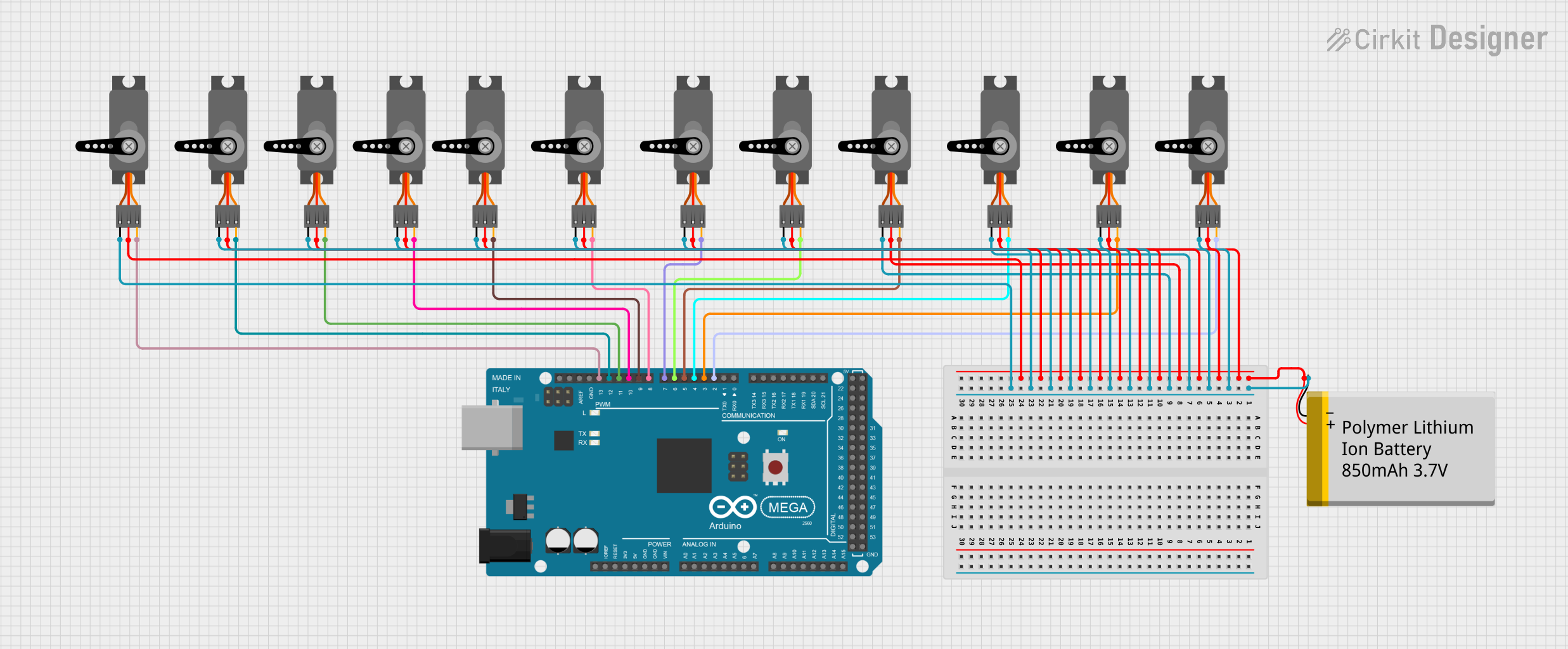
Can I control multiple servos with one Arduino? Yes, you can control multiple servos using different PWM-capable pins. Use the Servo library to manage multiple servos.
What happens if I exceed the servo's voltage rating? Exceeding the voltage rating can damage the servo's internal components. Always stay within the specified range.
Can I use a servo for continuous rotation? Some servos are designed for continuous rotation. These are modified to interpret PWM signals as speed and direction rather than position.
Why does my servo make a buzzing noise? A buzzing noise indicates the servo is under load or struggling to maintain its position. Check for mechanical obstructions or excessive torque requirements.