Cirkit Designer Logo
Cirkit Designer
Your all-in-one circuit design IDE
Home / 
Component Documentation

How to Use SparkFun Soil Moisture Sensor: Examples, Pinouts, and Specs
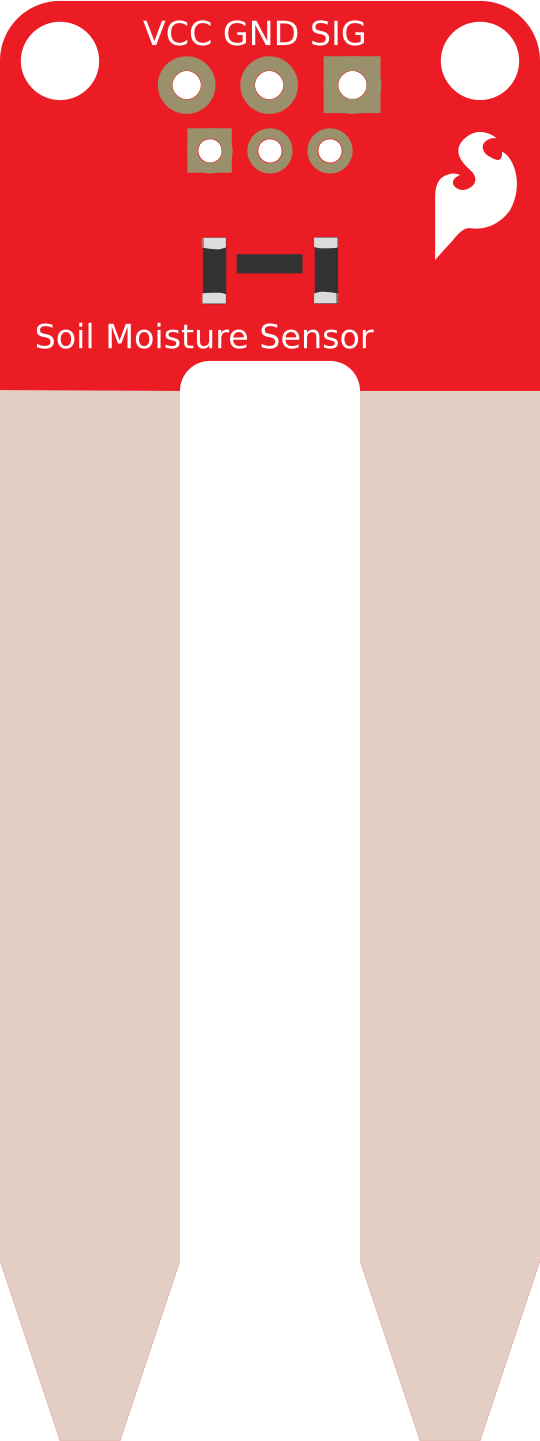

Image of SparkFun Soil Moisture Sensor
Cirkit Designer LogoDesign with SparkFun Soil Moisture Sensor in Cirkit Designer

Introduction

The SparkFun Soil Moisture Sensor is a device designed to measure the volumetric water content in soil. It provides an analog output that corresponds to the moisture level, making it an essential tool for applications such as precision agriculture, gardening automation, and environmental monitoring. By integrating this sensor into your projects, you can monitor soil conditions and optimize irrigation systems to conserve water and improve plant health.

Explore Projects Built with SparkFun Soil Moisture Sensor
Use Cirkit Designer to design, explore, and prototype these projects online. Some projects support real-time simulation. Click "Open Project" to start designing instantly!
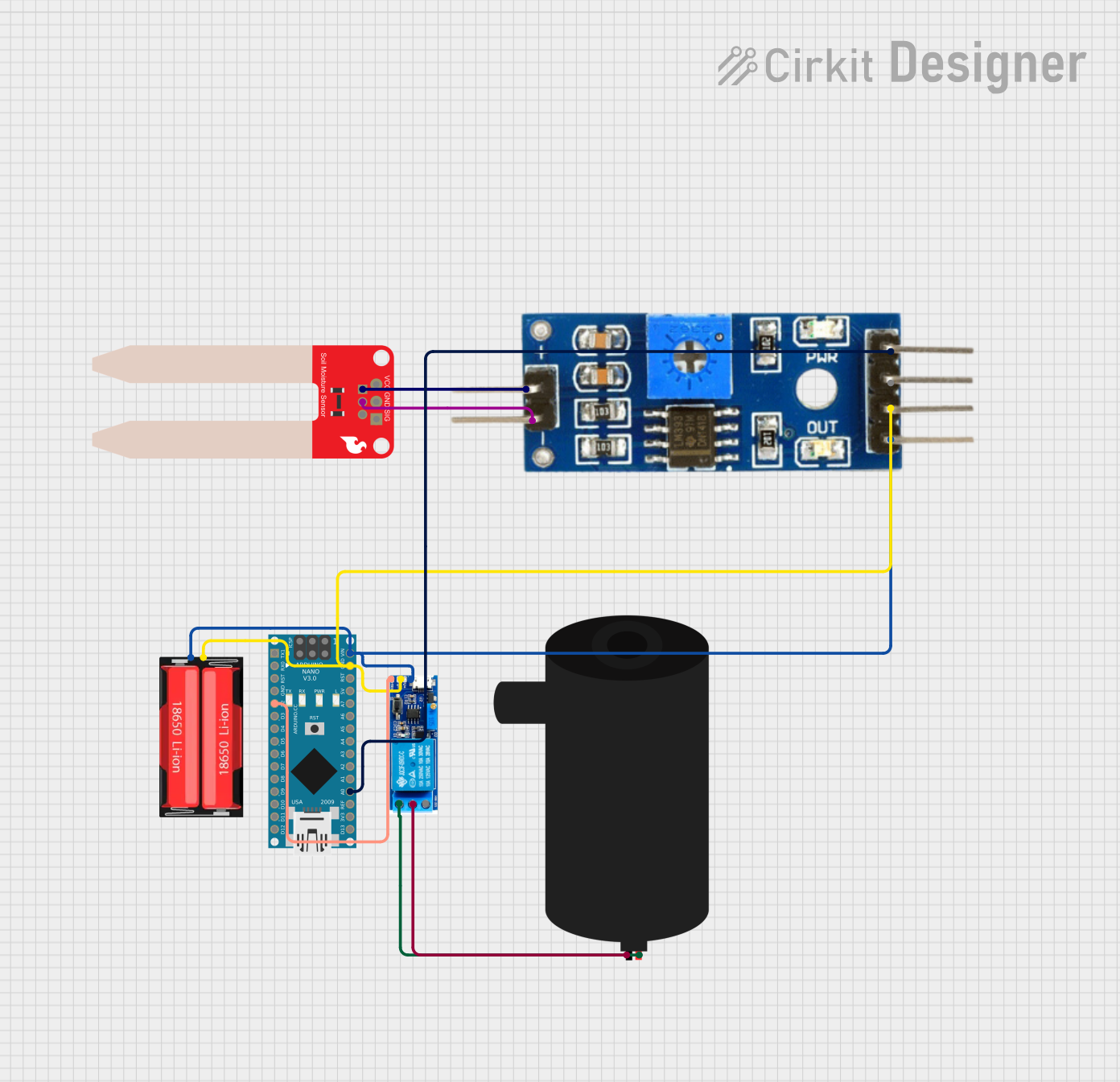
Arduino-Controlled Soil Moisture Sensing and Water Pump System
Image of SachetBhaiya: A project utilizing SparkFun Soil Moisture Sensor in a practical application
This circuit is designed to monitor soil moisture levels using a SparkFun Soil Moisture Sensor connected to a Soil Moisture Module, which interfaces with an Arduino Nano microcontroller. The Arduino reads the analog moisture level and can control a water pump via a relay module based on the moisture data. The system is powered by an 18650 Li-Ion battery, and the relay ensures that the pump is activated only when the soil moisture falls below a certain threshold, as determined by the Arduino's programmed logic.
Cirkit Designer LogoOpen Project in Cirkit Designer
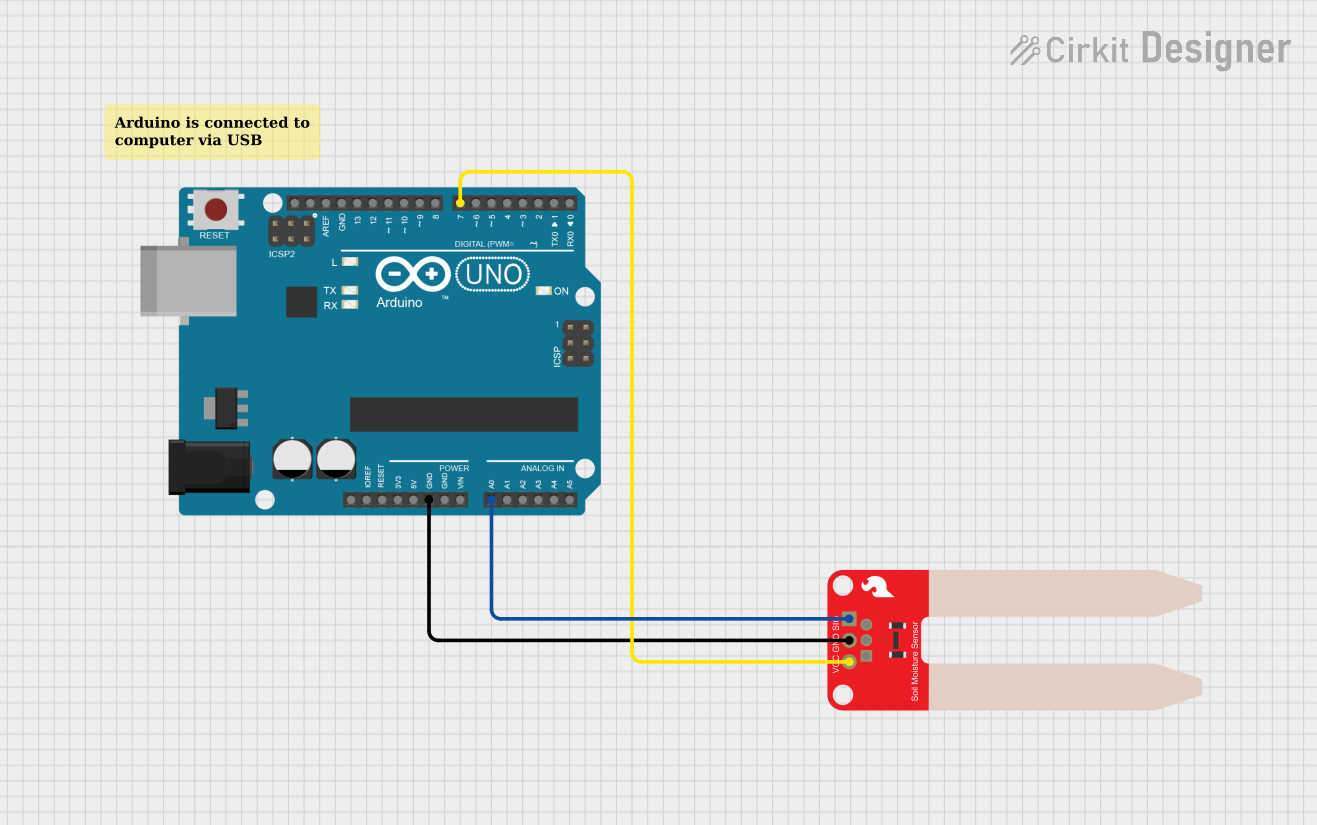
Arduino UNO Based Soil Moisture Sensing System
Image of Measure Soil Moisture With Arduino Uno: A project utilizing SparkFun Soil Moisture Sensor in a practical application
This circuit connects an Arduino UNO to a SparkFun Soil Moisture Sensor to measure the moisture content of soil. The sensor's signal pin is connected to the Arduino's analog input A0 for moisture readings, and it is powered by digital pin D7 to minimize corrosion by only supplying power when a measurement is taken. The embedded code on the Arduino manages the power to the sensor and reads the moisture levels, outputting the data to the serial monitor at a one-second interval.
Cirkit Designer LogoOpen Project in Cirkit Designer
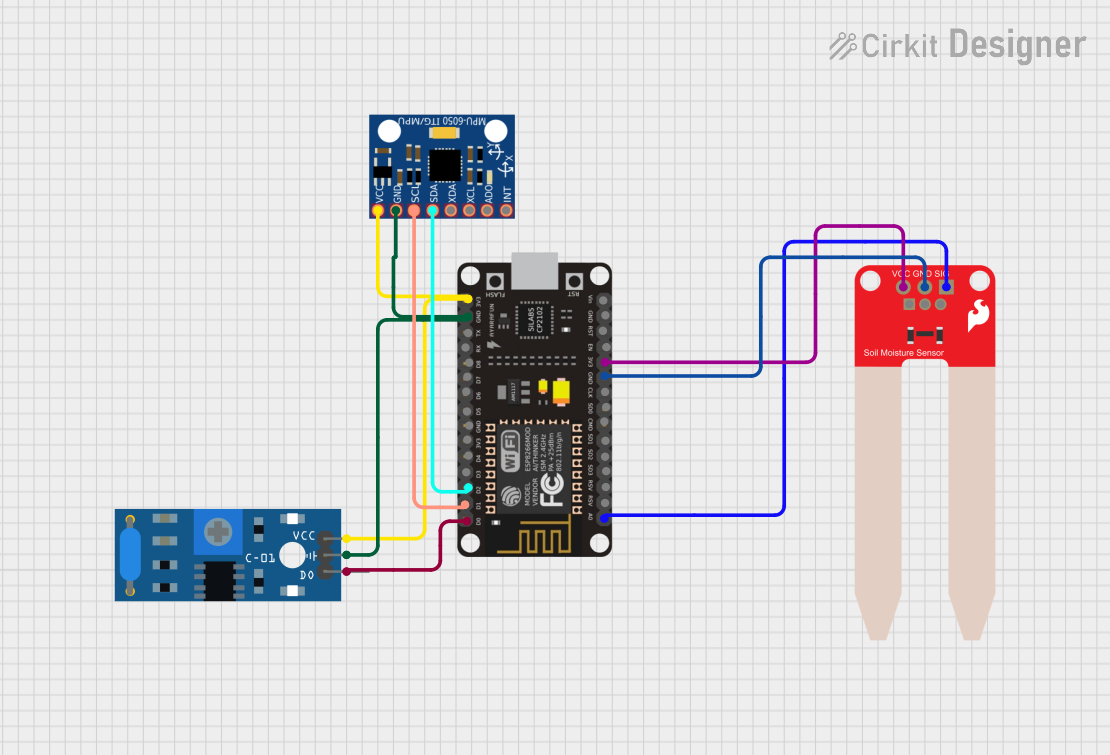
ESP8266 NodeMCU-Based Landslide Detection System with MPU-6050 and Soil Moisture Sensing
Image of Landslide monitoring system: A project utilizing SparkFun Soil Moisture Sensor in a practical application
This circuit is designed for environmental monitoring, specifically for detecting soil moisture levels, vibrations, and motion. It uses an ESP8266 NodeMCU microcontroller to read data from a SparkFun Soil Moisture Sensor, an SW-420 Vibration Sensor, and an MPU-6050 gyroscope/accelerometer. The microcontroller processes the sensor data and can send alerts or log events through the Blynk IoT platform when moisture levels are below a set threshold, vibrations are detected, or significant motion is observed.
Cirkit Designer LogoOpen Project in Cirkit Designer
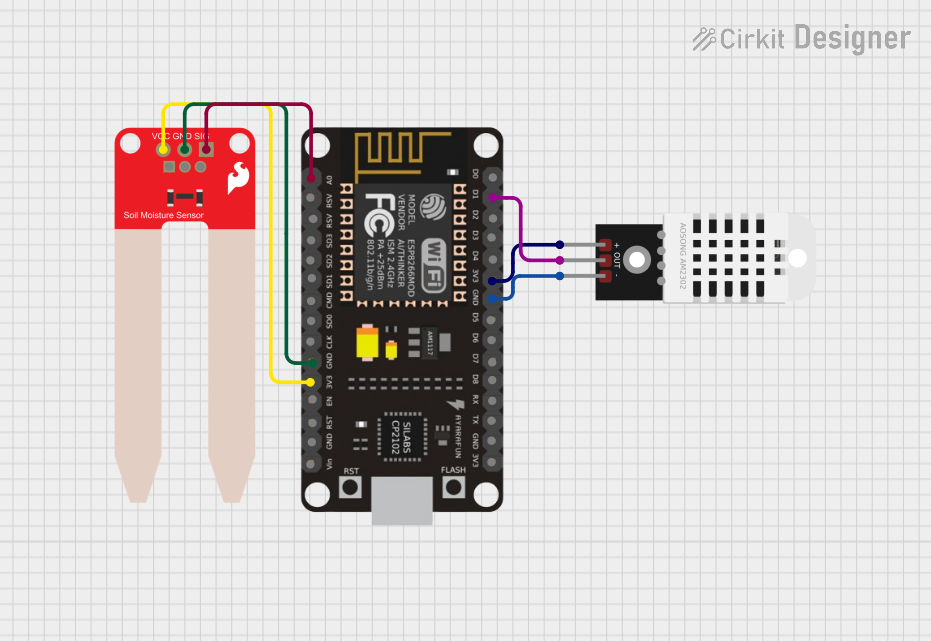
ESP8266 NodeMCU Based Environmental Monitoring System
Image of Image1: A project utilizing SparkFun Soil Moisture Sensor in a practical application
This circuit features an ESP8266 NodeMCU microcontroller connected to a DHT22 temperature and humidity sensor and a SparkFun Soil Moisture Sensor. The DHT22 sensor's data output is connected to the D1 pin of the NodeMCU, while the soil moisture sensor's signal is connected to the A0 analog pin. Both sensors are powered by the 3V3 output of the NodeMCU, and their grounds are connected to the NodeMCU's ground, enabling the microcontroller to monitor environmental conditions and soil moisture levels.
Cirkit Designer LogoOpen Project in Cirkit Designer

Explore Projects Built with SparkFun Soil Moisture Sensor

Use Cirkit Designer to design, explore, and prototype these projects online. Some projects support real-time simulation. Click "Open Project" to start designing instantly!
Image of SachetBhaiya: A project utilizing SparkFun Soil Moisture Sensor in a practical application
Arduino-Controlled Soil Moisture Sensing and Water Pump System
This circuit is designed to monitor soil moisture levels using a SparkFun Soil Moisture Sensor connected to a Soil Moisture Module, which interfaces with an Arduino Nano microcontroller. The Arduino reads the analog moisture level and can control a water pump via a relay module based on the moisture data. The system is powered by an 18650 Li-Ion battery, and the relay ensures that the pump is activated only when the soil moisture falls below a certain threshold, as determined by the Arduino's programmed logic.
Cirkit Designer LogoOpen Project in Cirkit Designer
Image of Measure Soil Moisture With Arduino Uno: A project utilizing SparkFun Soil Moisture Sensor in a practical application
Arduino UNO Based Soil Moisture Sensing System
This circuit connects an Arduino UNO to a SparkFun Soil Moisture Sensor to measure the moisture content of soil. The sensor's signal pin is connected to the Arduino's analog input A0 for moisture readings, and it is powered by digital pin D7 to minimize corrosion by only supplying power when a measurement is taken. The embedded code on the Arduino manages the power to the sensor and reads the moisture levels, outputting the data to the serial monitor at a one-second interval.
Cirkit Designer LogoOpen Project in Cirkit Designer
Image of Landslide monitoring system: A project utilizing SparkFun Soil Moisture Sensor in a practical application
ESP8266 NodeMCU-Based Landslide Detection System with MPU-6050 and Soil Moisture Sensing
This circuit is designed for environmental monitoring, specifically for detecting soil moisture levels, vibrations, and motion. It uses an ESP8266 NodeMCU microcontroller to read data from a SparkFun Soil Moisture Sensor, an SW-420 Vibration Sensor, and an MPU-6050 gyroscope/accelerometer. The microcontroller processes the sensor data and can send alerts or log events through the Blynk IoT platform when moisture levels are below a set threshold, vibrations are detected, or significant motion is observed.
Cirkit Designer LogoOpen Project in Cirkit Designer
Image of Image1: A project utilizing SparkFun Soil Moisture Sensor in a practical application
ESP8266 NodeMCU Based Environmental Monitoring System
This circuit features an ESP8266 NodeMCU microcontroller connected to a DHT22 temperature and humidity sensor and a SparkFun Soil Moisture Sensor. The DHT22 sensor's data output is connected to the D1 pin of the NodeMCU, while the soil moisture sensor's signal is connected to the A0 analog pin. Both sensors are powered by the 3V3 output of the NodeMCU, and their grounds are connected to the NodeMCU's ground, enabling the microcontroller to monitor environmental conditions and soil moisture levels.
Cirkit Designer LogoOpen Project in Cirkit Designer

Common Applications

  • Automated irrigation systems
  • Smart gardening projects
  • Agricultural monitoring
  • Environmental research and data collection

Technical Specifications

The SparkFun Soil Moisture Sensor is a simple yet effective tool for measuring soil moisture. Below are its key technical details:

Parameter Specification
Operating Voltage 3.3V - 5V
Output Signal Analog voltage (0V - Vcc)
Current Consumption < 20 mA
Dimensions 60mm x 20mm
Interface Type Analog
Operating Temperature -40°C to 85°C

Pin Configuration

The sensor has three pins, as described in the table below:

Pin Name Description
1 VCC Power supply pin (3.3V - 5V)
2 GND Ground connection
3 SIG Analog output pin that provides soil moisture data

Usage Instructions

Connecting the Sensor

To use the SparkFun Soil Moisture Sensor in a circuit:

  1. Connect the VCC pin to the 3.3V or 5V power supply of your microcontroller.
  2. Connect the GND pin to the ground of your microcontroller.
  3. Connect the SIG pin to an analog input pin on your microcontroller (e.g., A0 on an Arduino UNO).

Important Considerations

  • Corrosion Prevention: The sensor's probes are prone to corrosion over time, especially in wet soil. To extend the sensor's lifespan, avoid leaving it in the soil for prolonged periods or use a capacitive soil moisture sensor as an alternative.
  • Calibration: The sensor's output varies depending on the soil type. Calibrate the sensor by measuring the output in dry and fully saturated soil to determine the range for your specific application.
  • Power Supply: Ensure the sensor operates within its voltage range (3.3V - 5V) to avoid damage.

Example Code for Arduino UNO

Below is an example of how to use the SparkFun Soil Moisture Sensor with an Arduino UNO to read and display soil moisture levels:

// Define the analog pin connected to the sensor's SIG pin
const int sensorPin = A0;

// Variable to store the sensor reading
int sensorValue;

void setup() {
  // Initialize serial communication for debugging
  Serial.begin(9600);
}

void loop() {
  // Read the analog value from the sensor
  sensorValue = analogRead(sensorPin);

  // Map the sensor value to a percentage (0% - 100%)
  int moisturePercent = map(sensorValue, 0, 1023, 0, 100);

  // Print the raw sensor value and moisture percentage to the Serial Monitor
  Serial.print("Raw Sensor Value: ");
  Serial.print(sensorValue);
  Serial.print(" | Soil Moisture: ");
  Serial.print(moisturePercent);
  Serial.println("%");

  // Wait for 1 second before the next reading
  delay(1000);
}

Best Practices

  • Use a pull-down resistor on the SIG pin if the sensor output fluctuates.
  • Avoid exposing the sensor to water directly; it is designed for soil use only.
  • Periodically clean the sensor probes to ensure accurate readings.

Troubleshooting and FAQs

Common Issues

  1. No Output or Incorrect Readings

    • Cause: Loose or incorrect wiring.
    • Solution: Double-check all connections and ensure the sensor is powered correctly.
  2. Fluctuating Readings

    • Cause: Electrical noise or unstable power supply.
    • Solution: Add a capacitor (e.g., 0.1µF) between the VCC and GND pins to stabilize the power supply.
  3. Corroded Probes

    • Cause: Prolonged exposure to wet soil.
    • Solution: Clean the probes with a soft cloth and consider using a protective coating or switching to a capacitive sensor.

FAQs

Q: Can this sensor be used in hydroponic systems?
A: No, this sensor is designed for soil use and may corrode quickly in water. For hydroponics, consider using a different type of moisture sensor.

Q: How do I calibrate the sensor?
A: Measure the sensor's output in completely dry soil and fully saturated soil. Use these values to map the sensor's output to a percentage or other meaningful range.

Q: Can I use this sensor with a Raspberry Pi?
A: Yes, but since the Raspberry Pi lacks analog input pins, you will need an ADC (Analog-to-Digital Converter) module to read the sensor's output.

By following this documentation, you can effectively integrate the SparkFun Soil Moisture Sensor into your projects and ensure reliable performance.