
How to Use HW-025: Examples, Pinouts, and Specs
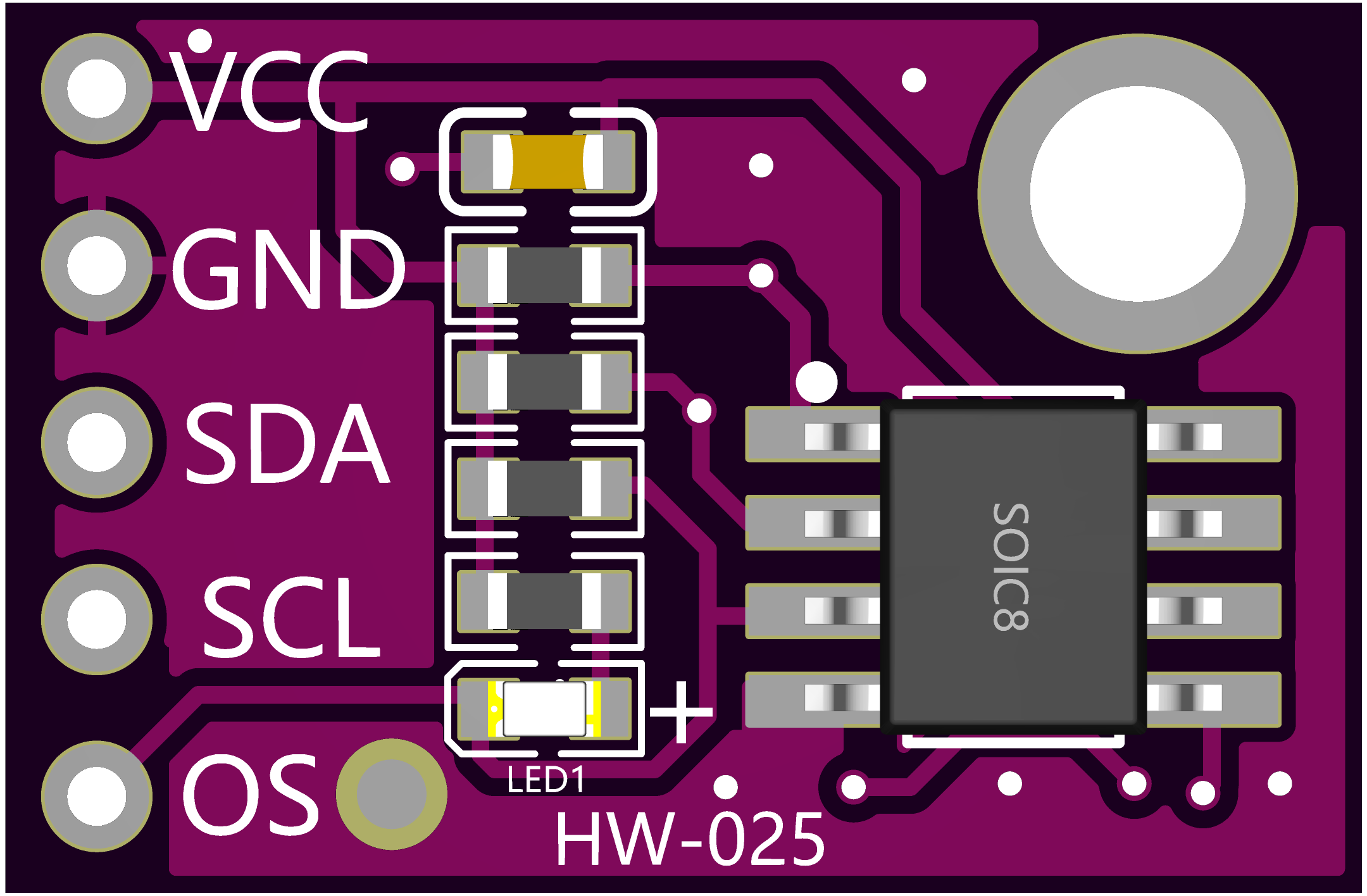
 Design with HW-025 in Cirkit Designer
Introduction
The HW-025, manufactured by 宏维微 (part ID: LM75A), is a versatile electronic component widely used in signal processing and control applications. Its compact design makes it ideal for integration into small devices, while its reliability and efficiency ensure consistent performance. The HW-025 is particularly popular in temperature sensing and monitoring systems due to its precision and ease of use.
Explore Projects Built with HW-025
 Open Project in Cirkit Designer
 Open Project in Cirkit Designer
 Open Project in Cirkit Designer
 Open Project in Cirkit Designer
Explore Projects Built with HW-025
Open Project in Cirkit DesignerOpen Project in Cirkit DesignerOpen Project in Cirkit DesignerOpen Project in Cirkit DesignerCommon Applications
- Temperature monitoring in industrial and consumer electronics
- Over-temperature protection in power supplies and motor drivers
- Environmental monitoring systems
- IoT devices requiring temperature data
Technical Specifications
The HW-025 (LM75A) is a digital temperature sensor with an I²C interface. Below are its key technical details:
Key Technical Details
| Parameter | Value |
|---|---|
| Supply Voltage (Vcc) | 2.7V to 5.5V |
| Temperature Range | -55°C to +125°C |
| Accuracy | ±2°C (typical) |
| Communication Protocol | I²C (2-wire) |
| Resolution | 9-bit (0.125°C per step) |
| Operating Current | 300 µA (typical) |
| Shutdown Current | 1 µA (typical) |
| Package Type | SOP-8 |
Pin Configuration and Descriptions
The HW-025 module has 8 pins, as described in the table below:
| Pin Number | Pin Name | Description |
|---|---|---|
| 1 | SDA | Serial Data Line for I²C communication |
| 2 | SCL | Serial Clock Line for I²C communication |
| 3 | OS | Over-Temperature Shutdown output (open-drain) |
| 4 | GND | Ground |
| 5 | A2 | Address bit 2 for I²C slave address selection |
| 6 | A1 | Address bit 1 for I²C slave address selection |
| 7 | A0 | Address bit 0 for I²C slave address selection |
| 8 | Vcc | Power supply (2.7V to 5.5V) |
Usage Instructions
The HW-025 is straightforward to use in a circuit, especially with microcontrollers like the Arduino UNO. Below are the steps and considerations for using the component:
Connecting the HW-025
- Power Supply: Connect the Vcc pin to a 3.3V or 5V power source and the GND pin to ground.
- I²C Communication: Connect the SDA and SCL pins to the corresponding I²C pins on your microcontroller (A4 and A5 on Arduino UNO).
- Address Configuration: Use the A0, A1, and A2 pins to set the I²C slave address. These pins can be connected to Vcc or GND to configure the address.
- Optional Output: The OS pin can be used for over-temperature shutdown functionality. Connect it to an external circuit if needed.
Arduino Example Code
Below is an example of how to interface the HW-025 with an Arduino UNO to read temperature data:
#include <Wire.h>

// Define the I²C address of the HW-025 (default: 0x48)
#define HW025_ADDRESS 0x48

void setup() {
  Wire.begin(); // Initialize I²C communication
  Serial.begin(9600); // Start serial communication for debugging
}

void loop() {
  int16_t rawTemp; // Variable to store raw temperature data
  float temperature; // Variable to store calculated temperature

  // Request 2 bytes of temperature data from the HW-025
  Wire.beginTransmission(HW025_ADDRESS);
  Wire.write(0x00); // Point to the temperature register
  Wire.endTransmission();
  Wire.requestFrom(HW025_ADDRESS, 2);

  if (Wire.available() == 2) {
    // Read the two bytes of temperature data
    rawTemp = (Wire.read() << 8) | Wire.read();
    rawTemp >>= 7; // Right-shift to remove unused bits
    temperature = rawTemp * 0.125; // Convert to Celsius
    Serial.print("Temperature: ");
    Serial.print(temperature);
    Serial.println(" °C");
  }

  delay(1000); // Wait 1 second before the next reading
}
Best Practices
- Use pull-up resistors (4.7kΩ recommended) on the SDA and SCL lines for proper I²C communication.
- Ensure the I²C address does not conflict with other devices on the same bus.
- Place decoupling capacitors (e.g., 0.1 µF) near the Vcc pin to reduce noise.
Troubleshooting and FAQs
Common Issues
No Temperature Reading:
- Cause: Incorrect I²C address or wiring.
- Solution: Verify the address configuration (A0, A1, A2 pins) and check connections.
Inaccurate Temperature:
- Cause: External heat sources affecting the sensor.
- Solution: Isolate the sensor from heat sources and ensure proper ventilation.
I²C Communication Failure:
- Cause: Missing pull-up resistors or incorrect clock speed.
- Solution: Add pull-up resistors to SDA and SCL lines and ensure the clock speed is within the sensor's limits.
FAQs
Q1: Can the HW-025 operate at 3.3V?
A1: Yes, the HW-025 supports a supply voltage range of 2.7V to 5.5V.
Q2: How do I change the I²C address?
A2: Configure the A0, A1, and A2 pins by connecting them to Vcc or GND. Refer to the datasheet for address mapping.
Q3: What is the resolution of the temperature readings?
A3: The HW-025 provides a 9-bit resolution, with each step representing 0.125°C.
Q4: Can I use the OS pin for interrupt-based temperature monitoring?
A4: Yes, the OS pin can be configured as an interrupt output for over-temperature events.