The Mean Well DDR-15L-5 is a compact, high-efficiency DC-DC converter designed to step down voltage from a higher input level to a stable 5V output. This component is ideal for powering low-voltage devices in industrial, automotive, and embedded systems. Its robust design ensures reliable performance in demanding environments, making it a popular choice for applications requiring efficient power conversion.
Explore Projects Built with DC-DC Converter DDR-15L-5
Use Cirkit Designer to design, explore, and prototype these projects online. Some projects support real-time simulation. Click "Open Project" to start designing instantly!
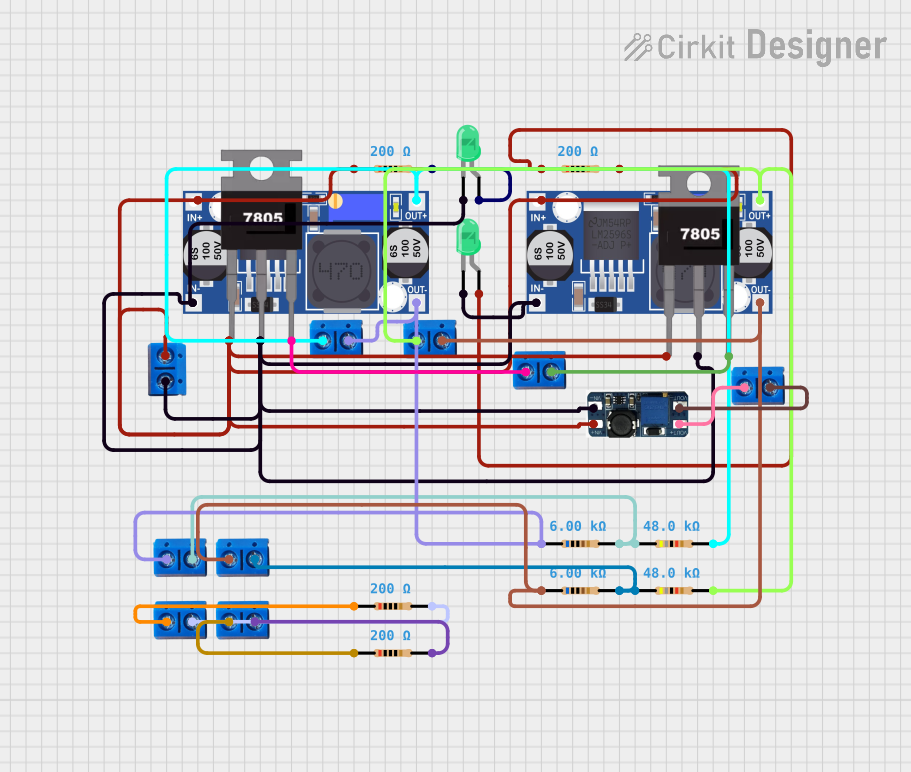
This circuit is designed for power management, featuring buck and boost converters for voltage adjustment, and linear regulators for stable voltage output. It includes LEDs for status indication, and terminal blocks for external connections.
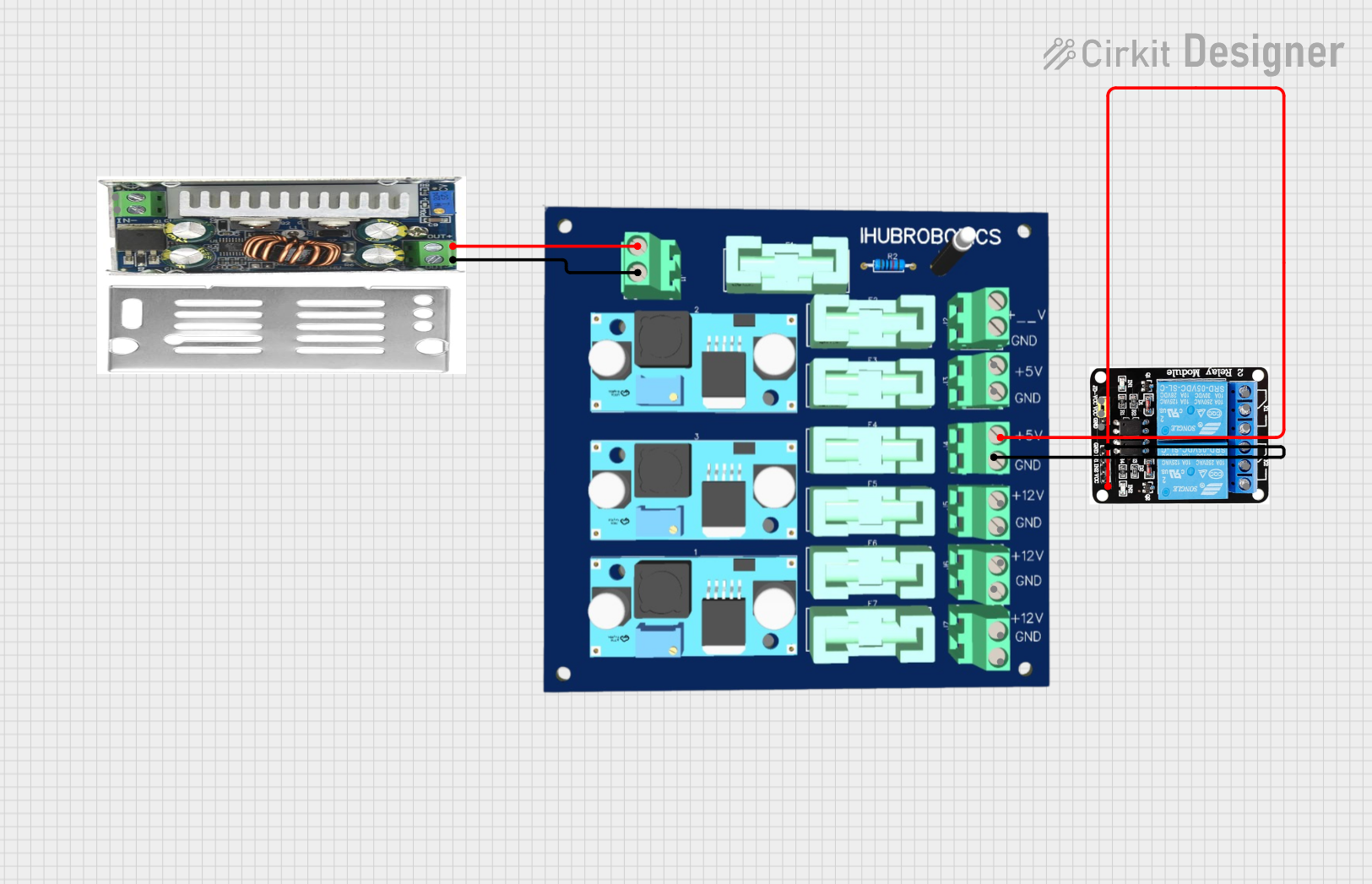
This circuit consists of a DC-DC converter powering a 6-channel power module, which in turn supplies 5V to a 2-relay module. The power module distributes the converted voltage to the relay module, enabling it to control external devices.
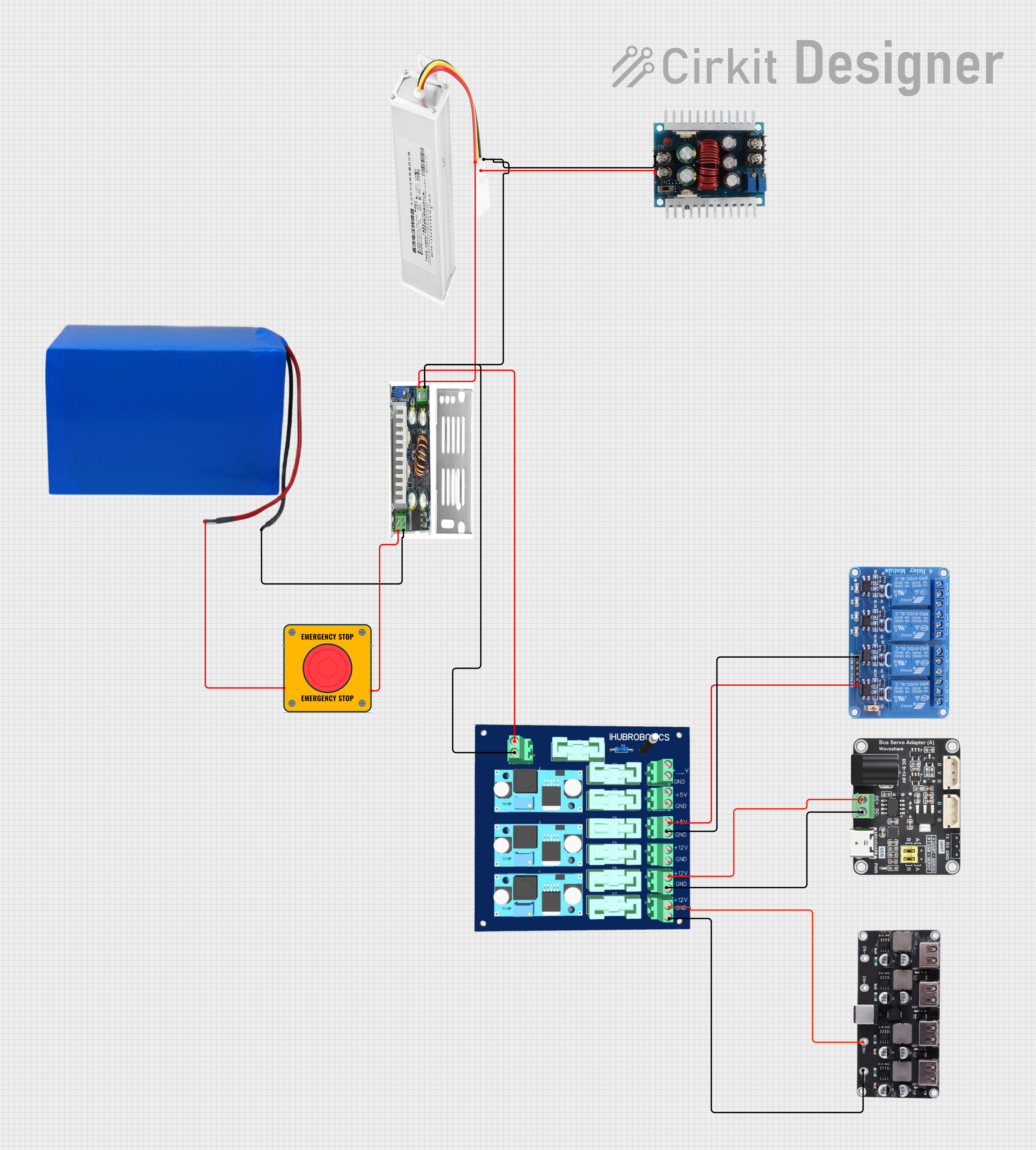
This circuit converts a 38.5V battery output to multiple lower voltage levels using a series of DC-DC converters and a power module. It includes an emergency stop switch for safety and distributes power to various components such as a relay module, USB ports, and a bus servo adaptor.
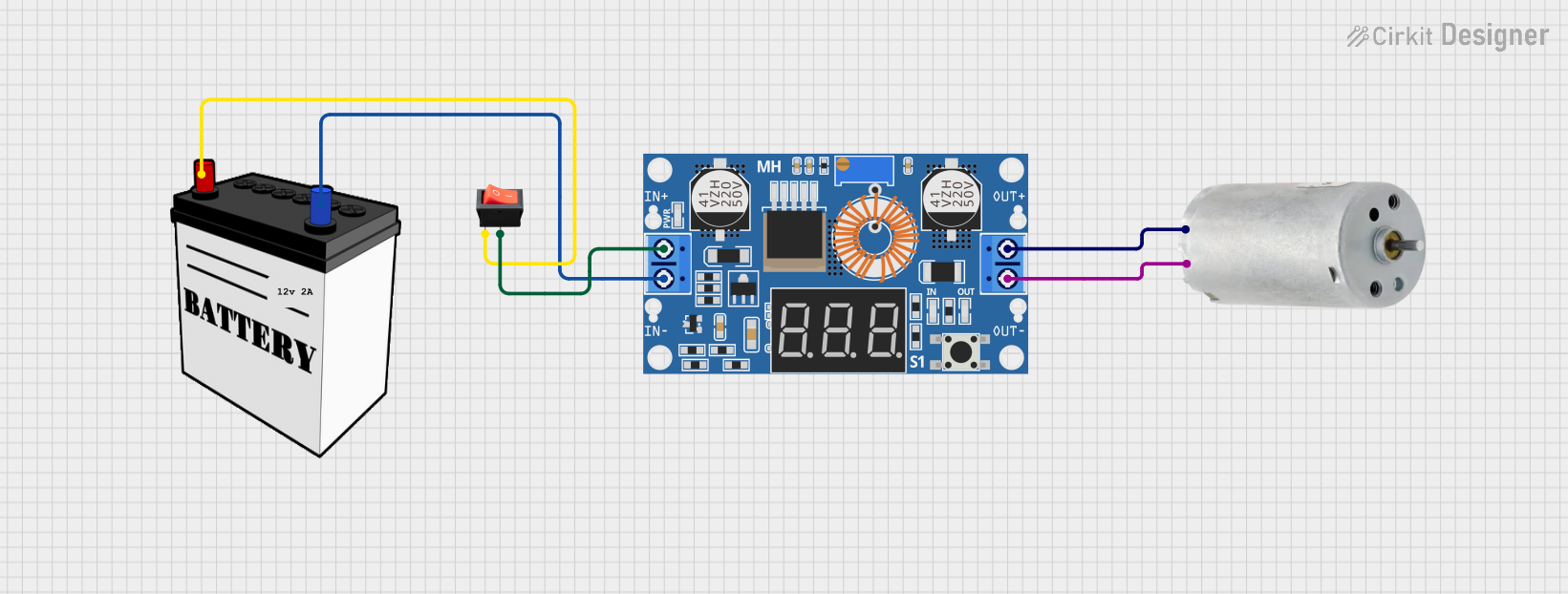
This circuit consists of a 12V battery connected to a rocker switch, which controls the input to an XL4015 DC Buck Step-down converter. The converter steps down the voltage to power a DC generator, with the generator's output connected back to the converter to form a feedback loop.
Powering microcontrollers, sensors, and other low-voltage devices
Industrial automation systems
Battery-powered systems
Embedded systems and IoT devices
Automotive electronics
Technical Specifications
The following table outlines the key technical details of the DDR-15L-5:
Parameter
Value
Input Voltage Range
9V to 36V DC
Output Voltage
5V DC
Output Current
3A
Output Power
15W
Efficiency
Up to 88%
Operating Temperature
-40°C to +85°C
Dimensions
25.4mm x 25.4mm x 15mm
Weight
30g
Protection Features
Overload, Overvoltage, Short Circuit
Pin Configuration
The DDR-15L-5 has a simple pin layout for easy integration into circuits. The table below describes each pin:
Pin Number
Pin Name
Description
1
VIN+
Positive input voltage (9V to 36V DC)
2
VIN-
Negative input voltage (Ground)
3
VOUT+
Positive output voltage (5V DC)
4
VOUT-
Negative output voltage (Ground)
Usage Instructions
How to Use the DDR-15L-5 in a Circuit
Input Voltage Connection: Connect the input voltage source (9V to 36V DC) to the VIN+ and VIN- pins. Ensure the input voltage is within the specified range to avoid damage.
Output Voltage Connection: Connect the load (e.g., microcontroller, sensor) to the VOUT+ and VOUT- pins. The output voltage will be a stable 5V DC.
Decoupling Capacitors: For optimal performance, place decoupling capacitors (e.g., 10µF and 0.1µF) close to the input and output pins to reduce noise and improve stability.
Mounting: Secure the module on a PCB or chassis using appropriate mounting hardware. Ensure proper ventilation to maintain operating temperature.
Important Considerations
Input Voltage Range: Always ensure the input voltage is within the 9V to 36V range. Exceeding this range may damage the converter.
Load Requirements: Do not exceed the maximum output current of 3A. Overloading may trigger the protection features or damage the device.
Thermal Management: Operate the converter in an environment with adequate airflow to prevent overheating, especially under high load conditions.
Polarity: Double-check the polarity of the input and output connections to avoid reverse polarity damage.
Example: Using DDR-15L-5 with an Arduino UNO
The DDR-15L-5 can be used to power an Arduino UNO from a 12V battery. Below is an example circuit and Arduino code:
Circuit Setup
Connect the 12V battery's positive terminal to VIN+ and the negative terminal to VIN-.
Connect the VOUT+ pin to the Arduino UNO's 5V pin.
Connect the VOUT- pin to the Arduino UNO's GND pin.
Arduino Code Example
// Example code to blink an LED using Arduino UNO powered by DDR-15L-5
// Ensure the DDR-15L-5 is providing a stable 5V to the Arduino UNO.

const int ledPin = 13; // Pin connected to the onboard LED

void setup() {
  pinMode(ledPin, OUTPUT); // Set the LED pin as an output
}

void loop() {
  digitalWrite(ledPin, HIGH); // Turn the LED on
  delay(1000);                // Wait for 1 second
  digitalWrite(ledPin, LOW);  // Turn the LED off
  delay(1000);                // Wait for 1 second
}
Troubleshooting and FAQs
Common Issues and Solutions
Issue
Possible Cause
Solution
No output voltage
Input voltage is not connected or too low
Verify input voltage is within 9V to 36V range.
Output voltage is unstable or noisy
Insufficient decoupling capacitors
Add 10µF and 0.1µF capacitors near the output pins.
Overheating
High ambient temperature or poor ventilation
Ensure proper airflow and reduce load if necessary.
Output voltage drops under load
Load exceeds 3A
Reduce the load to within the 3A limit.
FAQs
Can the DDR-15L-5 be used with a 24V input?
Yes, the DDR-15L-5 supports input voltages from 9V to 36V, so 24V is within the acceptable range.
What happens if the input voltage exceeds 36V?
Exceeding 36V may damage the converter. Use a voltage regulator or protection circuit to limit the input voltage.
Is the DDR-15L-5 suitable for battery-powered systems?
Yes, it is ideal for battery-powered systems due to its high efficiency and wide input voltage range.
Does the DDR-15L-5 require a heatsink?
In most cases, a heatsink is not required. However, for high-load applications in hot environments, additional cooling may be necessary.
By following this documentation, users can effectively integrate the DDR-15L-5 into their projects and ensure reliable operation.


 Open Project in Cirkit Designer