The ILI9341 4.0-inch TFT LCD display module is a versatile and compact display solution designed for embedded systems and microcontroller-based projects. Manufactured in China, this module features a 240x320 pixel resolution and utilizes the ILI9341 driver IC for efficient control and rendering of graphical content. Its vibrant color display and touch functionality (if supported by the specific variant) make it ideal for applications requiring visual output, such as user interfaces, data visualization, and gaming.
Explore Projects Built with ILI9341 4.0 inch
Use Cirkit Designer to design, explore, and prototype these projects online. Some projects support real-time simulation. Click "Open Project" to start designing instantly!
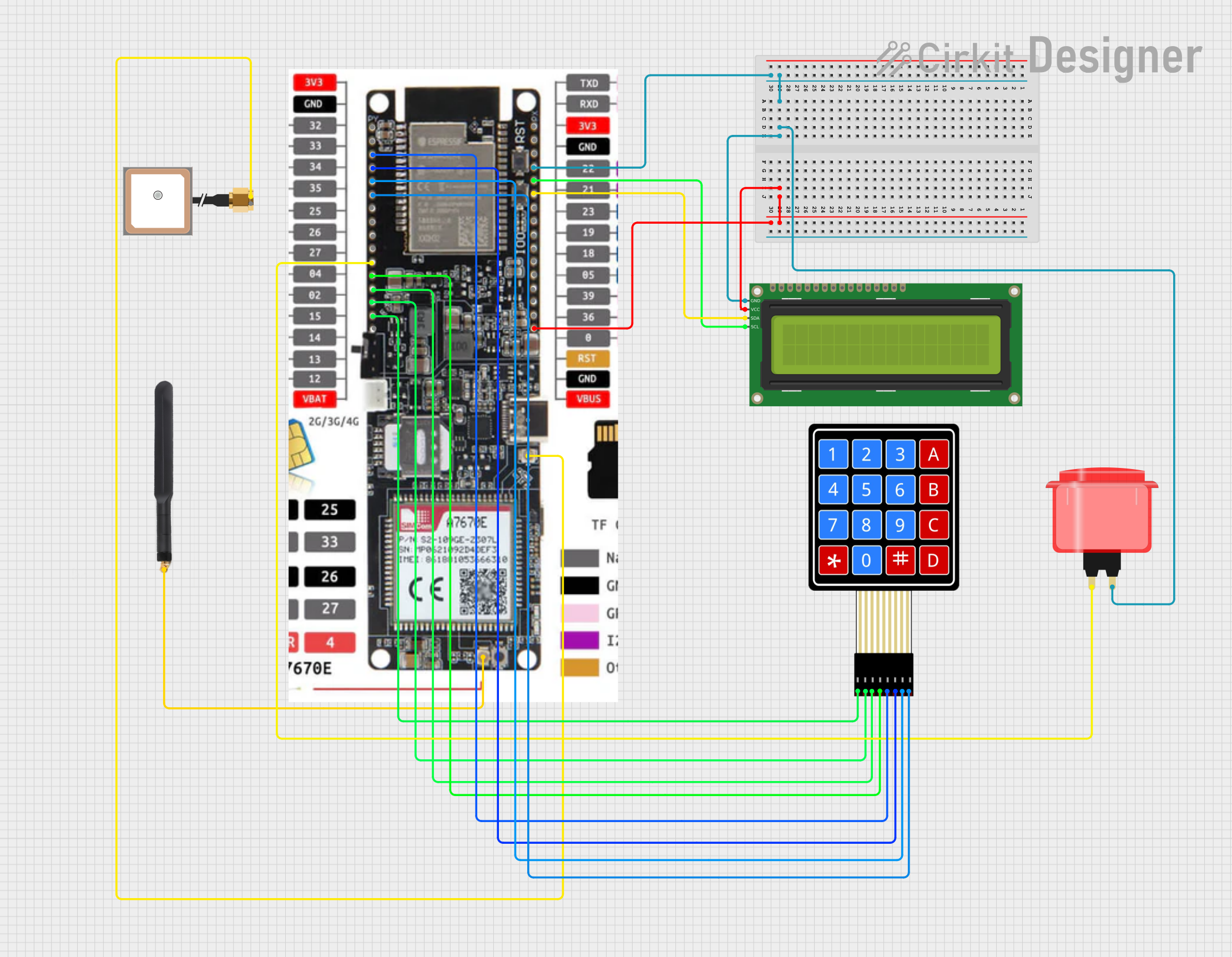
This circuit features a Lilygo 7670e microcontroller interfaced with a 16x2 I2C LCD for display, a 4X4 membrane matrix keypad for input, and an arcade button for additional control. It also includes a 4G antenna and a GPS antenna for communication and location tracking capabilities.
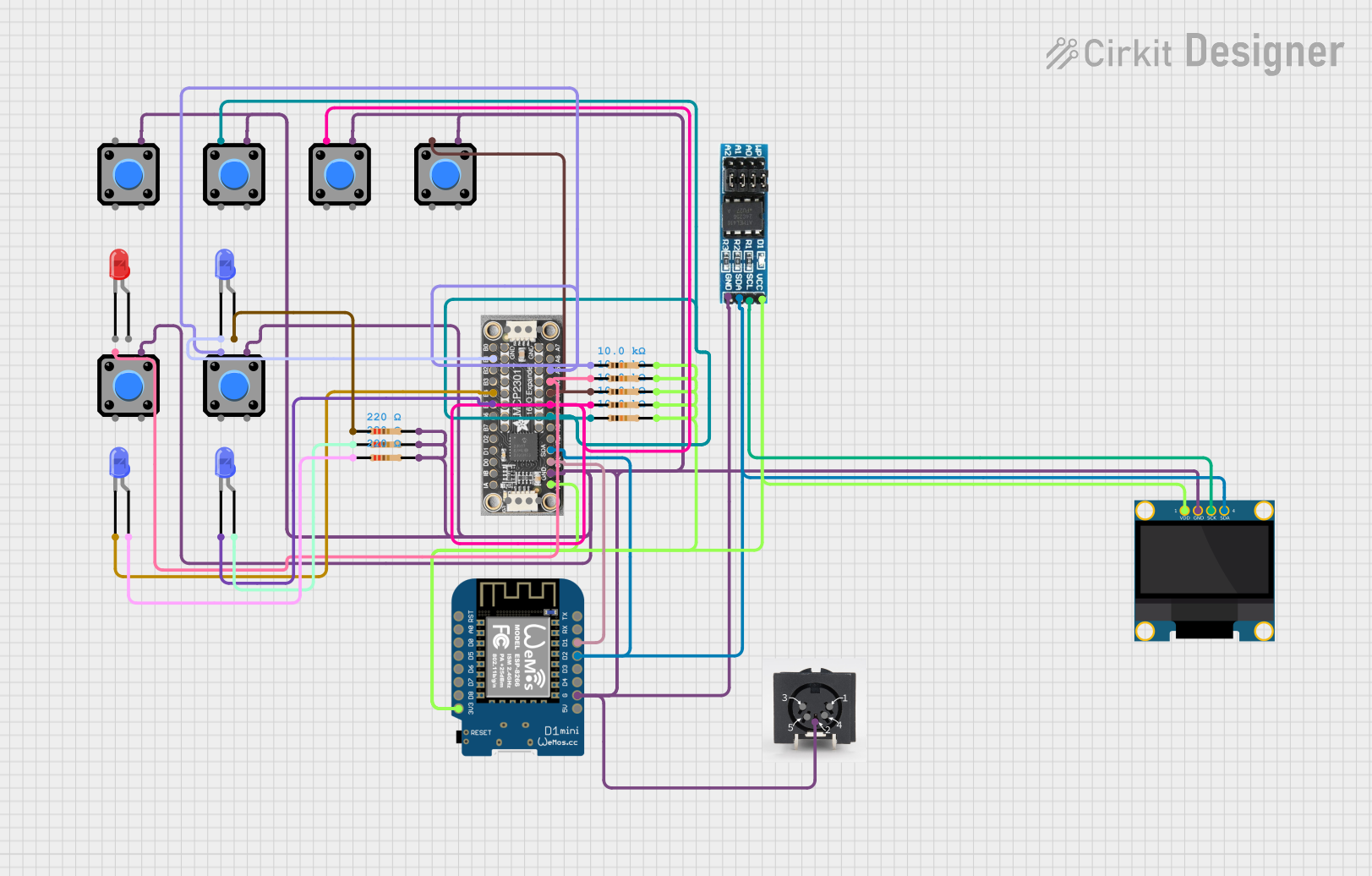
This is a microcontroller-based interactive device featuring a Wemos D1 Mini, an OLED display, external EEPROM, and an I/O expander. It includes user input buttons and status LEDs, with potential MIDI interface capabilities.
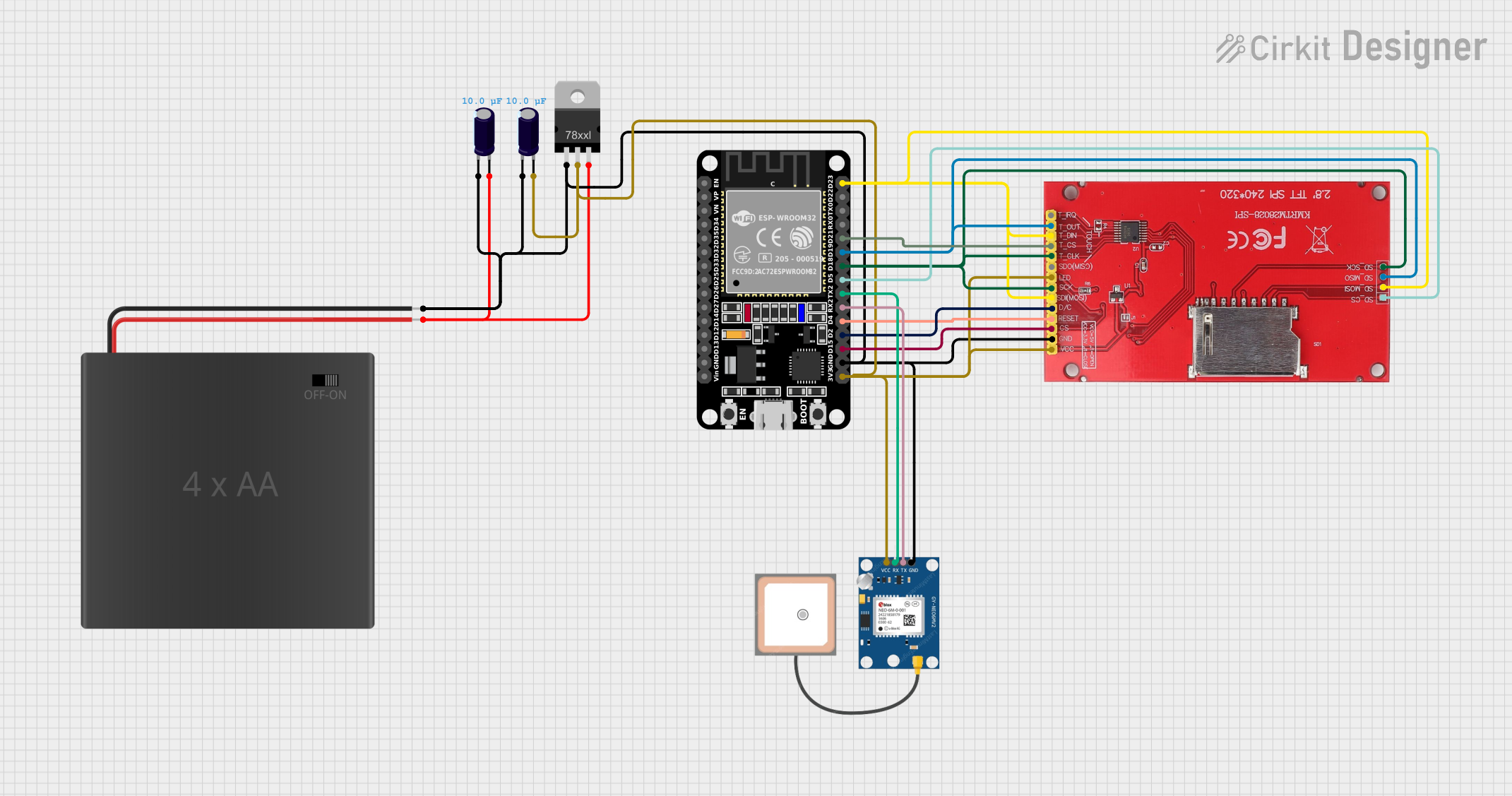
This circuit integrates an ESP32 microcontroller with a GPS NEO 6M module and an ILI9341 TFT display. The ESP32 communicates with the GPS module to receive location data and displays this information on the TFT screen. Power is supplied by a 4xAA battery pack, regulated by an LD1117 voltage regulator.
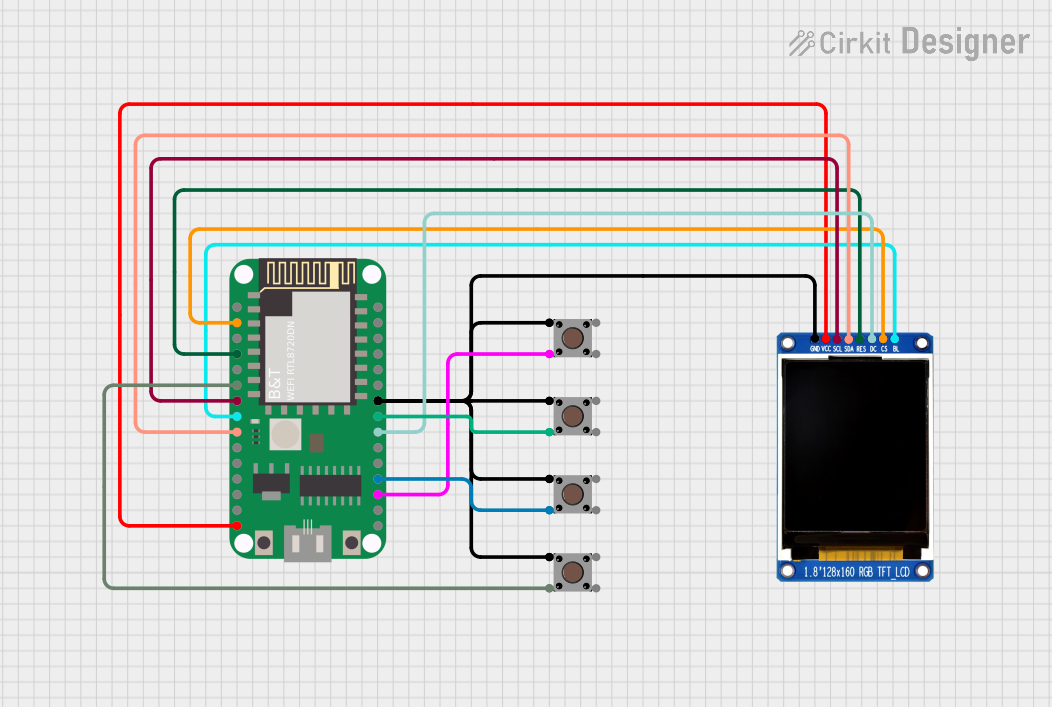
This circuit features an RTL8720DN microcontroller interfaced with a China ST7735S 160x128 TFT LCD display and four pushbuttons. The microcontroller reads the states of the pushbuttons and displays their statuses on the TFT LCD, providing a visual feedback system for button presses.
Embedded systems requiring graphical user interfaces (GUIs)
DIY electronics projects and prototyping
Industrial control panels
Portable devices and handheld instruments
Educational projects and hobbyist applications
Technical Specifications
The following table outlines the key technical details of the ILI9341 4.0-inch TFT LCD module:
Parameter
Specification
Display Type
TFT LCD
Driver IC
ILI9341
Screen Size
4.0 inches
Resolution
240x320 pixels
Color Depth
16-bit (65,536 colors)
Interface
SPI (Serial Peripheral Interface)
Operating Voltage
3.3V (logic level)
Backlight Voltage
3.3V to 5V
Current Consumption
~50mA (typical, with backlight on)
Operating Temperature
-20°C to 70°C
Dimensions
~71mm x 52mm x 7mm
Pin Configuration and Descriptions
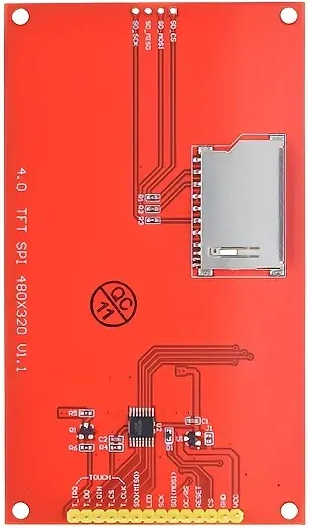
The ILI9341 module typically features an 8-pin or 10-pin interface for SPI communication. Below is the pinout description:
Pin
Name
Description
1
VCC
Power supply input (3.3V or 5V, depending on the module variant).
2
GND
Ground connection.
3
CS
Chip Select (active low). Used to enable communication with the display.
4
RESET
Reset pin. Resets the display when pulled low.
5
DC (RS)
Data/Command control pin. High for data, low for command.
6
SDI (MOSI)
Serial Data Input (Master Out Slave In). Transfers data to the display.
7
SCK
Serial Clock. Synchronizes data transfer.
8
LED
Backlight control. Connect to 3.3V or 5V for backlight operation.
9
SDO (MISO)
Serial Data Output (optional, used for SPI read operations).
10
T_IRQ
Touch interrupt pin (if touch functionality is supported).
Note: Pin names and configurations may vary slightly depending on the specific module variant. Always refer to the datasheet or documentation provided with your module.
Usage Instructions
How to Use the ILI9341 in a Circuit
Power Supply: Connect the VCC pin to a 3.3V or 5V power source (depending on the module variant) and the GND pin to ground.
SPI Communication: Connect the CS, RESET, DC, SDI (MOSI), and SCK pins to the corresponding SPI pins on your microcontroller.
Backlight: Connect the LED pin to 3.3V or 5V to enable the backlight. Optionally, use a PWM pin for brightness control.
Touch Functionality: If your module supports touch, connect the T_IRQ pin to an interrupt-capable pin on your microcontroller.
Software Setup: Use a compatible library (e.g., Adafruit_GFX and Adafruit_ILI9341 for Arduino) to initialize and control the display.
Example Arduino UNO Connection
Below is an example of how to connect the ILI9341 module to an Arduino UNO:
ILI9341 Pin
Arduino UNO Pin
VCC
5V
GND
GND
CS
Pin 10
RESET
Pin 9
DC
Pin 8
SDI (MOSI)
Pin 11
SCK
Pin 13
LED
5V
Example Arduino Code
The following Arduino sketch demonstrates how to initialize and display basic graphics on the ILI9341 module using the Adafruit_ILI9341 library:
#include <Adafruit_GFX.h>      // Core graphics library
#include <Adafruit_ILI9341.h>  // ILI9341 driver library

// Define pin connections
#define TFT_CS   10  // Chip Select
#define TFT_RST  9   // Reset
#define TFT_DC   8   // Data/Command

// Create an instance of the display
Adafruit_ILI9341 tft = Adafruit_ILI9341(TFT_CS, TFT_DC, TFT_RST);

void setup() {
  tft.begin();  // Initialize the display

  // Fill the screen with a solid color
  tft.fillScreen(ILI9341_BLUE);

  // Draw a rectangle
  tft.fillRect(50, 50, 100, 100, ILI9341_RED);

  // Display text
  tft.setTextColor(ILI9341_WHITE);
  tft.setTextSize(2);
  tft.setCursor(10, 10);
  tft.print("Hello, ILI9341!");
}

void loop() {
  // Nothing to do here
}
Important Considerations:
Ensure the module operates at 3.3V logic levels. Use a level shifter if your microcontroller operates at 5V.
Avoid connecting the backlight pin (LED) directly to a GPIO pin without a current-limiting resistor.
Troubleshooting and FAQs
Common Issues and Solutions
Display Not Turning On:
Verify the power supply connections (VCC and GND).
Ensure the backlight pin (LED) is connected to 3.3V or 5V.
No Output or Incorrect Display:
Check the SPI connections (CS, RESET, DC, SDI, SCK).
Ensure the correct pins are defined in your code.
Verify that the Adafruit_ILI9341 library is installed and properly configured.
Touch Functionality Not Working:
Confirm that your module supports touch functionality.
Check the T_IRQ pin connection and ensure it is configured as an interrupt in your code.
Flickering or Dim Backlight:
Ensure the backlight pin (LED) is connected to a stable power source.
If using PWM for brightness control, verify the PWM frequency is appropriate.
FAQs
Q: Can I use the ILI9341 with a 5V microcontroller?
A: Yes, but you must use level shifters to convert the 5V logic signals to 3.3V to avoid damaging the display.
Q: Does the ILI9341 support parallel communication?
A: The ILI9341 driver IC supports parallel communication, but most 4.0-inch modules are designed for SPI communication.
Q: How do I control the brightness of the backlight?
A: Connect the LED pin to a PWM-capable GPIO pin on your microcontroller and adjust the duty cycle to control brightness.
Q: Can I use this display with platforms other than Arduino?
A: Yes, the ILI9341 is compatible with other platforms like Raspberry Pi, ESP32, and STM32. Ensure you use the appropriate libraries and pin configurations.

 Open Project in Cirkit Designer