
How to Use 3.7V 4000mAh LiPo Battery Rechargeable 1S: Examples, Pinouts, and Specs
 Design with 3.7V 4000mAh LiPo Battery Rechargeable 1S in Cirkit Designer
Introduction
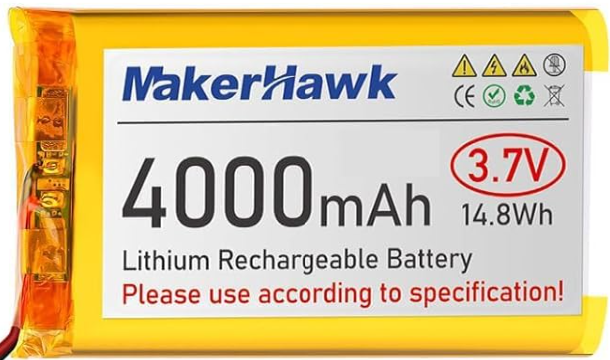
The MakerHawk 3.7V 4000mAh LiPo Battery Rechargeable 1S (Part ID: 124065) is a high-capacity lithium polymer battery designed for a wide range of rechargeable applications. With a nominal voltage of 3.7V and a capacity of 4000mAh, this battery is ideal for powering devices that require a reliable and lightweight energy source. Its compact design and high energy density make it suitable for drones, RC vehicles, portable electronics, and IoT devices.
Explore Projects Built with 3.7V 4000mAh LiPo Battery Rechargeable 1S
 Open Project in Cirkit Designer
 Open Project in Cirkit Designer
 Open Project in Cirkit Designer
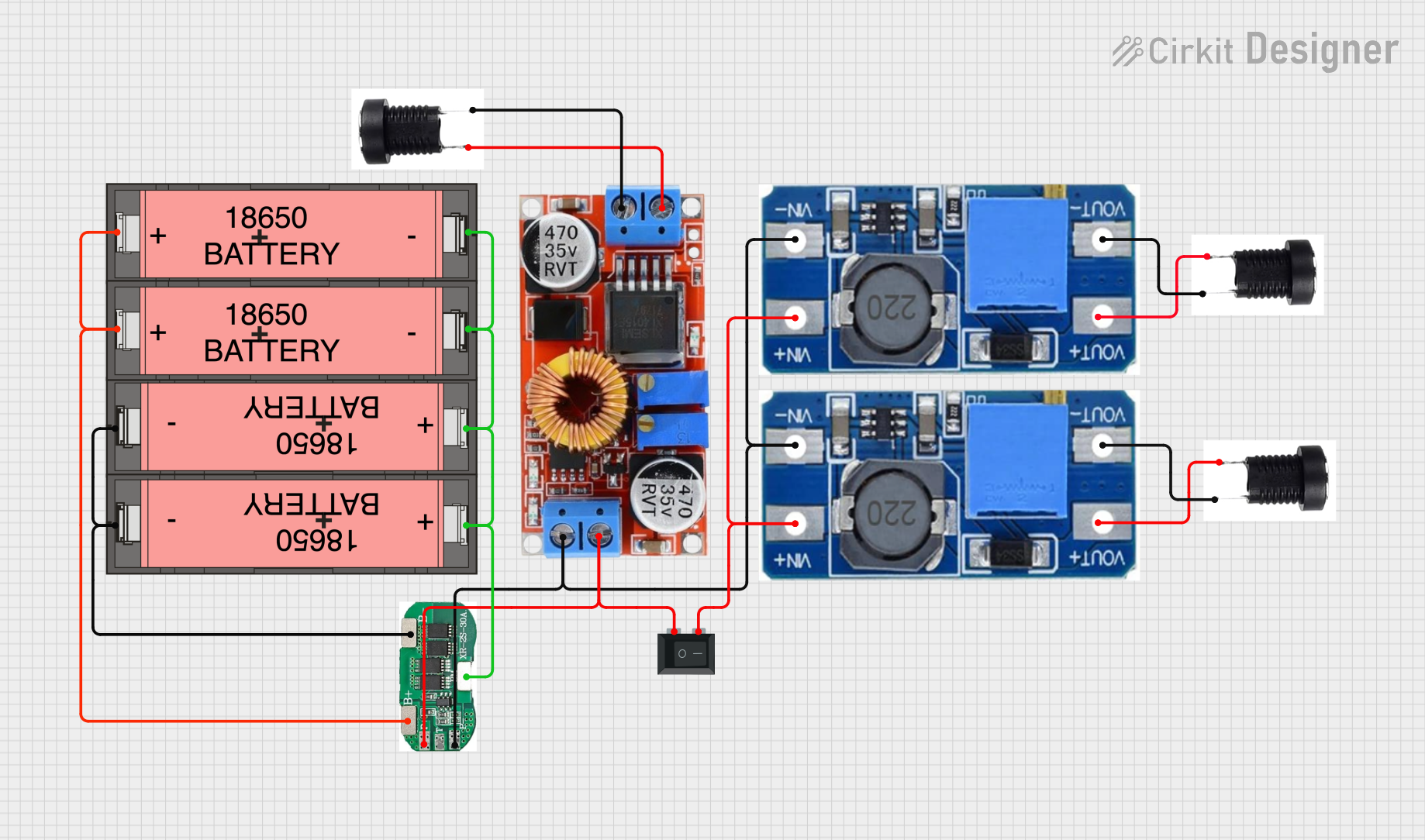 Open Project in Cirkit Designer
Explore Projects Built with 3.7V 4000mAh LiPo Battery Rechargeable 1S
Open Project in Cirkit DesignerOpen Project in Cirkit DesignerOpen Project in Cirkit DesignerOpen Project in Cirkit DesignerCommon Applications
- Drones and RC Vehicles: Provides lightweight, high-capacity power for extended operation.
- Portable Electronics: Powers devices such as handheld gaming consoles, Bluetooth speakers, and wearables.
- IoT Devices: Supplies energy for sensors, trackers, and other low-power devices.
- DIY Projects: Ideal for hobbyists building custom electronics or robotics.
Technical Specifications
Key Specifications
| Parameter | Value |
|---|---|
| Manufacturer | MakerHawk |
| Part ID | 124065 |
| Battery Type | Lithium Polymer (LiPo) |
| Nominal Voltage | 3.7V |
| Capacity | 4000mAh |
| Configuration | 1S (Single Cell) |
| Maximum Discharge Rate | 1C (4A) |
| Charging Voltage | 4.2V (Maximum) |
| Charging Current | Recommended: 0.5C (2A) |
| Connector Type | JST-XH 2.54mm |
| Dimensions | 80mm x 50mm x 10mm |
| Weight | ~70g |
Pin Configuration
The battery is equipped with a JST-XH 2.54mm connector for easy integration into circuits. The pinout is as follows:
| Pin Number | Pin Name | Description |
|---|---|---|
| 1 | Positive (+) | Battery positive terminal |
| 2 | Negative (-) | Battery negative terminal |
Usage Instructions
How to Use the Battery in a Circuit
- Connection: Connect the battery's JST-XH connector to the corresponding port on your device or circuit. Ensure the polarity matches (positive to positive, negative to negative).
- Charging: Use a LiPo-compatible charger to recharge the battery. Set the charger to 1S mode (3.7V nominal, 4.2V max) and limit the charging current to 2A (0.5C) for optimal battery life.
- Discharge: Avoid discharging the battery below 3.0V to prevent damage. Use a battery management system (BMS) or low-voltage cutoff circuit for protection.
Important Considerations
- Safety: Never puncture, short-circuit, or expose the battery to fire or water.
- Storage: Store the battery at room temperature, ideally at 3.8V (50% charge) for long-term storage.
- Balancing: If using multiple batteries in series, ensure they are balanced to prevent overcharging or over-discharging.
- Heat Management: Avoid operating the battery in environments exceeding 60°C to prevent overheating.
Example: Using with Arduino UNO
To power an Arduino UNO with this battery, you can connect it to the Vin pin and GND pin via a voltage regulator (if necessary). Below is an example of Arduino code to monitor the battery voltage using an analog pin:
// Arduino code to monitor battery voltage
const int batteryPin = A0;  // Analog pin connected to battery voltage divider
const float voltageDividerRatio = 2.0; // Adjust based on your resistor values
const float referenceVoltage = 5.0;   // Arduino's reference voltage (5V for UNO)

void setup() {
  Serial.begin(9600); // Initialize serial communication
}

void loop() {
  int rawValue = analogRead(batteryPin); // Read analog value
  float batteryVoltage = (rawValue / 1023.0) * referenceVoltage * voltageDividerRatio;

  // Print battery voltage to Serial Monitor
  Serial.print("Battery Voltage: ");
  Serial.print(batteryVoltage);
  Serial.println(" V");

  delay(1000); // Wait 1 second before next reading
}
Note: Use a voltage divider circuit to scale down the battery voltage to a safe range for the Arduino's analog input (0-5V).
Troubleshooting and FAQs
Common Issues and Solutions
Battery Not Charging:
- Cause: Incorrect charger settings or damaged charger.
- Solution: Verify the charger is set to 1S mode (4.2V max) and check the connections.
Battery Overheating:
- Cause: Excessive charging/discharging current or environmental temperature.
- Solution: Reduce the current to recommended levels and ensure proper ventilation.
Device Not Powering On:
- Cause: Battery voltage too low or incorrect polarity.
- Solution: Check the battery voltage with a multimeter and ensure correct polarity.
Shortened Battery Life:
- Cause: Frequent overcharging or deep discharging.
- Solution: Use a BMS and follow recommended charging/discharging practices.
FAQs
Q: Can I use this battery in series or parallel configurations?
- A: Yes, but ensure proper balancing and use a BMS to manage the cells.
Q: How long does it take to fully charge the battery?
- A: At the recommended charging current of 2A, it takes approximately 2-3 hours.
Q: Is this battery safe for air travel?
- A: Yes, but check airline regulations for carrying LiPo batteries.
Q: Can I use a solar panel to charge this battery?
- A: Yes, but ensure the solar panel output is regulated to 4.2V and does not exceed 2A.
This documentation provides all the necessary details to safely and effectively use the MakerHawk 3.7V 4000mAh LiPo Battery Rechargeable 1S in your projects. Always follow safety guidelines and manufacturer recommendations for optimal performance and longevity.