
How to Use ESP32-H2 Mini: Examples, Pinouts, and Specs
 Design with ESP32-H2 Mini in Cirkit Designer
Introduction
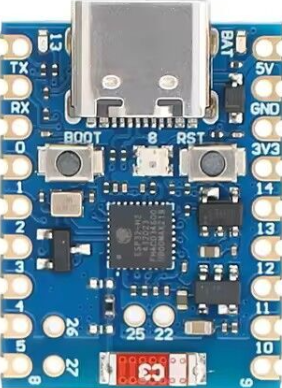
The ESP32-H2 Mini, manufactured by Espressif, is a compact microcontroller designed for Internet of Things (IoT) applications. It integrates Wi-Fi and Bluetooth Low Energy (BLE) capabilities, making it ideal for wireless communication in smart devices. With its low power consumption and high performance, the ESP32-H2 Mini is well-suited for battery-powered devices, home automation, wearable electronics, and industrial IoT systems.
Explore Projects Built with ESP32-H2 Mini
 Open Project in Cirkit Designer
 Open Project in Cirkit Designer
 Open Project in Cirkit Designer
 Open Project in Cirkit Designer
Explore Projects Built with ESP32-H2 Mini
Open Project in Cirkit DesignerOpen Project in Cirkit DesignerOpen Project in Cirkit DesignerOpen Project in Cirkit DesignerCommon Applications
- Smart home devices (e.g., smart plugs, thermostats)
- Wearable technology
- Industrial IoT sensors and controllers
- Wireless communication hubs
- Battery-powered IoT devices
Technical Specifications
The ESP32-H2 Mini is a powerful microcontroller with the following key specifications:
| Parameter | Value |
|---|---|
| Manufacturer | Espressif |
| Part ID | H2 Mini |
| Wireless Connectivity | Wi-Fi (802.11 b/g/n), Bluetooth Low Energy (BLE 5.0) |
| Processor | 32-bit RISC-V single-core processor |
| Operating Frequency | Up to 96 MHz |
| Flash Memory | 4 MB (external SPI flash) |
| RAM | 512 KB SRAM |
| GPIO Pins | 18 GPIO pins |
| Operating Voltage | 3.0V to 3.6V |
| Power Consumption | Ultra-low power consumption in deep sleep mode (<10 µA) |
| Communication Interfaces | UART, SPI, I2C, I2S, PWM |
| ADC Channels | 6 ADC channels (12-bit resolution) |
| Dimensions | 18 mm x 25 mm |
| Operating Temperature Range | -40°C to +85°C |
Pin Configuration
The ESP32-H2 Mini features a compact pinout. Below is the pin configuration:
| Pin Number | Pin Name | Function |
|---|---|---|
| 1 | GND | Ground |
| 2 | 3V3 | Power Supply (3.3V) |
| 3 | GPIO0 | General Purpose I/O, Boot Mode |
| 4 | GPIO1 | General Purpose I/O |
| 5 | GPIO2 | General Purpose I/O |
| 6 | GPIO3 | General Purpose I/O |
| 7 | GPIO4 | General Purpose I/O |
| 8 | GPIO5 | General Purpose I/O |
| 9 | GPIO6 | General Purpose I/O |
| 10 | GPIO7 | General Purpose I/O |
| 11 | GPIO8 | General Purpose I/O |
| 12 | GPIO9 | General Purpose I/O |
| 13 | TXD | UART Transmit |
| 14 | RXD | UART Receive |
| 15 | ADC1 | Analog Input Channel 1 |
| 16 | ADC2 | Analog Input Channel 2 |
| 17 | EN | Enable Pin |
| 18 | RST | Reset Pin |
Usage Instructions
Using the ESP32-H2 Mini in a Circuit
- Power Supply: Connect the 3V3 pin to a 3.3V power source and the GND pin to ground.
- Programming: Use the UART pins (TXD and RXD) to upload code to the microcontroller. A USB-to-UART converter may be required.
- GPIO Usage: Configure the GPIO pins as input or output in your code. These pins can be used for interfacing with sensors, actuators, and other peripherals.
- Wi-Fi and BLE: Use the built-in Wi-Fi and BLE modules for wireless communication. Libraries such as
WiFi.handBLEDevice.h(available in the Arduino IDE) can simplify development.
Important Considerations
- Voltage Levels: Ensure all connected peripherals operate at 3.3V logic levels to avoid damaging the microcontroller.
- Deep Sleep Mode: Use deep sleep mode to minimize power consumption in battery-powered applications.
- Boot Mode: To enter boot mode for programming, hold GPIO0 low while resetting the device.
Example Code for Arduino UNO Integration
Below is an example of using the ESP32-H2 Mini to connect to a Wi-Fi network and send data to a server:
#include <WiFi.h> // Include the Wi-Fi library

// Replace with your network credentials
const char* ssid = "Your_SSID";
const char* password = "Your_PASSWORD";

void setup() {
  Serial.begin(115200); // Initialize serial communication
  WiFi.begin(ssid, password); // Connect to Wi-Fi

  // Wait for connection
  while (WiFi.status() != WL_CONNECTED) {
    delay(1000);
    Serial.println("Connecting to Wi-Fi...");
  }

  Serial.println("Connected to Wi-Fi!");
}

void loop() {
  // Example: Send a message to the serial monitor
  Serial.println("ESP32-H2 Mini is running...");
  delay(2000); // Wait for 2 seconds
}
Troubleshooting and FAQs
Common Issues
Device Not Connecting to Wi-Fi
- Ensure the SSID and password are correct.
- Check if the Wi-Fi network is within range.
- Verify that the power supply is stable and sufficient.
Microcontroller Not Responding
- Check the connections to the UART pins.
- Ensure the GPIO0 pin is held low during programming.
- Verify that the correct board and port are selected in the Arduino IDE.
High Power Consumption
- Use deep sleep mode to reduce power consumption.
- Disconnect unused peripherals to minimize current draw.
FAQs
Q: Can the ESP32-H2 Mini operate on 5V?
A: No, the ESP32-H2 Mini operates at 3.3V. Connecting it to 5V may damage the device.
Q: How do I reset the ESP32-H2 Mini?
A: Use the RST pin to reset the microcontroller. Alternatively, you can power cycle the device.
Q: Is the ESP32-H2 Mini compatible with the Arduino IDE?
A: Yes, the ESP32-H2 Mini can be programmed using the Arduino IDE. Install the ESP32 board package to get started.
Q: Can I use the ESP32-H2 Mini for battery-powered applications?
A: Yes, the ESP32-H2 Mini is optimized for low power consumption, making it suitable for battery-powered devices. Use deep sleep mode to extend battery life.