
How to Use 3.7V 1200mah 803048 Lipo: Examples, Pinouts, and Specs
 Design with 3.7V 1200mah 803048 Lipo in Cirkit Designer
Introduction
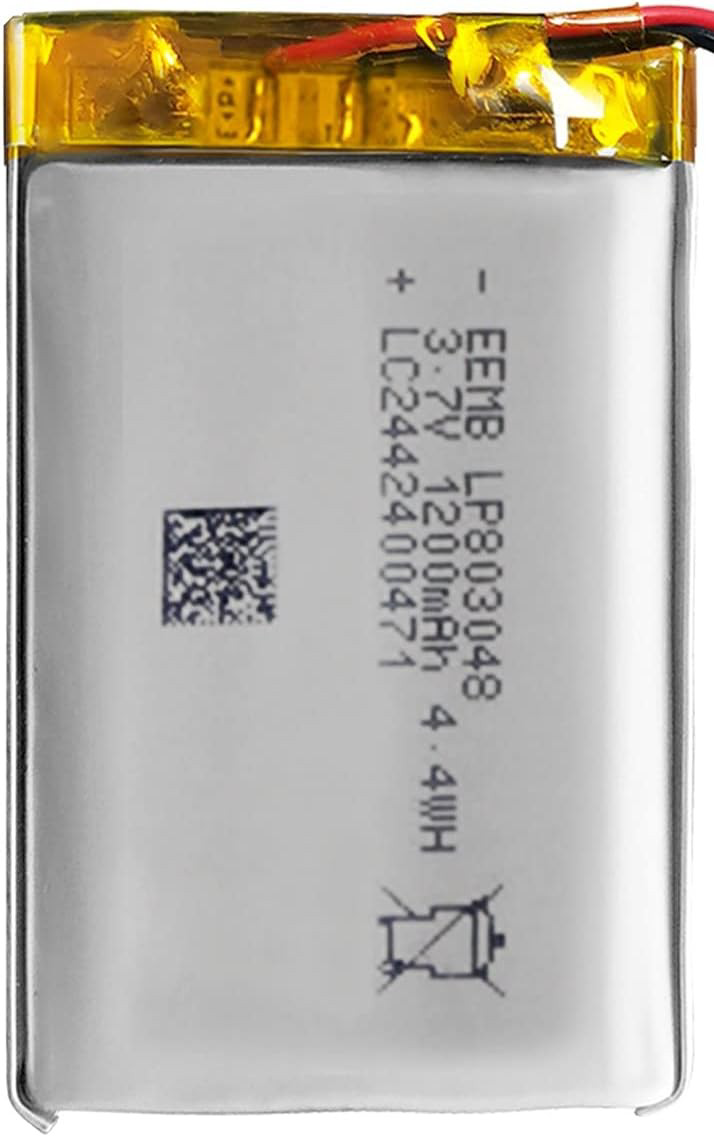
The 3.7V 1200mAh 803048 LiPo Battery, manufactured by EEMB, is a lightweight and high-energy-density lithium polymer (LiPo) battery. With a nominal voltage of 3.7V and a capacity of 1200mAh, this battery is ideal for powering portable electronic devices, wearables, IoT devices, and small robotics. Its compact size and reliable performance make it a popular choice for applications requiring rechargeable power sources.
Explore Projects Built with 3.7V 1200mah 803048 Lipo
 Open Project in Cirkit Designer
 Open Project in Cirkit Designer
 Open Project in Cirkit Designer
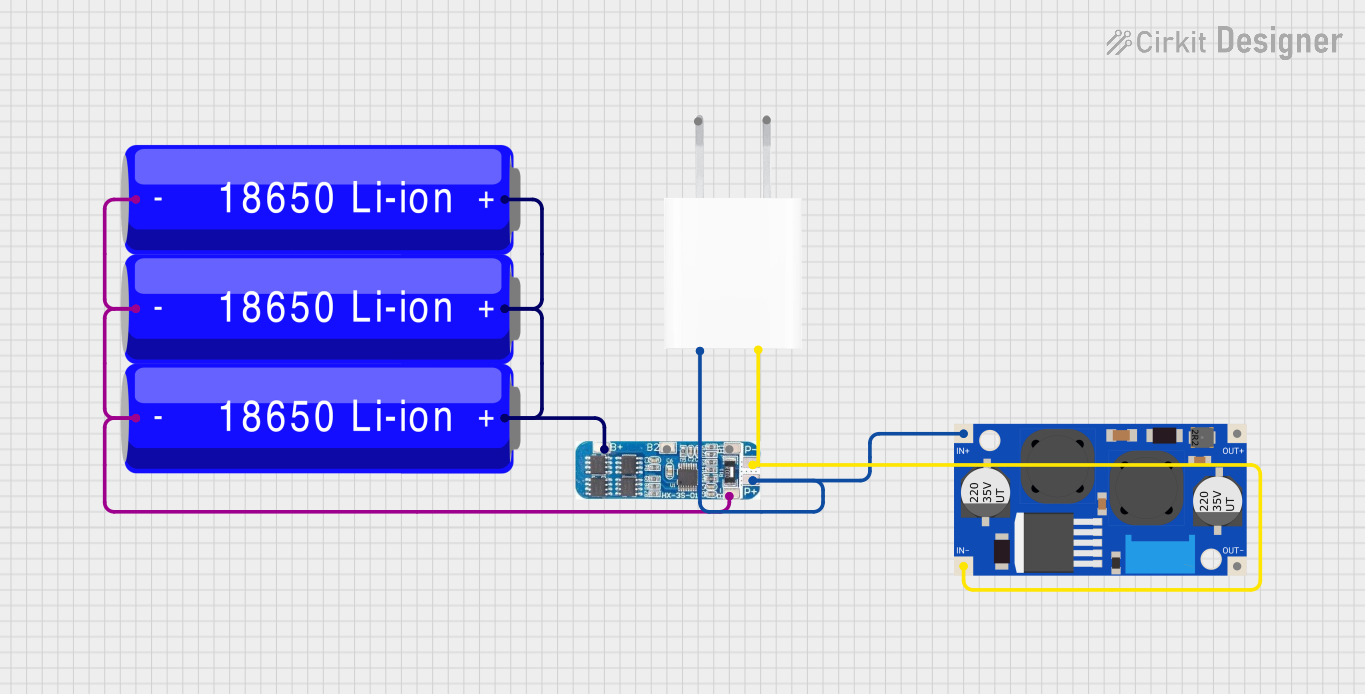 Open Project in Cirkit Designer
Explore Projects Built with 3.7V 1200mah 803048 Lipo
Open Project in Cirkit DesignerOpen Project in Cirkit DesignerOpen Project in Cirkit DesignerOpen Project in Cirkit DesignerCommon Applications
- Portable electronic devices (e.g., handheld gadgets, Bluetooth speakers)
- Wearable technology (e.g., smartwatches, fitness trackers)
- Internet of Things (IoT) devices
- Small robotics and drones
- Backup power for embedded systems
Technical Specifications
Key Specifications
| Parameter | Value |
|---|---|
| Manufacturer | EEMB |
| Part Number | 803048 |
| Nominal Voltage | 3.7V |
| Capacity | 1200mAh |
| Battery Chemistry | Lithium Polymer (LiPo) |
| Charge Voltage | 4.2V (maximum) |
| Discharge Cutoff Voltage | 3.0V (minimum) |
| Standard Charge Current | 0.2C (240mA) |
| Maximum Charge Current | 1C (1200mA) |
| Standard Discharge Rate | 0.2C (240mA) |
| Maximum Discharge Rate | 1C (1200mA) |
| Dimensions (L x W x H) | 48mm x 30mm x 8mm |
| Weight | ~25g |
| Connector Type | JST or bare wire leads |
| Operating Temperature | -20°C to 60°C (discharge) |
| Storage Temperature | -20°C to 45°C |
Pin Configuration
The battery typically comes with a two-wire configuration:
| Pin Name | Wire Color | Description |
|---|---|---|
| Positive | Red | Positive terminal (+3.7V) |
| Negative | Black | Negative terminal (ground, 0V) |
Usage Instructions
How to Use the Battery in a Circuit
- Connection:
- Connect the red wire to the positive terminal of your circuit.
- Connect the black wire to the ground terminal of your circuit.
- Ensure the polarity is correct to avoid damage to the battery or circuit.
- Charging:
- Use a LiPo-compatible charger with a constant current/constant voltage (CC/CV) charging profile.
- Set the charging voltage to 4.2V and the current to 0.2C (240mA) for standard charging.
- Do not exceed the maximum charge current of 1C (1200mA).
- Discharging:
- Ensure the load does not draw more than 1C (1200mA) to prevent overheating or damage.
- Use a battery protection circuit to prevent over-discharge (below 3.0V).
- Mounting:
- Secure the battery in your device using non-conductive adhesive or a battery holder.
- Avoid puncturing or bending the battery during installation.
Important Considerations and Best Practices
- Safety: Never short-circuit the battery terminals. Avoid exposing the battery to fire, water, or extreme temperatures.
- Storage: Store the battery at 40-60% charge in a cool, dry place if not in use for extended periods.
- Protection Circuit: Use a battery management system (BMS) or protection circuit module (PCM) to prevent overcharging, over-discharging, and short circuits.
- Charging with Arduino: If using with an Arduino project, connect the battery to a LiPo charging module (e.g., TP4056) and ensure proper voltage regulation.
Example: Using the Battery with an Arduino UNO
Below is an example of connecting the battery to an Arduino UNO via a TP4056 charging module:
Circuit Diagram
- Connect the battery to the TP4056 module:
- Red wire to the
B+terminal. - Black wire to the
B-terminal.
- Red wire to the
- Connect the TP4056 output to the Arduino:
OUT+to the Arduino'sVINpin.OUT-to the Arduino'sGNDpin.
Sample Code
// Example code to monitor battery voltage using Arduino UNO
// Connect the battery to an analog input pin via a voltage divider

const int batteryPin = A0; // Analog pin connected to the battery
const float voltageDividerRatio = 2.0; // Adjust based on your resistor values
const float referenceVoltage = 5.0; // Arduino UNO reference voltage

void setup() {
  Serial.begin(9600); // Initialize serial communication
}

void loop() {
  int rawValue = analogRead(batteryPin); // Read the analog value
  float batteryVoltage = (rawValue / 1023.0) * referenceVoltage * voltageDividerRatio;

  // Print the battery voltage to the Serial Monitor
  Serial.print("Battery Voltage: ");
  Serial.print(batteryVoltage);
  Serial.println(" V");

  delay(1000); // Wait for 1 second before the next reading
}
Note: Use a voltage divider to ensure the battery voltage does not exceed the Arduino's input voltage range (5V). For example, use two resistors (e.g., 10kΩ each) to divide the voltage by half.
Troubleshooting and FAQs
Common Issues and Solutions
| Issue | Possible Cause | Solution |
|---|---|---|
| Battery not charging | Faulty charger or incorrect connection | Verify charger and connections |
| Battery overheating during charge | Overcharging or high charge current | Use a LiPo-compatible charger and limit current to 0.2C |
| Device not powering on | Battery voltage too low | Recharge the battery |
| Swollen or damaged battery | Overcharging, physical damage, or aging | Stop using the battery immediately and dispose of it safely |
FAQs
Can I use this battery for high-current applications?
- Yes, but ensure the current draw does not exceed 1C (1200mA). For higher currents, consider a battery with a higher capacity or discharge rate.
How do I safely dispose of the battery?
- Take the battery to a certified e-waste recycling facility. Do not throw it in regular trash.
What happens if I over-discharge the battery?
- Over-discharging can permanently damage the battery. Use a protection circuit to prevent the voltage from dropping below 3.0V.
Can I connect multiple batteries in series or parallel?
- Yes, but ensure proper balancing and use a BMS to manage the pack safely.
This documentation provides a comprehensive guide to using the 3.7V 1200mAh 803048 LiPo Battery effectively and safely. Always follow the manufacturer's guidelines and safety precautions for optimal performance.