
How to Use Bluetooth HC-05 Module: Examples, Pinouts, and Specs
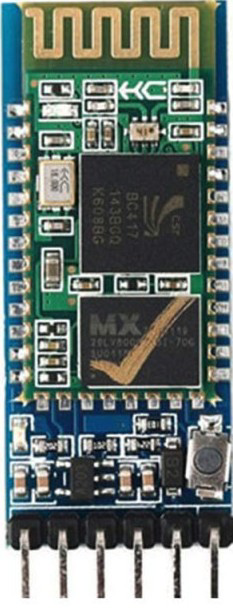
 Design with Bluetooth HC-05 Module in Cirkit Designer
Introduction
The Bluetooth HC-05 Module, manufactured by ARDUINO (Part ID: MEGA), is a wireless communication module designed for short-range data transmission using Bluetooth technology. It is widely used in embedded systems to enable seamless communication between devices without the need for physical connections. The HC-05 module supports both master and slave modes, making it versatile for various applications.
Explore Projects Built with Bluetooth HC-05 Module
 Open Project in Cirkit Designer
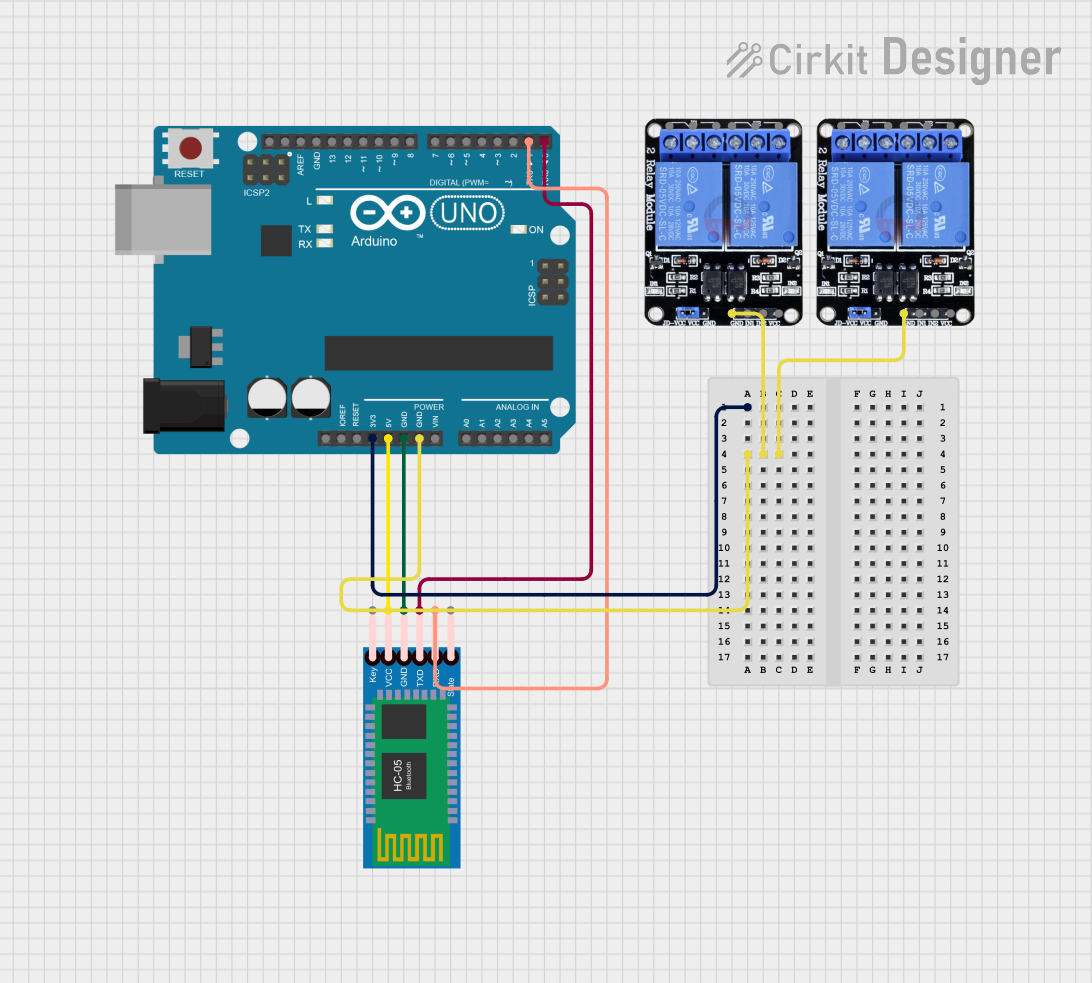 Open Project in Cirkit Designer
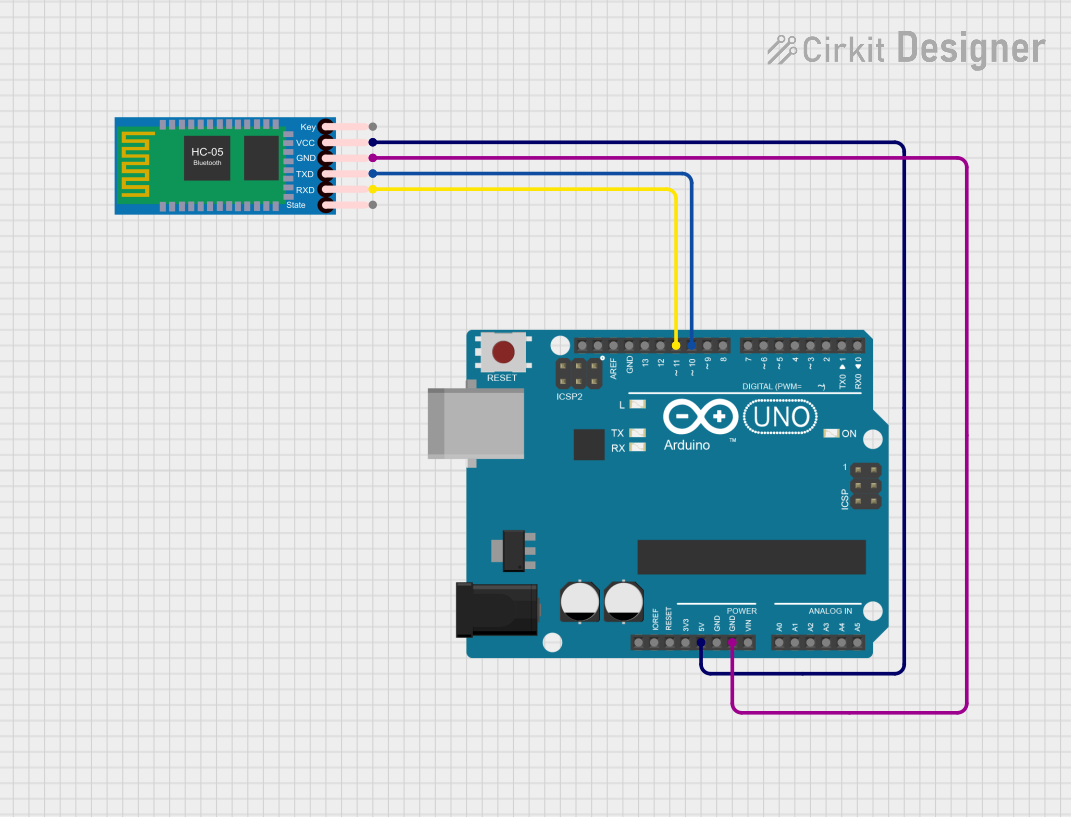 Open Project in Cirkit Designer
 Open Project in Cirkit Designer
Explore Projects Built with Bluetooth HC-05 Module
Open Project in Cirkit DesignerOpen Project in Cirkit DesignerOpen Project in Cirkit DesignerOpen Project in Cirkit DesignerCommon Applications and Use Cases
- Wireless communication between microcontrollers and smartphones
- Remote control of robots and IoT devices
- Data logging and monitoring systems
- Home automation projects
- Serial communication between devices
Technical Specifications
The HC-05 module is a robust and reliable Bluetooth module with the following key specifications:
| Parameter | Value |
|---|---|
| Bluetooth Version | 2.0 + EDR (Enhanced Data Rate) |
| Operating Voltage | 3.3V to 5V |
| Operating Current | 30mA (typical) |
| Communication Protocol | UART (Universal Asynchronous Receiver-Transmitter) |
| Baud Rate (Default) | 9600 bps |
| Range | Up to 10 meters (unobstructed) |
| Frequency Band | 2.4 GHz ISM band |
| Master/Slave Support | Configurable |
| Dimensions | 28mm x 15mm x 2.35mm |
Pin Configuration and Descriptions
The HC-05 module has 6 pins, as described in the table below:
| Pin Name | Pin Number | Description |
|---|---|---|
| EN (Key) | 1 | Enables AT command mode when pulled HIGH. |
| VCC | 2 | Power supply pin (3.3V to 5V). |
| GND | 3 | Ground pin. |
| TXD | 4 | Transmit data pin (connect to RX of microcontroller). |
| RXD | 5 | Receive data pin (connect to TX of microcontroller). |
| STATE | 6 | Indicates connection status (HIGH when connected). |
Usage Instructions
How to Use the HC-05 Module in a Circuit
- Power Supply: Connect the VCC pin to a 5V power source and the GND pin to ground.
- UART Communication: Connect the TXD pin of the HC-05 to the RX pin of your microcontroller, and the RXD pin of the HC-05 to the TX pin of your microcontroller.
- AT Command Mode: To configure the module, pull the EN (Key) pin HIGH and use AT commands via a serial terminal.
- Pairing: The HC-05 module will appear as a Bluetooth device on your smartphone or computer. Pair it using the default PIN code (
1234or0000).
Important Considerations and Best Practices
- Use a voltage divider or level shifter on the RXD pin if your microcontroller operates at 5V logic levels to avoid damaging the module.
- Ensure the module is within the specified range (10 meters) for reliable communication.
- Avoid placing the module near sources of electromagnetic interference (e.g., motors, high-frequency circuits).
- Use AT commands to configure the module's baud rate, name, and mode (master/slave) as needed.
Example: Connecting HC-05 to Arduino UNO
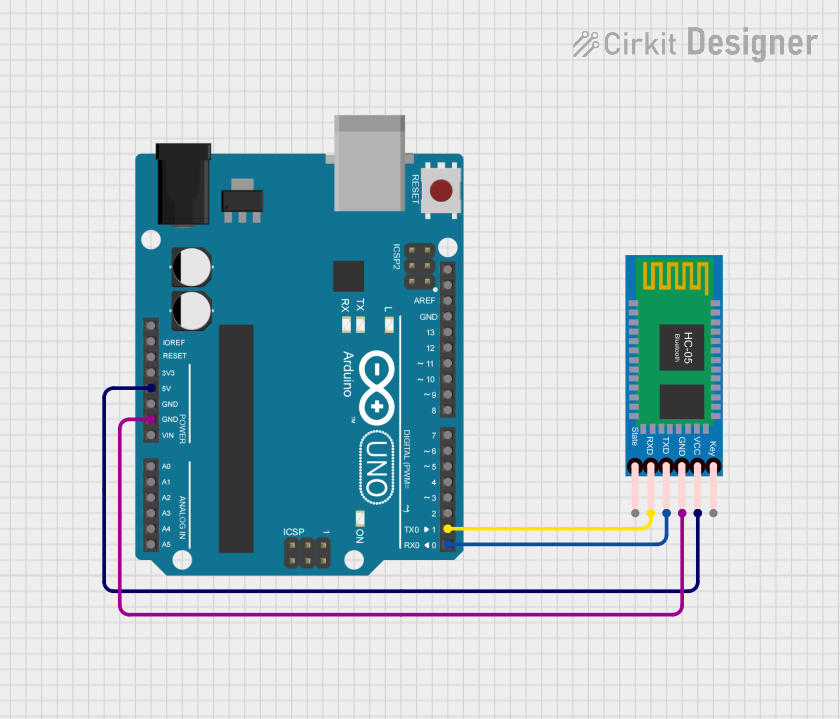
Below is an example of how to use the HC-05 module with an Arduino UNO to send and receive data via Bluetooth.
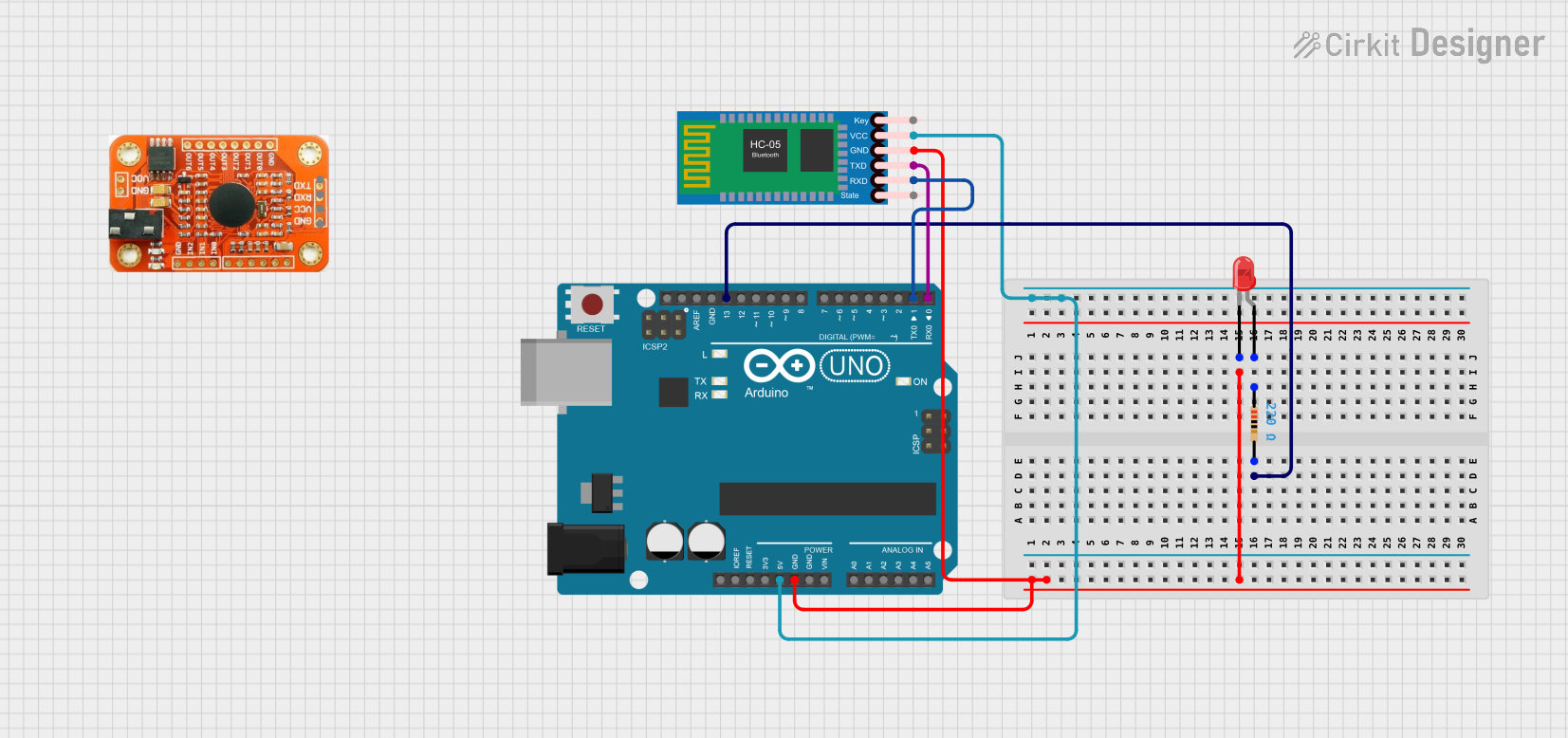
Circuit Connections
- HC-05 VCC → Arduino 5V
- HC-05 GND → Arduino GND
- HC-05 TXD → Arduino RX (Pin 0)
- HC-05 RXD → Arduino TX (Pin 1)
Arduino Code
#include <SoftwareSerial.h>

// Create a SoftwareSerial object to communicate with HC-05
SoftwareSerial BTSerial(10, 11); // RX, TX pins for HC-05

void setup() {
  Serial.begin(9600); // Initialize Serial Monitor at 9600 baud
  BTSerial.begin(9600); // Initialize HC-05 at 9600 baud

  Serial.println("Bluetooth HC-05 Module Test");
  Serial.println("Send data via Bluetooth to see it here.");
}

void loop() {
  // Check if data is available from HC-05
  if (BTSerial.available()) {
    char data = BTSerial.read(); // Read data from HC-05
    Serial.print("Received: ");
    Serial.println(data); // Print received data to Serial Monitor
  }

  // Check if data is available from Serial Monitor
  if (Serial.available()) {
    char data = Serial.read(); // Read data from Serial Monitor
    BTSerial.write(data); // Send data to HC-05
  }
}
Troubleshooting and FAQs
Common Issues and Solutions
Module Not Powering On
- Ensure the VCC pin is connected to a 5V power source.
- Check for loose connections or damaged wires.
Unable to Pair with Device
- Verify that the module is powered on and in discoverable mode (LED blinking rapidly).
- Ensure the correct PIN code (
1234or0000) is used during pairing.
No Data Transmission
- Check the TXD and RXD connections between the HC-05 and the microcontroller.
- Ensure the baud rate of the HC-05 matches the microcontroller's UART settings.
AT Commands Not Working
- Confirm that the EN (Key) pin is pulled HIGH to enable AT command mode.
- Use a serial terminal with the correct baud rate (default: 9600 bps).
FAQs
Q: Can the HC-05 module be used with 3.3V microcontrollers?
A: Yes, the HC-05 module operates at 3.3V logic levels and is compatible with 3.3V microcontrollers.
Q: How do I reset the HC-05 module to factory settings?
A: Enter AT command mode and send the AT+ORGL command to reset the module to its default settings.
Q: Can the HC-05 module communicate with another HC-05 module?
A: Yes, configure one module as a master and the other as a slave using AT commands.
Q: What is the maximum data rate supported by the HC-05 module?
A: The HC-05 module supports a maximum baud rate of 1382400 bps, but the default is 9600 bps.