
How to Use 3S 2200 mAh Battery: Examples, Pinouts, and Specs

 Design with 3S 2200 mAh Battery in Cirkit Designer
Introduction
The 3S 2200 mAh lithium polymer (LiPo) battery is a high-performance power source designed for applications requiring lightweight, compact, and high-energy storage. With three cells connected in series, this battery provides a nominal voltage of 11.1V and a capacity of 2200 mAh, making it ideal for powering RC vehicles, drones, robotics, and other portable electronic devices. Its ability to deliver high discharge rates and recharge quickly makes it a popular choice for hobbyists and professionals alike.
Explore Projects Built with 3S 2200 mAh Battery
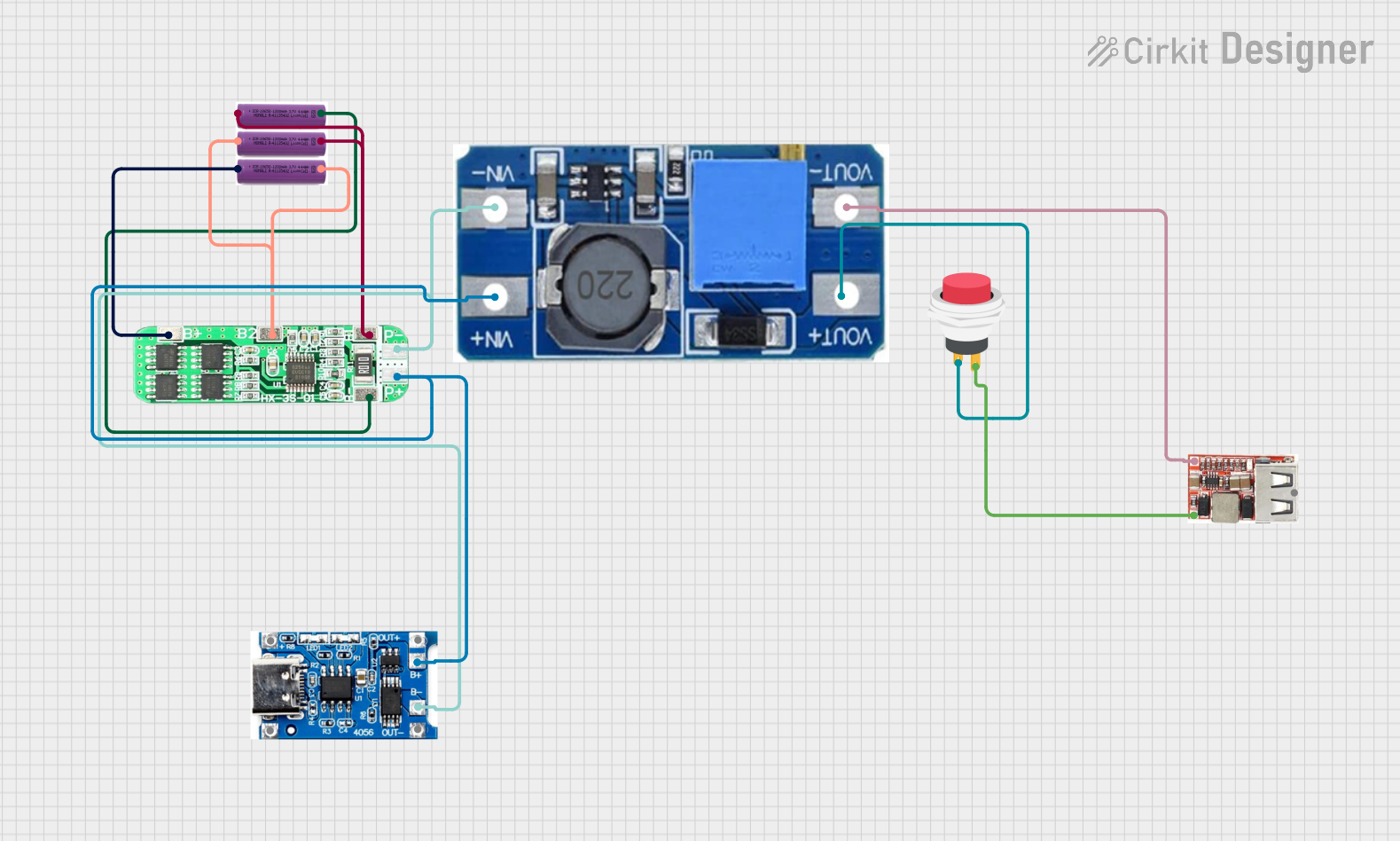 Open Project in Cirkit Designer
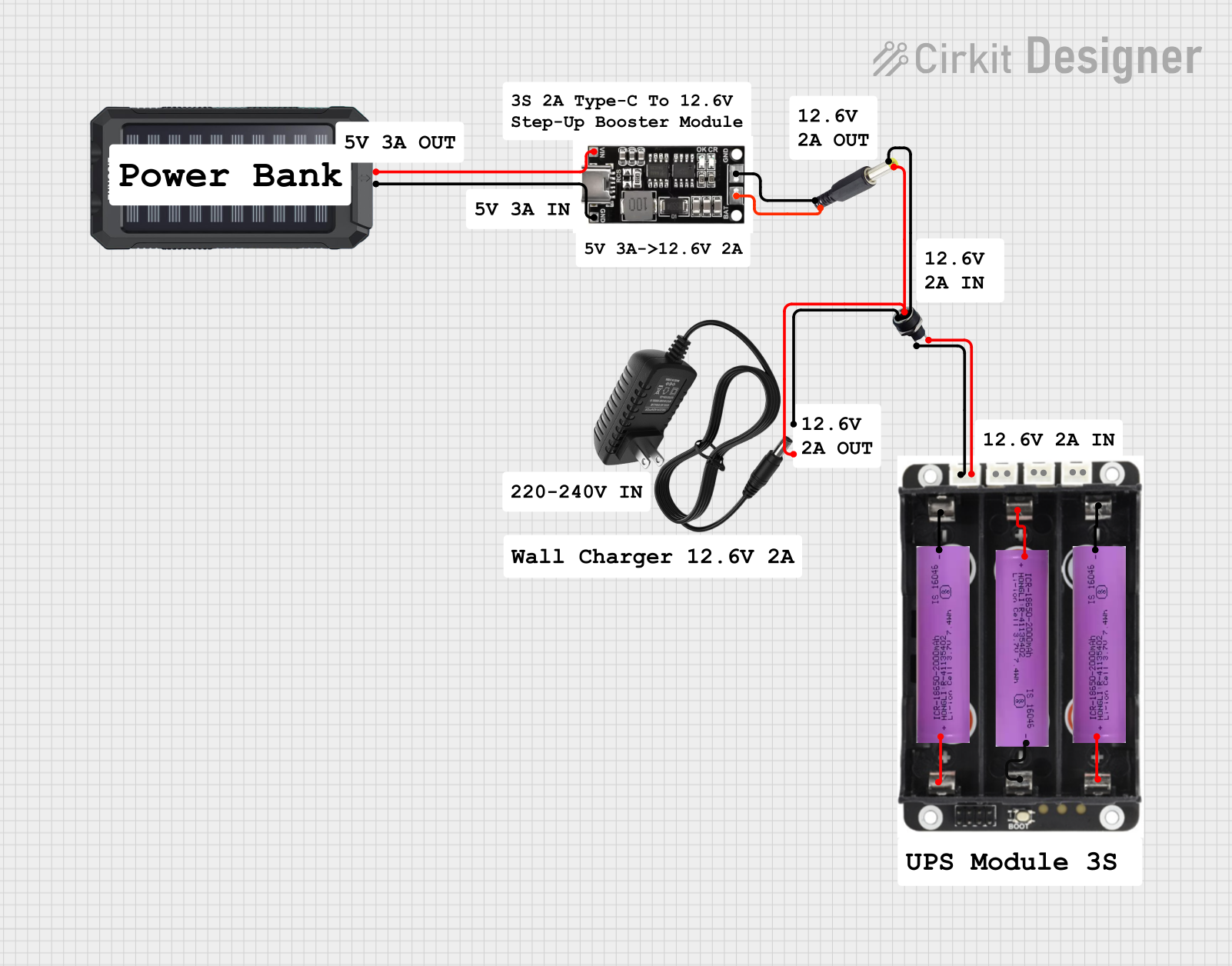 Open Project in Cirkit Designer
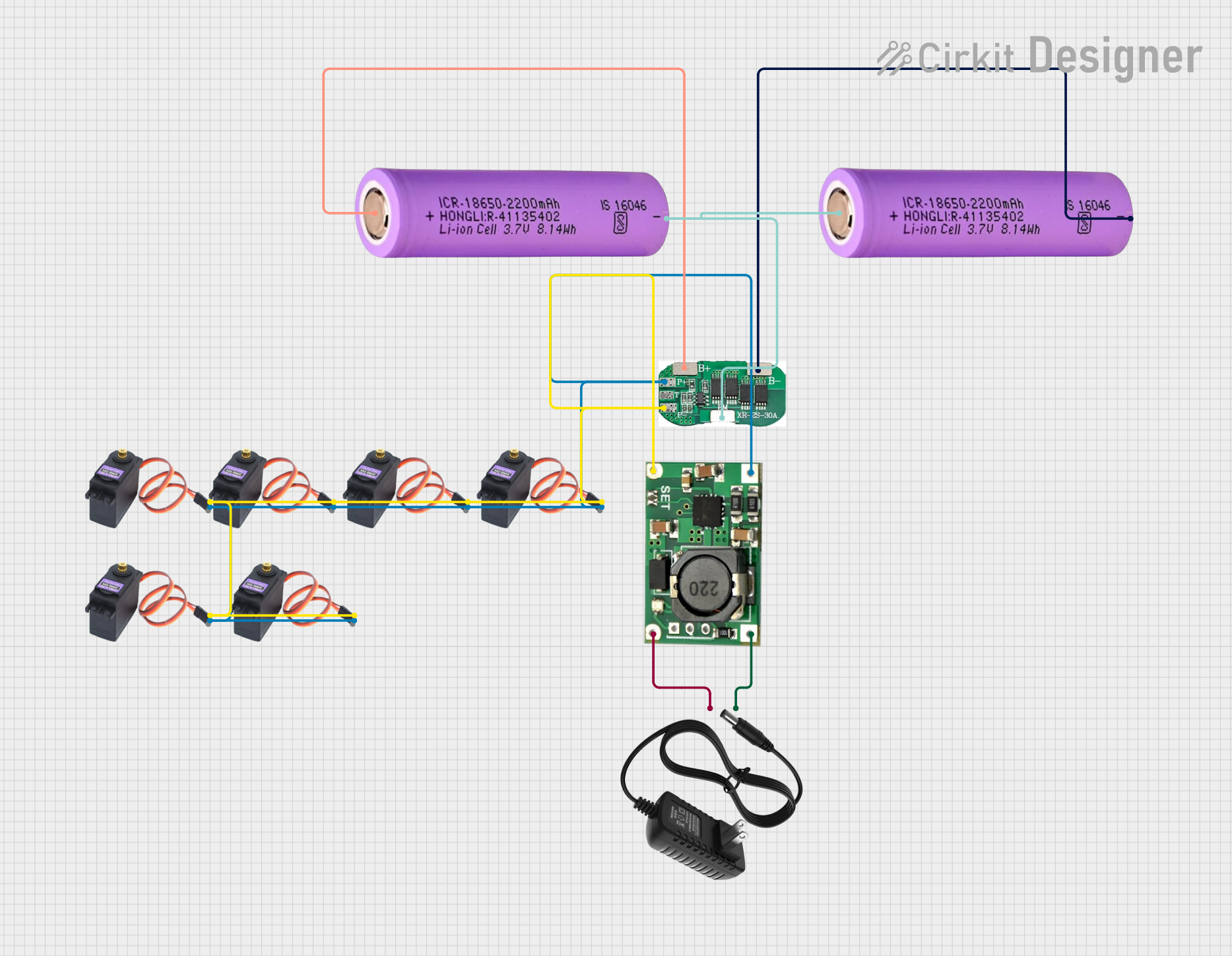 Open Project in Cirkit Designer
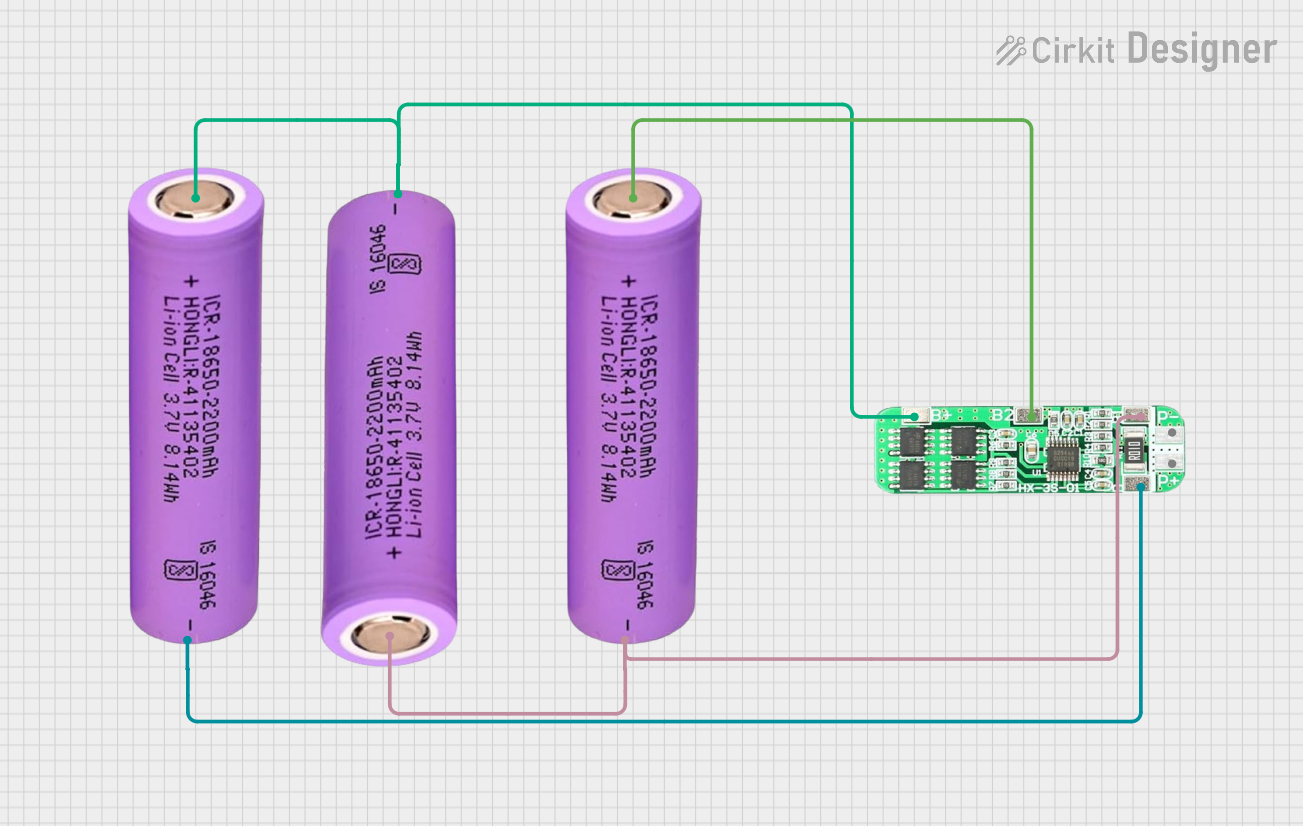 Open Project in Cirkit Designer
Explore Projects Built with 3S 2200 mAh Battery
Open Project in Cirkit DesignerOpen Project in Cirkit DesignerOpen Project in Cirkit DesignerOpen Project in Cirkit DesignerCommon Applications
- Remote-controlled (RC) vehicles, including cars, boats, and planes
- Drones and quadcopters
- Robotics and automation projects
- Portable electronic devices
- DIY electronics requiring a lightweight, high-capacity power source
Technical Specifications
Below are the key technical details of the 3S 2200 mAh battery:
| Parameter | Specification |
|---|---|
| Nominal Voltage | 11.1V (3.7V per cell) |
| Capacity | 2200 mAh |
| Configuration | 3 cells in series (3S) |
| Maximum Discharge Rate | Typically 20C to 30C |
| Maximum Charge Voltage | 12.6V (4.2V per cell) |
| Minimum Discharge Voltage | 9.0V (3.0V per cell) |
| Connector Type | XT60, JST, or similar |
| Weight | ~180g |
| Dimensions | ~105mm x 35mm x 25mm |
| Chemistry | Lithium Polymer (LiPo) |
Pin Configuration
The 3S 2200 mAh battery typically has two connectors:
- Main Power Connector: Used to deliver power to the load.
- Balance Connector: Used for charging and balancing the individual cells.
| Pin | Balance Connector Description |
|---|---|
| Pin 1 | Negative terminal of Cell 1 |
| Pin 2 | Positive terminal of Cell 1 |
| Pin 3 | Positive terminal of Cell 2 |
| Pin 4 | Positive terminal of Cell 3 |
Usage Instructions
How to Use the 3S 2200 mAh Battery in a Circuit
- Connecting the Battery:
- Use the main power connector (e.g., XT60) to connect the battery to your circuit or device.
- Ensure the polarity matches the input terminals of your device to avoid damage.
- Charging the Battery:
- Use a LiPo-compatible balance charger to charge the battery.
- Set the charger to the correct configuration: 3S (11.1V) and a charge current of 2.2A (1C rate).
- Always connect the balance connector to the charger to ensure proper cell balancing.
- Discharging the Battery:
- Avoid discharging below 9.0V (3.0V per cell) to prevent damage to the battery.
- Use a battery monitor or low-voltage alarm to track the voltage during use.
Important Considerations and Best Practices
- Safety: LiPo batteries are sensitive to overcharging, over-discharging, and physical damage. Handle with care.
- Storage: Store the battery at a voltage of approximately 11.4V (3.8V per cell) for long-term storage.
- Temperature: Avoid exposing the battery to extreme temperatures (below 0°C or above 60°C).
- Inspection: Regularly inspect the battery for swelling, damage, or loose connectors. Do not use a damaged battery.
Example: Using the Battery with an Arduino UNO
To power an Arduino UNO with the 3S 2200 mAh battery, you can use a voltage regulator module (e.g., LM2596) to step down the voltage to 5V. Below is an example circuit and code:
Circuit Setup
- Connect the battery's main power connector to the input of the voltage regulator.
- Set the regulator output to 5V using a multimeter.
- Connect the regulator's output to the Arduino UNO's 5V and GND pins.
Example Code
// Example code to blink an LED using Arduino UNO powered by a 3S 2200 mAh battery

const int ledPin = 13; // Pin connected to the onboard LED

void setup() {
  pinMode(ledPin, OUTPUT); // Set the LED pin as an output
}

void loop() {
  digitalWrite(ledPin, HIGH); // Turn the LED on
  delay(1000);               // Wait for 1 second
  digitalWrite(ledPin, LOW);  // Turn the LED off
  delay(1000);               // Wait for 1 second
}
Troubleshooting and FAQs
Common Issues
- Battery Not Charging:
- Cause: Incorrect charger settings or damaged balance connector.
- Solution: Verify the charger is set to 3S (11.1V) and inspect the balance connector for damage.
- Battery Swelling:
- Cause: Overcharging, over-discharging, or physical damage.
- Solution: Stop using the battery immediately and dispose of it safely.
- Device Not Powering On:
- Cause: Low battery voltage or incorrect connection.
- Solution: Check the battery voltage and ensure proper polarity when connecting.
FAQs
- Can I use this battery for a 12V device?
- Yes, but ensure the device can handle the voltage range of 9.0V to 12.6V.
- How long does it take to charge the battery?
- At a 1C charge rate (2.2A), it takes approximately 1 hour to fully charge.
- What is the maximum current this battery can deliver?
- Multiply the capacity (2.2 Ah) by the discharge rate (e.g., 20C). For a 20C battery, the maximum current is 44A.
By following this documentation, you can safely and effectively use the 3S 2200 mAh battery in your projects.