
How to Use nRF24L01: Examples, Pinouts, and Specs
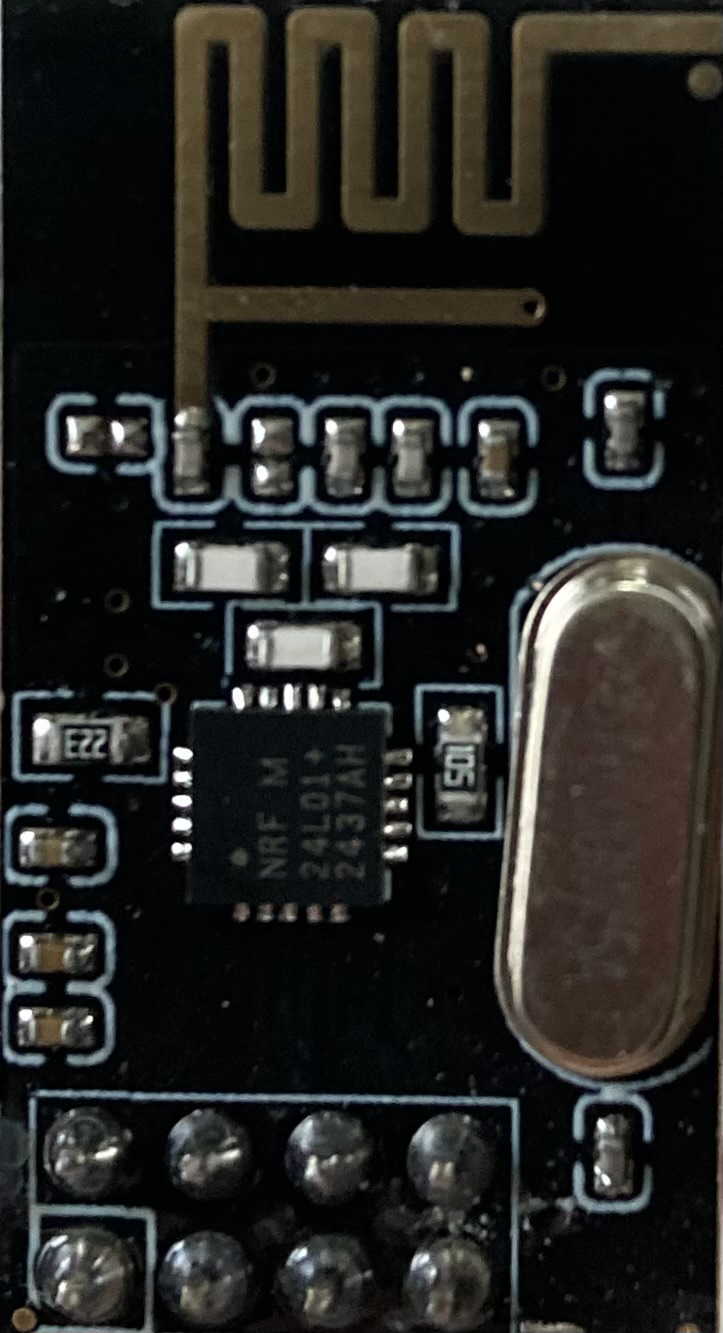
 Design with nRF24L01 in Cirkit Designer
Introduction
The nRF24L01 is a low-power 2.4 GHz wireless transceiver module manufactured by TECNOIOT (Part ID: nRF24L01). It is designed for short-range communication and supports multiple data rates (250 kbps, 1 Mbps, and 2 Mbps). The module features a built-in packet handling system, making it highly efficient for wireless data transmission. Its compact size and low power consumption make it ideal for battery-powered devices.
Explore Projects Built with nRF24L01
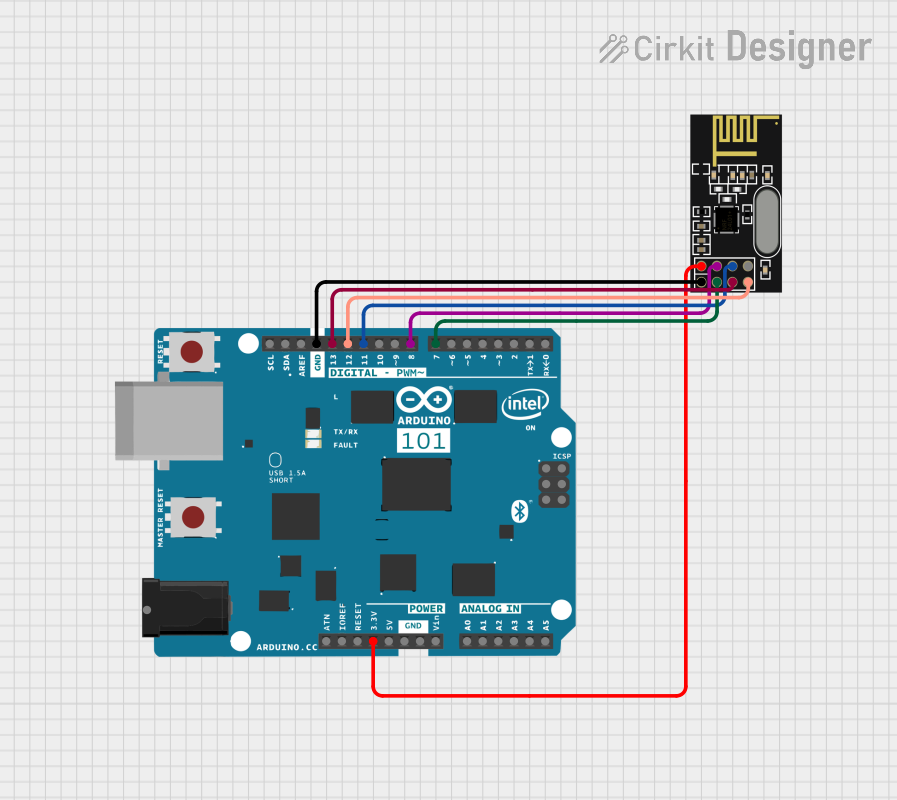 Open Project in Cirkit Designer
 Open Project in Cirkit Designer
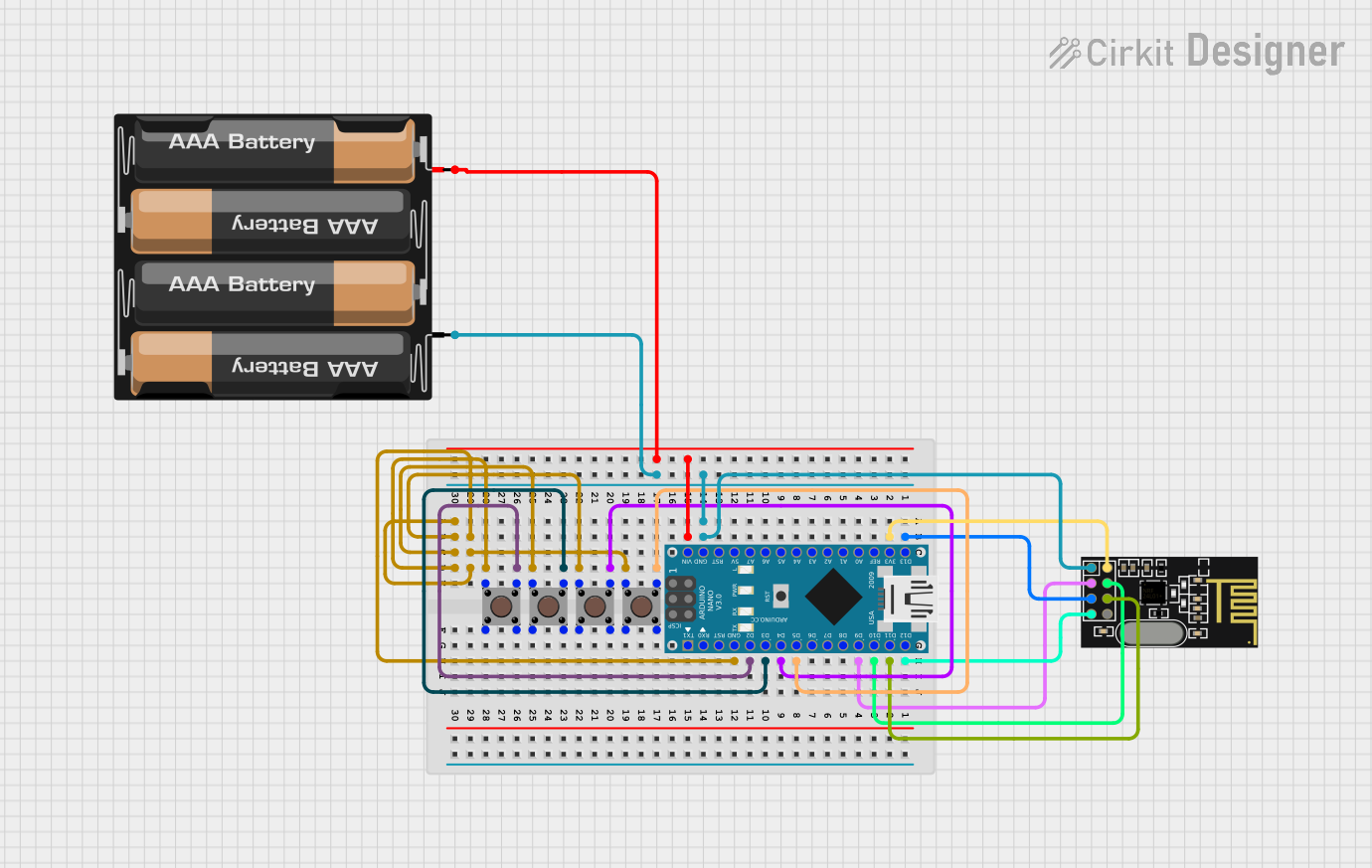 Open Project in Cirkit Designer
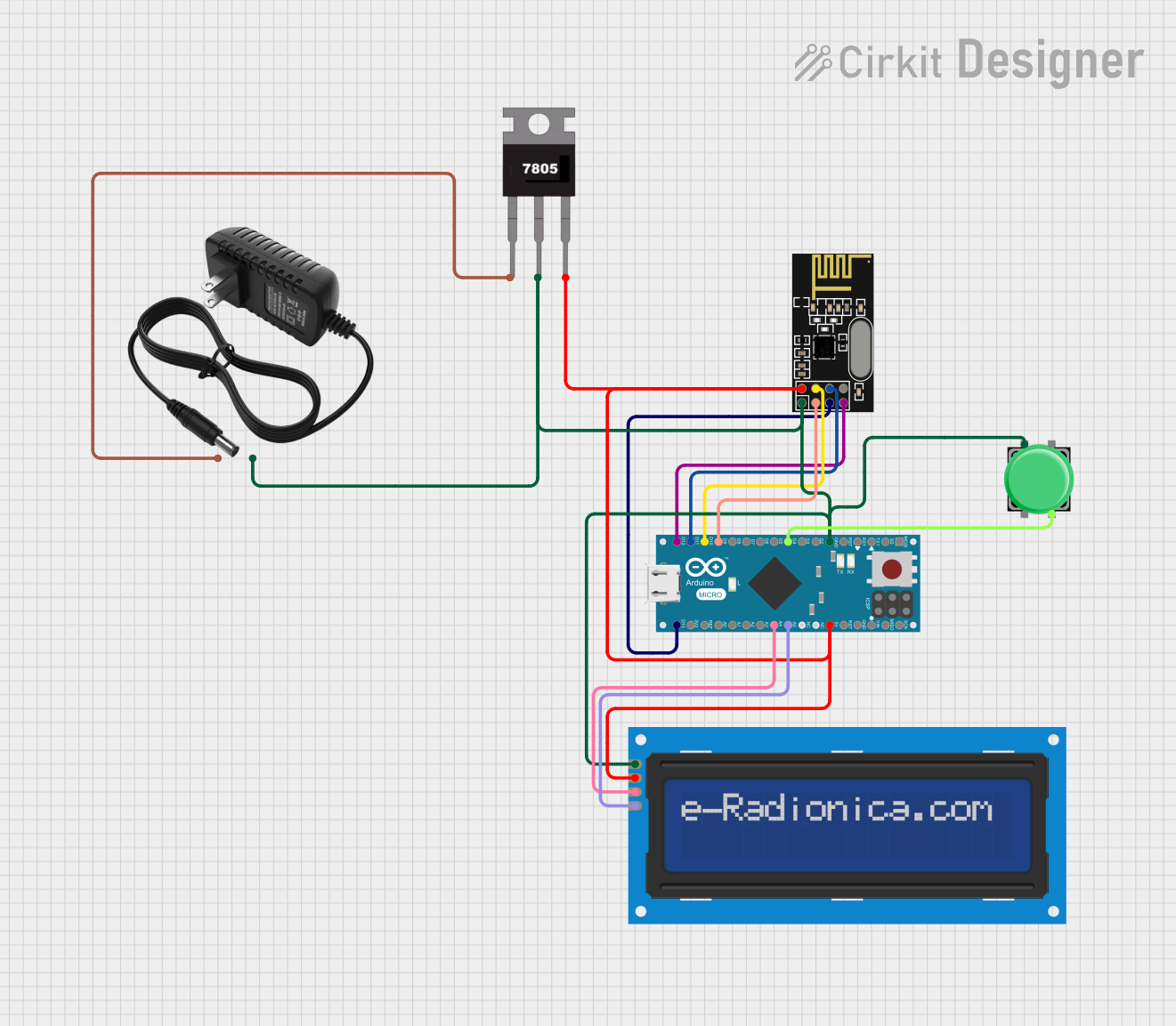 Open Project in Cirkit Designer
Explore Projects Built with nRF24L01
Open Project in Cirkit DesignerOpen Project in Cirkit DesignerOpen Project in Cirkit DesignerOpen Project in Cirkit DesignerCommon Applications
- Wireless sensors and IoT devices
- Remote controls for drones, toys, and appliances
- Home automation systems
- Wireless data logging
- Industrial monitoring and control systems
Technical Specifications
The following table outlines the key technical details of the nRF24L01 module:
| Parameter | Value |
|---|---|
| Operating Frequency | 2.4 GHz ISM Band |
| Data Rates | 250 kbps, 1 Mbps, 2 Mbps |
| Operating Voltage | 1.9V to 3.6V |
| Maximum Output Power | 0 dBm |
| Current Consumption | 11.3 mA (TX at 0 dBm), 13.5 mA (RX) |
| Sleep Mode Current | 900 nA |
| Communication Interface | SPI |
| Range | Up to 100 meters (line of sight) |
| Dimensions | 15 mm x 29 mm |
Pin Configuration and Descriptions
The nRF24L01 module has 8 pins. The table below describes each pin:
| Pin | Name | Description |
|---|---|---|
| 1 | GND | Ground connection |
| 2 | VCC | Power supply (1.9V to 3.6V, typically 3.3V) |
| 3 | CE | Chip Enable: Activates RX or TX mode |
| 4 | CSN | Chip Select Not: SPI chip select (active low) |
| 5 | SCK | Serial Clock: SPI clock input |
| 6 | MOSI | Master Out Slave In: SPI data input |
| 7 | MISO | Master In Slave Out: SPI data output |
| 8 | IRQ | Interrupt Request: Active low, indicates data received or transmission complete |
Usage Instructions
How to Use the nRF24L01 in a Circuit
- Power Supply: Connect the VCC pin to a 3.3V power source. Do not connect it directly to 5V as it may damage the module.
- SPI Interface: Connect the SPI pins (SCK, MOSI, MISO, CSN) to the corresponding SPI pins on your microcontroller.
- CE Pin: Use a GPIO pin on your microcontroller to control the CE pin for switching between RX and TX modes.
- IRQ Pin: Optionally connect the IRQ pin to a GPIO pin to handle interrupts for data transmission or reception.
Important Considerations
- Use a 10 µF capacitor across the VCC and GND pins to stabilize the power supply.
- Ensure proper SPI configuration: Clock polarity (CPOL) = 0, Clock phase (CPHA) = 0.
- Keep the module away from metal objects or other RF sources to avoid interference.
Example Code for Arduino UNO
Below is an example of how to use the nRF24L01 with an Arduino UNO to send and receive data. This example uses the popular RF24 library.
#include <SPI.h>
#include <nRF24L01.h>
#include <RF24.h>

// Define the CE and CSN pins for the nRF24L01 module
#define CE_PIN 9
#define CSN_PIN 10

// Create an RF24 object
RF24 radio(CE_PIN, CSN_PIN);

// Define the address for communication
const byte address[6] = "00001";

void setup() {
  Serial.begin(9600); // Initialize serial communication
  radio.begin();      // Initialize the nRF24L01 module
  radio.openWritingPipe(address); // Set the address for transmission
  radio.setPALevel(RF24_PA_LOW);  // Set power level to low
  radio.stopListening();          // Set the module to TX mode
}

void loop() {
  const char text[] = "Hello, World!"; // Data to send
  bool success = radio.write(&text, sizeof(text)); // Send data

  if (success) {
    Serial.println("Data sent successfully!");
  } else {
    Serial.println("Data transmission failed.");
  }

  delay(1000); // Wait 1 second before sending again
}
Notes:
- Install the RF24 library in the Arduino IDE before running the code.
- Adjust the CE and CSN pin definitions if using different GPIO pins.
Troubleshooting and FAQs
Common Issues
No Communication Between Modules
- Ensure both modules are using the same address and data rate.
- Verify proper wiring and power supply (3.3V, not 5V).
- Check for interference from other 2.4 GHz devices.
Unstable Operation
- Add a 10 µF capacitor across the VCC and GND pins to stabilize the power supply.
- Ensure the SPI clock speed is within the module's specifications.
Short Range
- Ensure line-of-sight communication for maximum range.
- Use an external antenna or a high-power version of the module (e.g., nRF24L01+PA+LNA).
FAQs
Q: Can I use the nRF24L01 with a 5V microcontroller?
A: Yes, but you must use a 3.3V regulator or level shifters to avoid damaging the module.
Q: What is the maximum range of the nRF24L01?
A: The range is up to 100 meters in line-of-sight conditions. Obstacles and interference can reduce the range.
Q: How do I know if data was successfully transmitted?
A: Use the radio.write() function, which returns true if the transmission was successful.
Q: Can I use multiple nRF24L01 modules in the same network?
A: Yes, the module supports up to 6 data pipes for simultaneous communication with multiple devices.