The NIBM (Non-Isolated Buck Module), manufactured by Flame with part ID fire, is a highly efficient DC-DC converter designed to step down voltage from a higher input level to a lower output level. Unlike isolated converters, the NIBM does not provide electrical isolation between the input and output, making it ideal for applications where isolation is not required but high efficiency and compact design are critical.
Explore Projects Built with nibm
Use Cirkit Designer to design, explore, and prototype these projects online. Some projects support real-time simulation. Click "Open Project" to start designing instantly!
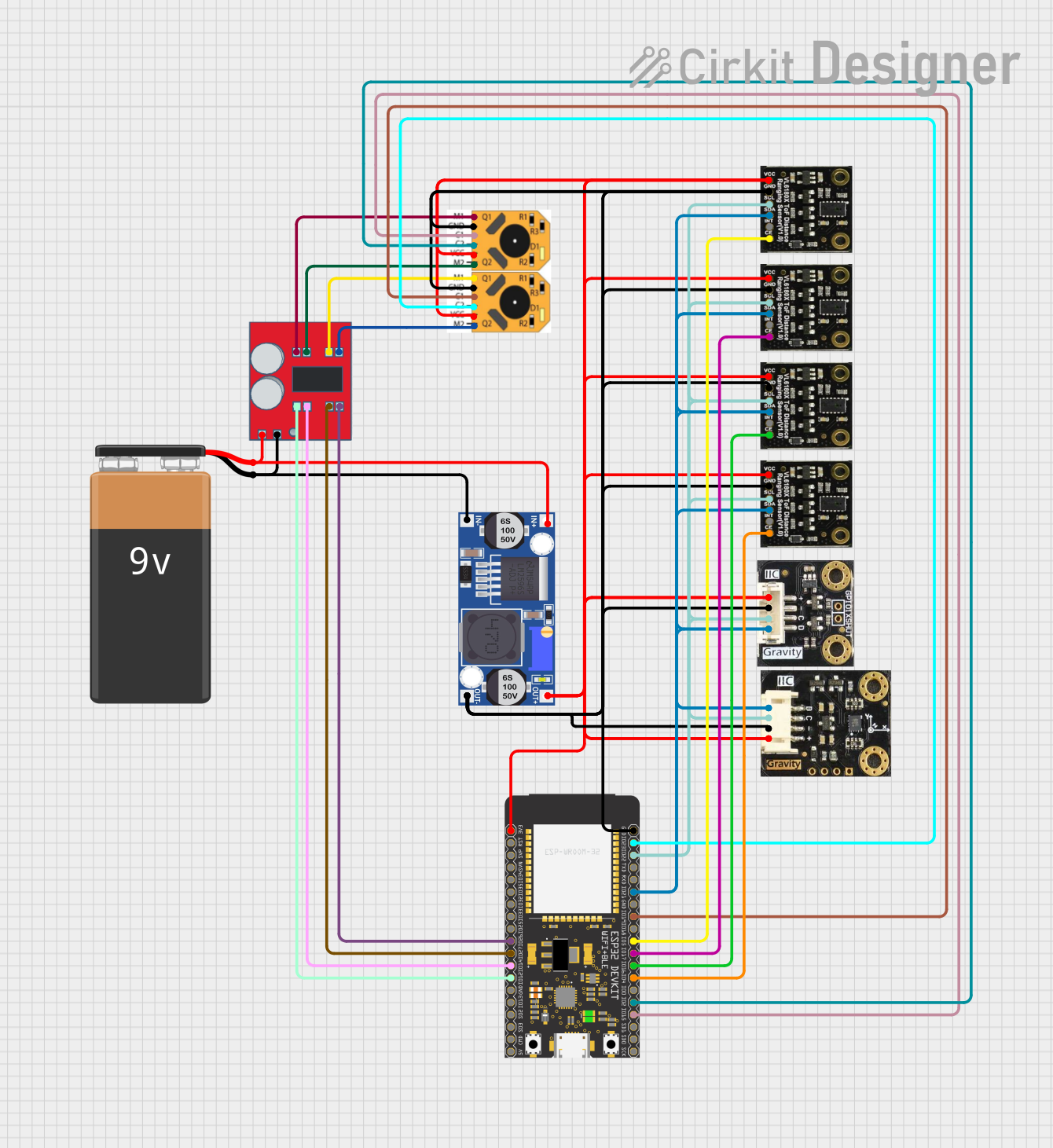
This circuit is a sensor and motor control system powered by a 9V battery and regulated by a buck converter. It includes multiple sensors (SEN0245, SEN0427, I2C BMI160) connected via I2C to an ESP32 microcontroller, which also controls two N20 motors with encoders through an MX1508 DC motor driver.
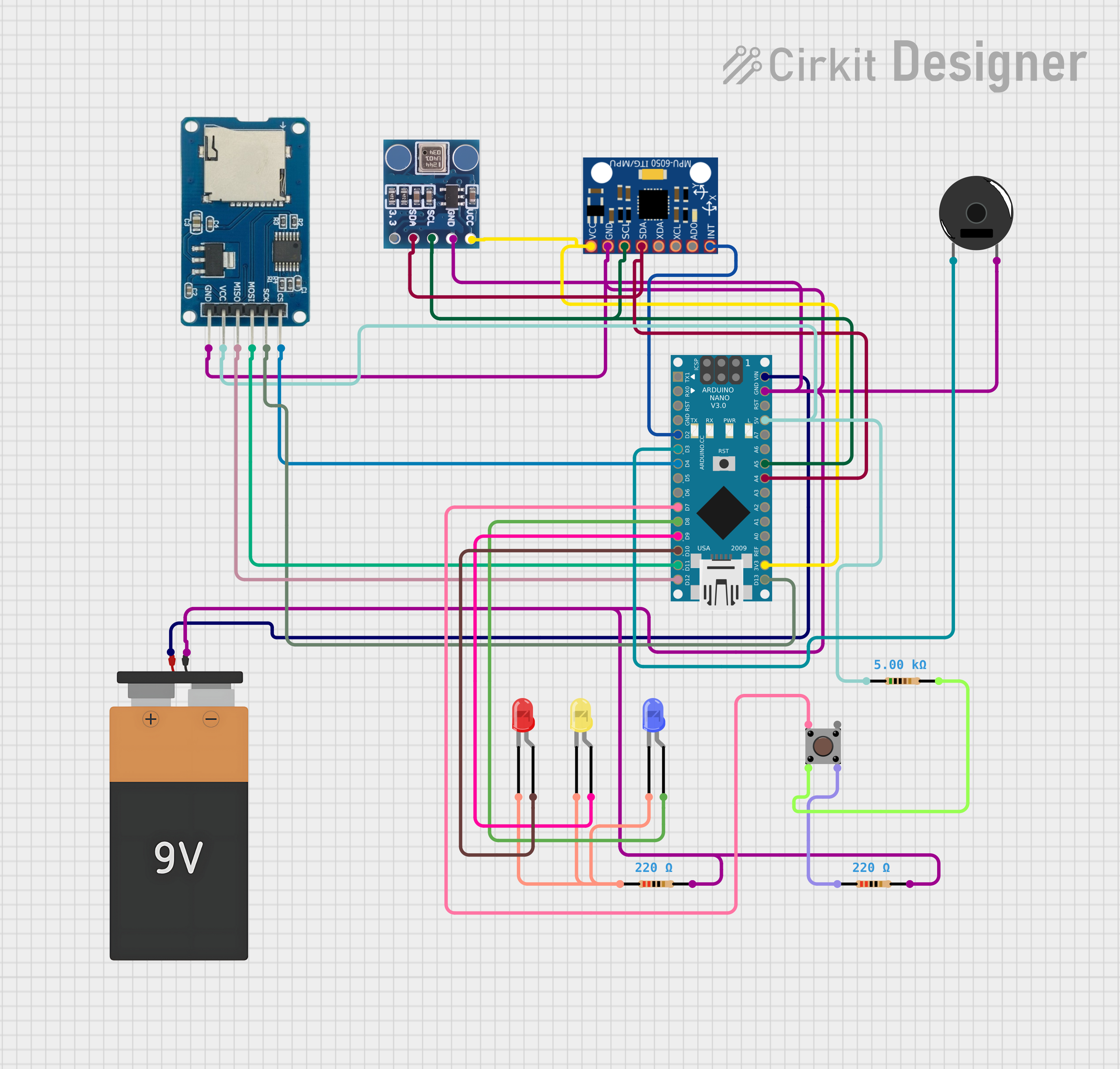
This circuit features an Arduino Nano microcontroller interfaced with BMP180 and MPU-6050 sensors via I2C communication for environmental and motion sensing. It includes a piezo buzzer and three LEDs (red, yellow, blue) for audio-visual feedback, controlled by digital pins on the Arduino. A pushbutton with a pull-up resistor, a micro SD card module for data logging, and a 9V battery for power supply are also part of the circuit.
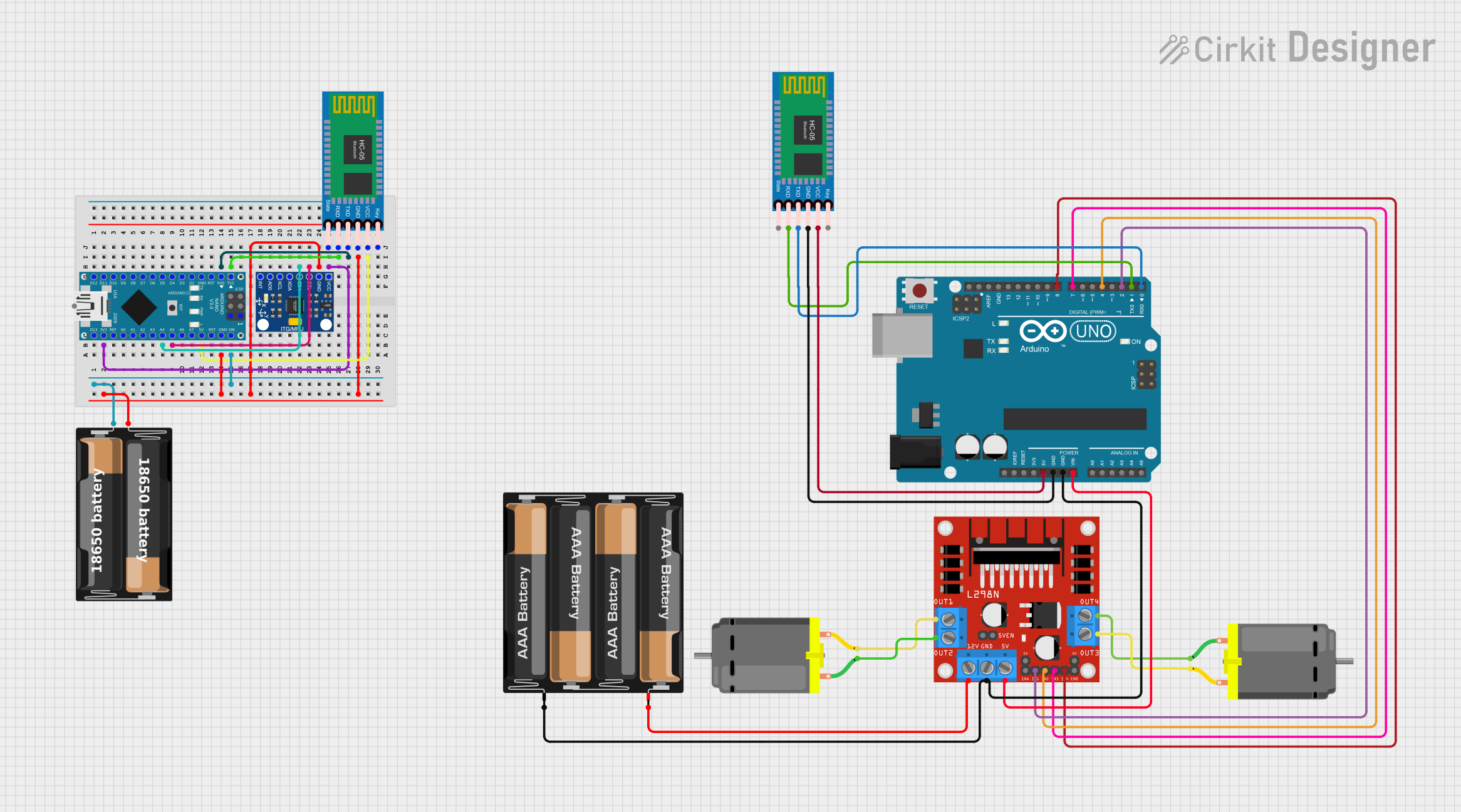
This circuit features an Arduino Nano interfaced with an InvenSense MPU6050 accelerometer/gyroscope for motion sensing and an HC-05 Bluetooth module for wireless communication. The Arduino Nano processes the MPU6050 data to interpret gestures and sends corresponding commands via Bluetooth. Additionally, an Arduino UNO is connected to an L298N motor driver to control two DC motors, receiving commands from a separate HC-05 module, likely for remote maneuvering of a vehicle or robotic platform.
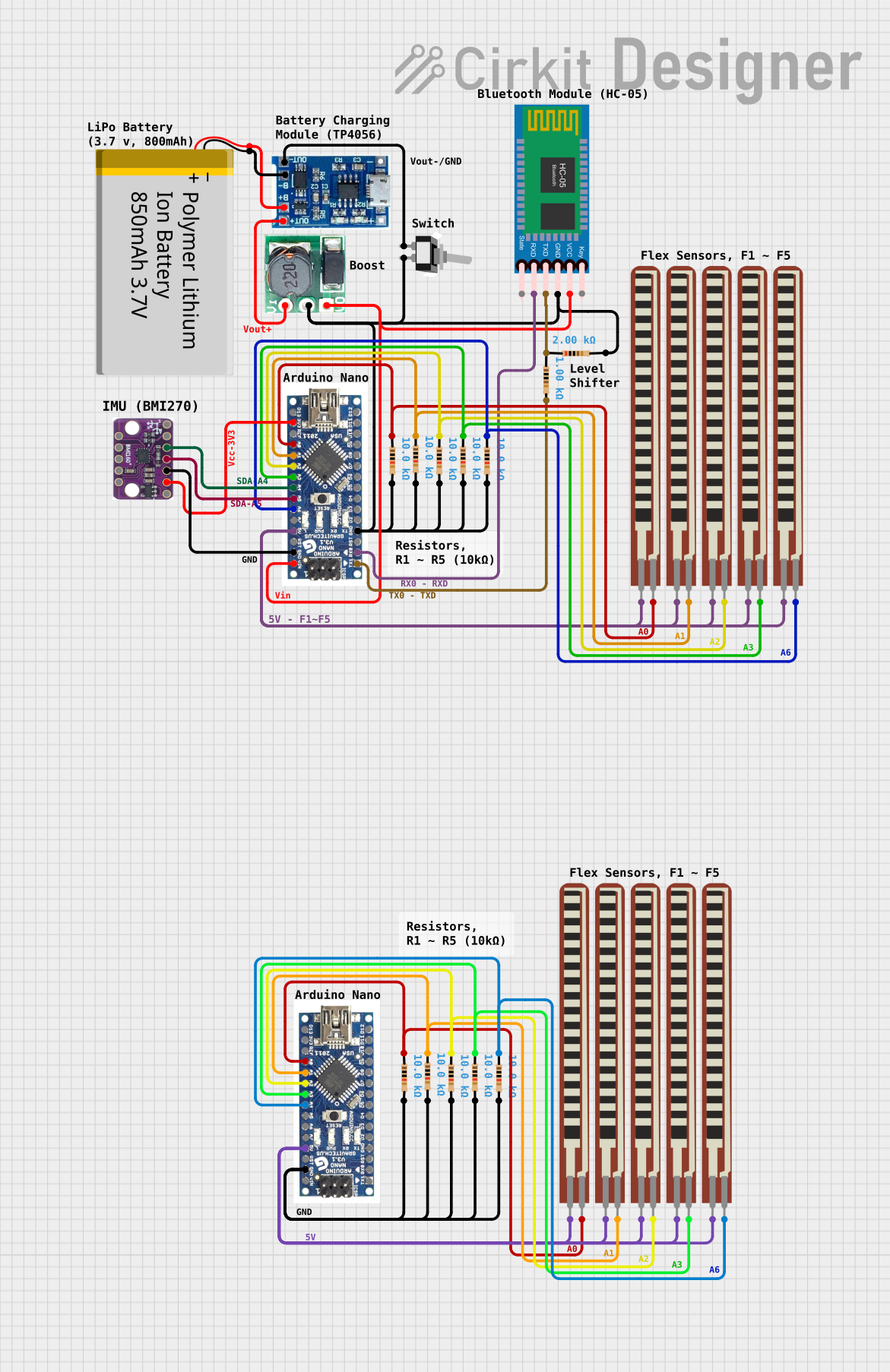
This circuit features an Arduino Nano interfaced with an HC-05 Bluetooth module, a BMI160 6DOF sensor, and multiple flex resistors. It is powered by a polymer lithium-ion battery through a lipo battery charger module and a step-up boost converter. The primary function appears to be wireless sensor data collection and transmission, with the flex resistors possibly serving as input devices and the accelerometer/gyro for motion tracking.
Powering low-voltage devices from higher-voltage sources
Battery-powered systems
Embedded systems and microcontrollers
LED drivers
Industrial automation and control systems
Technical Specifications
The following table outlines the key technical specifications of the NIBM:
Parameter
Value
Input Voltage Range
6V to 36V
Output Voltage Range
1.2V to 24V (adjustable)
Maximum Output Current
3A
Efficiency
Up to 95%
Switching Frequency
150 kHz
Operating Temperature
-40°C to +85°C
Dimensions
22mm x 17mm x 6mm
Pin Configuration and Descriptions
The NIBM module has the following pin configuration:
Pin
Name
Description
1
VIN
Input voltage pin. Connect to the positive terminal of the input power source.
2
GND
Ground pin. Connect to the negative terminal of the input power source.
3
VOUT
Output voltage pin. Provides the stepped-down voltage to the load.
4
ADJ
Voltage adjustment pin. Use a potentiometer or resistor to set the output voltage.
Usage Instructions
How to Use the NIBM in a Circuit
Connect the Input Voltage:
Attach the positive terminal of the input power source to the VIN pin.
Connect the negative terminal of the input power source to the GND pin.
Set the Output Voltage:
Use a potentiometer or a fixed resistor connected to the ADJ pin to adjust the output voltage.
Refer to the datasheet or manufacturer guidelines for the resistor value corresponding to the desired output voltage.
Connect the Load:
Attach the load to the VOUT pin and connect the load's ground to the GND pin.
Power On:
Ensure all connections are secure and within the specified voltage and current limits before powering on the module.
Important Considerations and Best Practices
Input Voltage: Ensure the input voltage is within the specified range (6V to 36V). Exceeding this range may damage the module.
Heat Dissipation: For high-current applications, consider adding a heatsink or improving airflow to prevent overheating.
Output Voltage Adjustment: Use a multimeter to verify the output voltage after adjustment to ensure it matches the desired level.
Capacitors: Add input and output capacitors (e.g., 10µF to 100µF) close to the module to improve stability and reduce noise.
Example: Using NIBM with an Arduino UNO
The NIBM can be used to power an Arduino UNO from a 12V source by stepping down the voltage to 5V. Below is an example circuit and Arduino code:
Circuit Connections
Connect the 12V source to the VIN and GND pins of the NIBM.
Adjust the ADJ pin to set the output voltage to 5V.
Connect the VOUT pin of the NIBM to the 5V pin of the Arduino UNO.
Connect the GND pin of the NIBM to the GND pin of the Arduino UNO.
Arduino Code
// Example code to blink an LED connected to pin 13 of the Arduino UNO
// Ensure the NIBM module is providing a stable 5V to the Arduino UNO

void setup() {
  pinMode(13, OUTPUT); // Set pin 13 as an output
}

void loop() {
  digitalWrite(13, HIGH); // Turn the LED on
  delay(1000);            // Wait for 1 second
  digitalWrite(13, LOW);  // Turn the LED off
  delay(1000);            // Wait for 1 second
}
Troubleshooting and FAQs
Common Issues and Solutions
No Output Voltage:
Verify that the input voltage is within the specified range (6V to 36V).
Check all connections for loose wires or poor solder joints.
Ensure the ADJ pin is properly configured to set the output voltage.
Overheating:
Ensure the load does not exceed the maximum output current of 3A.
Improve heat dissipation by adding a heatsink or increasing airflow around the module.
Output Voltage Fluctuations:
Add input and output capacitors close to the module to stabilize the voltage.
Verify that the input power source is stable and not introducing noise.
Cannot Adjust Output Voltage:
Check the potentiometer or resistor connected to the ADJ pin for proper operation.
Ensure the module is not damaged due to incorrect connections or overvoltage.
FAQs
Q: Can the NIBM be used to power sensitive electronics?
A: Yes, but it is recommended to add capacitors to reduce noise and ensure stable operation.
Q: What happens if the input voltage exceeds 36V?
A: Exceeding the maximum input voltage may permanently damage the module. Always use a power source within the specified range.
Q: Can the NIBM be used in battery-powered systems?
A: Yes, the NIBM is ideal for battery-powered systems due to its high efficiency and compact size.
Q: Is the NIBM suitable for automotive applications?
A: Yes, as long as the input voltage remains within the specified range and proper heat dissipation is ensured.

 Open Project in Cirkit Designer