
How to Use RESONATOR-WIDE: Examples, Pinouts, and Specs
 Design with RESONATOR-WIDE in Cirkit Designer
Introduction
The RESONATOR-WIDE is an electronic component designed to operate over a broad frequency range. It is commonly used in oscillators and filters to stabilize and control signal frequencies in electronic circuits. Its ability to maintain precise frequency characteristics makes it an essential component in communication systems, microcontroller-based designs, and signal processing applications.
Explore Projects Built with RESONATOR-WIDE
 Open Project in Cirkit Designer
 Open Project in Cirkit Designer
 Open Project in Cirkit Designer
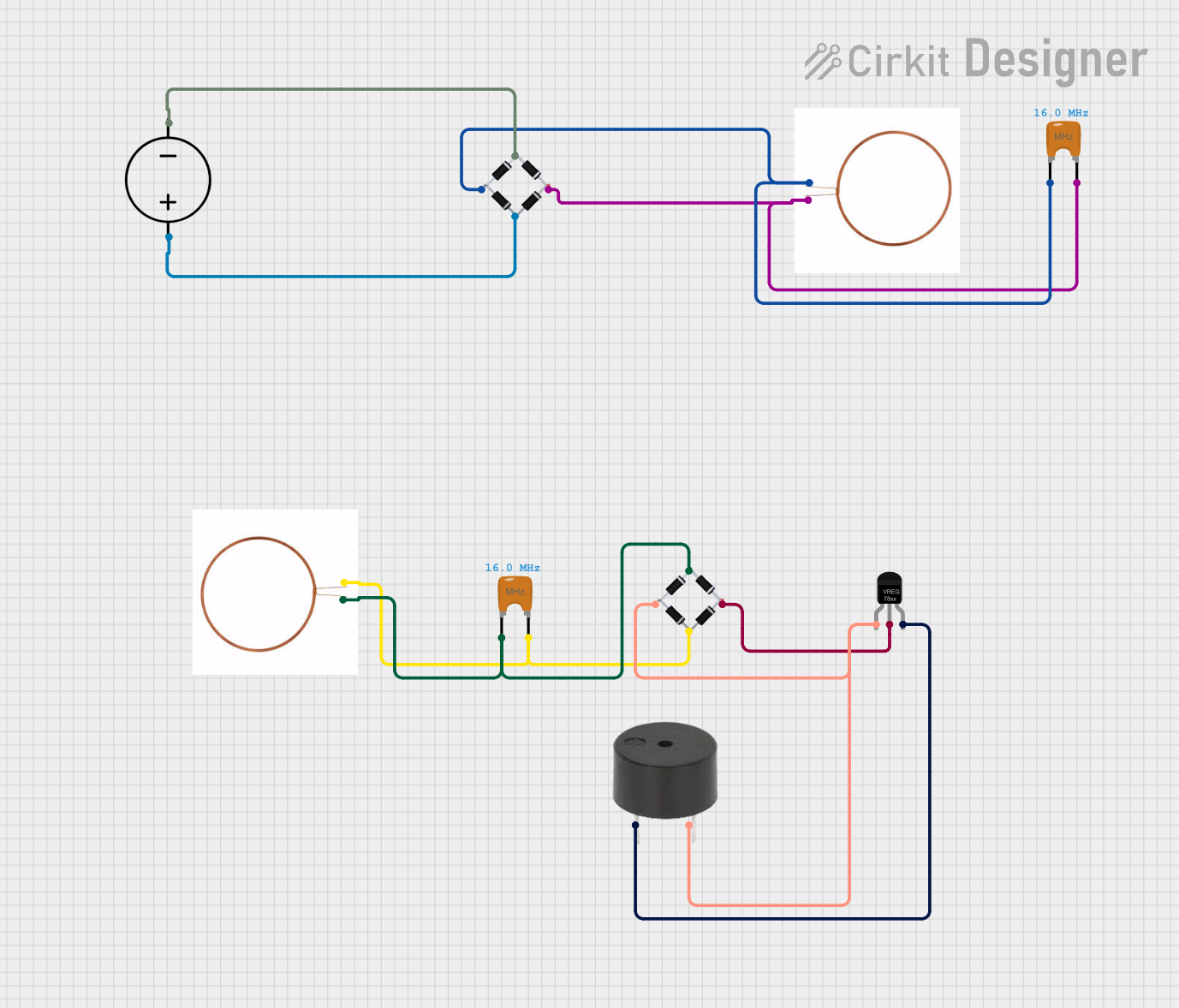 Open Project in Cirkit Designer
Explore Projects Built with RESONATOR-WIDE
Open Project in Cirkit DesignerOpen Project in Cirkit DesignerOpen Project in Cirkit DesignerOpen Project in Cirkit DesignerCommon Applications
- Frequency stabilization in oscillators
- Signal filtering in communication systems
- Clock generation for microcontrollers
- RF circuits and wireless communication devices
- Audio signal processing
Technical Specifications
The RESONATOR-WIDE is available in various configurations to suit different applications. Below are its key technical details:
General Specifications
| Parameter | Value |
|---|---|
| Frequency Range | 1 MHz to 50 MHz |
| Frequency Tolerance | ±0.5% |
| Operating Voltage | 3.3V to 5V |
| Operating Temperature | -40°C to +85°C |
| Package Type | SMD (Surface Mount Device) |
| Aging Rate | ±0.3% per year |
Pin Configuration
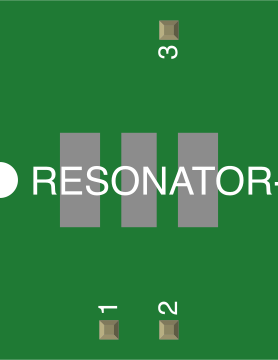
The RESONATOR-WIDE typically has three pins: two for signal connections and one for grounding. Below is the pinout description:
| Pin Number | Name | Description |
|---|---|---|
| 1 | Signal 1 | Input or output signal terminal |
| 2 | Ground | Ground connection for stability |
| 3 | Signal 2 | Input or output signal terminal |
Usage Instructions
To use the RESONATOR-WIDE in a circuit, follow these steps:
- Placement in Circuit: Place the resonator close to the microcontroller or oscillator circuit to minimize signal loss and interference.
- Connection:
- Connect Pin 1 (Signal 1) to the input or output of the oscillator circuit.
- Connect Pin 2 (Ground) to the circuit's ground plane.
- Connect Pin 3 (Signal 2) to the other input or output terminal of the oscillator.
- Bypass Capacitors: For optimal performance, use small bypass capacitors (e.g., 10pF to 22pF) between the signal pins and ground to reduce noise.
- Frequency Selection: Ensure the resonator's frequency range matches the requirements of your circuit.
Example: Using RESONATOR-WIDE with an Arduino UNO
The RESONATOR-WIDE can be used to stabilize the clock signal in Arduino-based projects. Below is an example of how to connect and use it:
Circuit Connection
- Connect Pin 1 of the resonator to the XTAL1 pin of the Arduino UNO.
- Connect Pin 3 of the resonator to the XTAL2 pin of the Arduino UNO.
- Connect Pin 2 (Ground) to the Arduino's GND pin.
- Add two 22pF capacitors between each signal pin (Pin 1 and Pin 3) and ground.
Sample Code
// Example code to demonstrate a stable clock signal using RESONATOR-WIDE
// This code blinks an LED at a precise 1-second interval.

const int ledPin = 13; // Pin connected to the onboard LED

void setup() {
  pinMode(ledPin, OUTPUT); // Set the LED pin as an output
}

void loop() {
  digitalWrite(ledPin, HIGH); // Turn the LED on
  delay(1000); // Wait for 1 second
  digitalWrite(ledPin, LOW); // Turn the LED off
  delay(1000); // Wait for 1 second
}
Best Practices
- Keep the resonator as close as possible to the oscillator circuit to reduce parasitic inductance and capacitance.
- Avoid routing high-frequency signals near the resonator to prevent interference.
- Use a stable power supply to ensure consistent performance.
Troubleshooting and FAQs
Common Issues
Frequency Drift:
- Cause: Temperature variations or aging of the resonator.
- Solution: Ensure the operating temperature is within the specified range. Replace the resonator if aging has caused significant drift.
Signal Instability:
- Cause: Poor grounding or improper bypass capacitor values.
- Solution: Verify the ground connection and use recommended capacitor values (10pF to 22pF).
No Oscillation:
- Cause: Incorrect pin connections or incompatible frequency range.
- Solution: Double-check the pin connections and ensure the resonator's frequency matches the circuit's requirements.
FAQs
Q1: Can I use the RESONATOR-WIDE without capacitors?
A1: While it is possible in some cases, using bypass capacitors is highly recommended to ensure stable operation and reduce noise.
Q2: How do I select the correct frequency for my application?
A2: Determine the required frequency for your oscillator or microcontroller and choose a resonator with a matching frequency range and tolerance.
Q3: Is the RESONATOR-WIDE compatible with 1.8V systems?
A3: No, the RESONATOR-WIDE is designed for 3.3V to 5V systems. For 1.8V systems, consider using a resonator specifically rated for lower voltages.
By following this documentation, you can effectively integrate the RESONATOR-WIDE into your electronic designs for stable and reliable frequency control.