
How to Use VN7003ALH: Examples, Pinouts, and Specs
 Design with VN7003ALH in Cirkit Designer
Introduction
The VN7003ALH is a robust low-side driver Integrated Circuit (IC) specifically designed for automotive applications. It is capable of driving a wide range of loads, including resistive, inductive, and capacitive types, under the demanding conditions typical of automotive environments. This IC is known for its high voltage and current handling capabilities, along with built-in protection features that safeguard against common fault conditions such as overvoltage, overtemperature, and undervoltage lockout. Common applications include power distribution, solenoid and relay control, as well as LED lighting control in vehicles.
Explore Projects Built with VN7003ALH
 Open Project in Cirkit Designer
 Open Project in Cirkit Designer
 Open Project in Cirkit Designer
 Open Project in Cirkit Designer
Explore Projects Built with VN7003ALH
Open Project in Cirkit DesignerOpen Project in Cirkit DesignerOpen Project in Cirkit DesignerOpen Project in Cirkit DesignerTechnical Specifications
Key Technical Details
- Supply Voltage (Vcc): 5.5V to 36V
- Output Current (Continuous): Up to 30A
- Output Voltage (Max): Vcc - 1.5V
- On-State Resistance (Rds(on)): 35 mΩ typical at 25°C
- Protection Features: Overvoltage, Overtemperature, Undervoltage Lockout, Load Dump Protection
- Operating Temperature Range: -40°C to 150°C
- Package: PowerSO-10
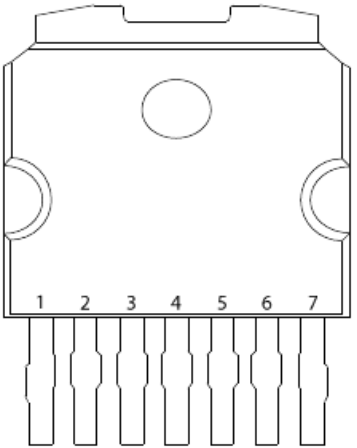
Pin Configuration and Descriptions
| Pin Number | Name | Description |
|---|---|---|
| 1 | OUT | Output to load, connects to the low side of the load |
| 2 | GND | Ground reference for the IC |
| 3 | IN | Input control signal, typically from a microcontroller |
| 4 | Vcc | Supply voltage for the IC |
| 5 | DIAG | Diagnostic output, indicates fault conditions |
| 6-10 | TAB | Exposed pad for enhanced thermal dissipation, must be connected to GND |
Usage Instructions
How to Use the VN7003ALH in a Circuit
- Power Supply Connection: Connect the Vcc pin to a stable 5.5V to 36V power supply. Ensure that the power supply can handle the current requirements of the load.
- Load Connection: Connect the load to the OUT pin. The other side of the load should be connected to the positive supply voltage.
- Input Signal: The IN pin should be connected to a digital output from a microcontroller. A logic high signal will turn on the driver, allowing current to flow through the load.
- Grounding: Connect the GND pin and the TAB (pins 6-10) to the system ground.
- Diagnostic Feature: The DIAG pin can be connected to a microcontroller input to monitor the status of the driver and the load.
Important Considerations and Best Practices
- Decoupling Capacitors: Place a decoupling capacitor close to the Vcc pin to filter out voltage spikes and noise.
- Heat Dissipation: Ensure proper heat sinking for the IC, especially when driving high current loads.
- Input Signal: The input signal voltage level should be compatible with the logic level of the microcontroller.
- Protection Diodes: When driving inductive loads, use a flyback diode to prevent voltage spikes during turn-off.
Troubleshooting and FAQs
Common Issues
- Driver Does Not Turn On: Check the input signal and power supply connections. Ensure the supply voltage is within the specified range.
- Overheating: Verify that the current through the load does not exceed the continuous current rating. Improve heat sinking if necessary.
- Diagnostic Flag Active: If the DIAG pin indicates a fault, check for overvoltage, overtemperature, or wiring issues.
Solutions and Tips for Troubleshooting
- Check Connections: Ensure all pins are properly soldered and connected.
- Monitor Supply Voltage: Use a multimeter to verify that the supply voltage is stable and within the specified range.
- Inspect Load: Confirm that the load does not have a short circuit or other issues causing excessive current draw.
FAQs
Q: Can the VN7003ALH be used with PWM signals? A: Yes, the VN7003ALH can be used with PWM signals to control the power delivered to the load.
Q: What is the maximum frequency for the PWM signal? A: The maximum frequency for the PWM signal will depend on the application and thermal considerations. Consult the datasheet for detailed information.
Q: How do I know if the IC is in a fault condition? A: The DIAG pin will provide a fault indication. Connecting this pin to a microcontroller can help identify and diagnose the specific fault condition.
Example Code for Arduino UNO
// Define the VN7003ALH control and diagnostic pins
const int controlPin = 3; // IN pin connected to digital pin 3
const int diagPin = 2;    // DIAG pin connected to digital pin 2

void setup() {
  pinMode(controlPin, OUTPUT);
  pinMode(diagPin, INPUT);
  Serial.begin(9600);
}

void loop() {
  // Turn on the VN7003ALH
  digitalWrite(controlPin, HIGH);
  delay(1000); // Wait for 1 second

  // Turn off the VN7003ALH
  digitalWrite(controlPin, LOW);
  delay(1000); // Wait for 1 second

  // Read the diagnostic pin
  int diagState = digitalRead(diagPin);
  if (diagState == HIGH) {
    // Fault condition detected, handle accordingly
    Serial.println("Fault detected!");
  }
}
This example demonstrates basic control of the VN7003ALH using an Arduino UNO. The control pin is toggled to switch the driver on and off, while the diagnostic pin is monitored for fault conditions.